

Audio By Carbonatix
For many modern homeowners, the septic tank is an invisible problem buried beneath concrete. It doesn’t treat waste; it stores it and eventually, that storage fills up.
What follows is a cycle most people know too well: paying for dislodging, dealing with unpleasant odours, worrying about leaks, and managing the stress of a system that quietly fails over time. A different approach is gaining ground, one that treats waste instead of storing it.
Biodegradable Biodigesters are designed as biological systems that break down waste in real time. They are not just an upgrade in technology; they represent a shift in how homes manage sanitation. This shift didn’t happen by chance.
In Ghana, the growing adoption of biodigesters was accelerated by the 2014 cholera outbreak, which exposed the dangers of poor waste management. The crisis forced attention onto how traditional systems contaminate environments, especially during flooding or structural failure.
In response, institutions like the World Bank pushed for safer, more effective alternatives. Biodigesters moved from being an unfamiliar concept to a recommended solution grounded in public health.
At a technical level, the difference is clear. A septic tank is a stagnant chamber where waste sits for years. A biodigester functions as a biological engine. It separates liquid and solid waste and uses aerobic digestion to break down organic material almost immediately.
In many modern systems, organic filter media such as coconut husks, fiber nets, and soil support microorganisms that convert waste into harmless byproducts.
Instead of accumulating sludge, the system continuously treats what flows through it.
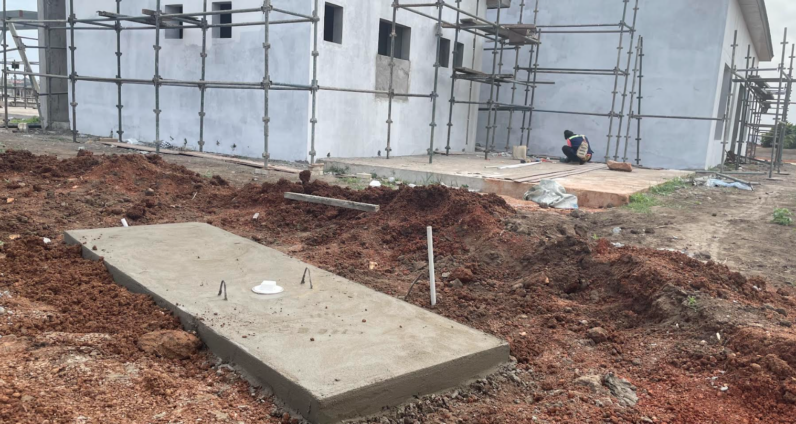
This difference extends to how wastewater is handled. Traditional systems rely on large holding tanks, often built with blocks and requiring significant space. Biodigesters use a smaller, compact, efficient structure with an attached soakaway that allows treated water to safely filter into the ground.
The footprint is smaller, the design is simpler, and the efficiency is higher. One of the most misunderstood aspects of biodegradable biodigesters is maintenance. They are often described as systems that never need dislodging.
While it’s true that you won’t need a vacuum truck to pump out waste, they are not completely maintenance-free. Over time, non-biodegradable items such as diapers, sanitary pads, and plastics can accumulate.

Every few years, these materials need to be removed, and the biological filter refreshed to maintain peak performance. When properly maintained, a biodigester can function effectively for decades. Depth also plays a critical role in safety.
Traditional septic tanks are typically constructed deep in the ground, closer to the water table, increasing the risk of contamination.
Biodigesters operate much closer to the surface, usually within three to four feet. This creates a natural safety buffer, especially when compared to boreholes that draw water from much deeper levels.
By filtering treated water through the upper layers of soil, biodigesters take advantage of natural microbial activity that further purifies the effluent. This approach not only protects groundwater but also prevents structural issues caused by deep soil saturation.
In many cases, the area above the system becomes fertile enough to support healthy vegetation. This is not experimental technology. Biodigesters are part of a broader sanitation strategy supported by significant international investment, including major funding initiatives aimed at improving waste management systems.
In Ghana, their construction and performance are monitored by regulatory bodies that ensure treated wastewater meets environmental standards. For homeowners who want additional assurance, effluent can even be tested independently to confirm safety levels.
The shift from septic tanks to biodigesters is not just about convenience; it’s about rethinking waste entirely. One system stores problems for later. The other deals with them immediately.
For anyone building a home or dealing with recurring sanitation issues, the question becomes unavoidable: continue managing the limitations of an outdated system, or adopt one designed to solve the problem at its source. The answer, quite literally, lies just a few feet beneath the ground.
Latest Stories
-
Newsfile to tackle World Cup visa scandal, beach demolitions, education strikes, BRICS bid
2 minutes -
UK-Ghana Trade & Investment Summit: Trade Resource Centre to help businesses maximise UK-Ghana trade opportunities
17 minutes -
Embassy of Denmark celebrates World Maritime Day
24 minutes -
Linking LEAP to productive inclusion could cut extreme poverty by 2030 – UNICEF
2 hours -
Trade Ministry backs use of creative arts to rehabilitate prison inmates
2 hours -
Negotiations with government to continue despite strike suspension – GNAT
2 hours -
‘Ghana cannot afford to waste public resources; every cedi has a job’ – Ato Forson
2 hours -
Ghana expects economic boost as World Assemblies of God Congress brings 10,000 delegates to Accra
2 hours -
Joy in Nayilifong as Farouk Aliu Mahama donates 100kVA transformer to improve power supply
2 hours -
Chief Justice urges employers to tackle mental health stigma in workplaces
3 hours -
Analysis: Ghana’s yellow fever numbers reveal a gap between vaccination and protection
3 hours -
Education Ministry welcomes suspension of teachers’ strike
4 hours -
Vice Chancellors Ghana appeal to striking university administrators to resume work
4 hours -
KNUST postpones 2026/2027 academic year reopening indefinitely amid GAUA strike
4 hours -
Fire destroys mattress factory at Sokoban in Kumasi
4 hours