

Audio By Carbonatix
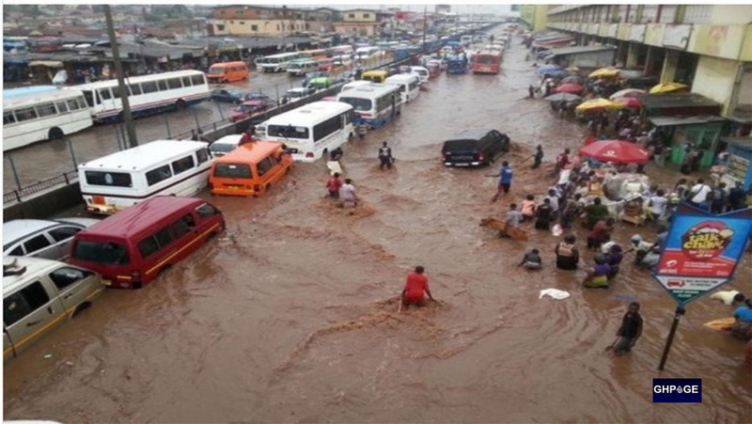
Member of Parliament for Sawla/Tuna/Kalba, Andrew Dari Chiwitey, has blamed poor planning, weak coordination among government agencies, and widespread corruption for Ghana's recurring flooding problems.
Speaking on Joy FM's Super Morning Show on Friday, June 5, during a discussion on how to break the country's flood cycle, the MP, who also serves as Vice Chairman of Parliament's Roads and Transportation Committee, said Ghana's drainage systems are unable to cope with heavy rainfall.
According to Mr Chiwitey, one of the biggest challenges is the lack of cooperation among key government institutions responsible for infrastructure development.
"You see, there's no collaboration. That one is a fact among the ministries," he said.
He explained that agencies responsible for roads, local government, energy, and water resources often fail to work together when planning infrastructure projects.
"If road construction, local government, the energy ministry, and water resources were coming together to ensure that we plan our road systems properly, we would have very good drainage systems," he stated.
The MP pointed to the small and shallow drains commonly found along roads across the country, saying that they are unable to handle even moderate rainfall.
"The gutters that you see are very shallow gutters that cannot contain just a minute of rain," he said.
Mr Chiwitey also blamed poor urban planning for worsening the flood situation. He said many roads were built years ago without adequate provision for drainage, while houses have been constructed too close to roads.
He explained that many residential compounds are now fully paved, preventing rainwater from soaking into the ground.
"The little drops of rain, the water has no place to go. So the water is compelled to go onto our roads," he said.
Beyond government action, he said that citizens must also accept responsibility for the problem. He accused some residents of obstructing drains by dumping materials into them, making it even harder for water to flow during rainfall.
"We all see these things, and we overlook them. When it's raining, they push out their materials into that small gutter that cannot even contain the water."
Mr Chiwitey said it was unfair to place all the blame on Parliament and government when some citizens contribute directly to the problem.
"At the end of the day, you blame Parliament, you blame government. What about the citizens there who have deliberately narrowed the gutter even more?" he asked.
He said that many countries have moved away from open drains and now use covered drainage systems. However, he suggested that such systems could face challenges in Ghana due to public attitudes.
"Elsewhere, they have stopped constructing open drains. They are all covered drains. You walk on them without knowing there are drains underneath," he said.
"But in Ghana, if you do it, people will push materials under them, and the water cannot flow."
The MP insisted that flooding is not solely a government problem but a national challenge that requires collective action.
"We have a problem as a people, not just as government or Members of Parliament. The whole country has a problem that we all have to sit down and see how we can fix," he stated.
Mr Chiwitey also defended efforts by authorities to remove structures built in waterways and other unauthorised locations.
Referring to recent demolition exercises in Greater Accra, he said public officials often face criticism when they attempt to enforce regulations.
"Look at what is happening in Greater Accra. When the Regional Minister and her team move around to demolish structures, people insult them," he said.
He blamed systemic corruption, which he believes is allowing unsafe and illegal developments to continue.
"The system is corrupt. That is the only thing. The system is very, very corrupt," he said.
According to him, corruption extends beyond politicians and involves officials responsible for issuing permits as well as traditional authorities.
"The man who gave out the permit is a corrupt person. Just because he took some money from the developer, he issued the permit for the person to go and build," he alleged.
He further claimed that some chiefs approve developments in unsuitable locations because of financial gain.
"The chief knows that the place the person has come to build is not appropriate. But the chief is corrupt because the chief wants money," he said.
Mr Chiwitey called for a national reassessment of governance systems and public attitudes if Ghana is to tackle flooding effectively and prevent future disasters.
"The whole system in our country, we just have to relook at it," he said.
Latest Stories
-
Tiptoe Lane’s tech takeover: The story behind Ghana’s booming informal phone market
44 minutes -
Abanga vows to use social media to counter NDC messaging ahead of 2028 elections
46 minutes -
Okai Mintah seeks Sabah Zita Benson’s support for NDC National Youth Organiser bid
60 minutes -
Okai Mintah vows to strengthen NDC campaign machinery ahead of 2028
1 hour -
Mother of four and Jasikan teacher among new Telecel M’ahitti Promo winners
1 hour -
International Youth Shakers Conclave 2026 set to bring global young leaders to London
1 hour -
Gov’t is committed to addressing teachers’ conditions of service, deprived-area allowance – Education Minister
1 hour -
GoldBod’s structure encouraging galamsey – Afenyo-Markin
1 hour -
Tullow starts selling Jubilee, TEN crude to Ghanaian refineries
1 hour -
Local Government Service authorises rationalisation, redistribution of staff
1 hour -
PURC assures consumers of working to ensure quality services in Northern Region
1 hour -
Ghana develops US$4.28bn water financing framework
2 hours -
Christian Council calls for protection of mission schools’ religious identity
2 hours -
Mahama holds discussions with India’s External Affairs Minister
2 hours -
Even when you cough, they come after you — Abanga accuses Mahama govt of criminalising free speech
2 hours