


Audio By Carbonatix
The Ministry of Gender, Children and Social Protection (MoGCSP) has launched investigations into concerns raised over the quality and quantity of meals served to pupils under the Ghana School Feeding Programme (GSFP) at Buaduyili Primary School in the Nanumba North Municipality of the Northern Region.
The move follows reports by parents and teachers who expressed dissatisfaction with meals being provided to beneficiaries of the programme, sparking public debate about standards and monitoring within one of the country's flagship social intervention initiatives.
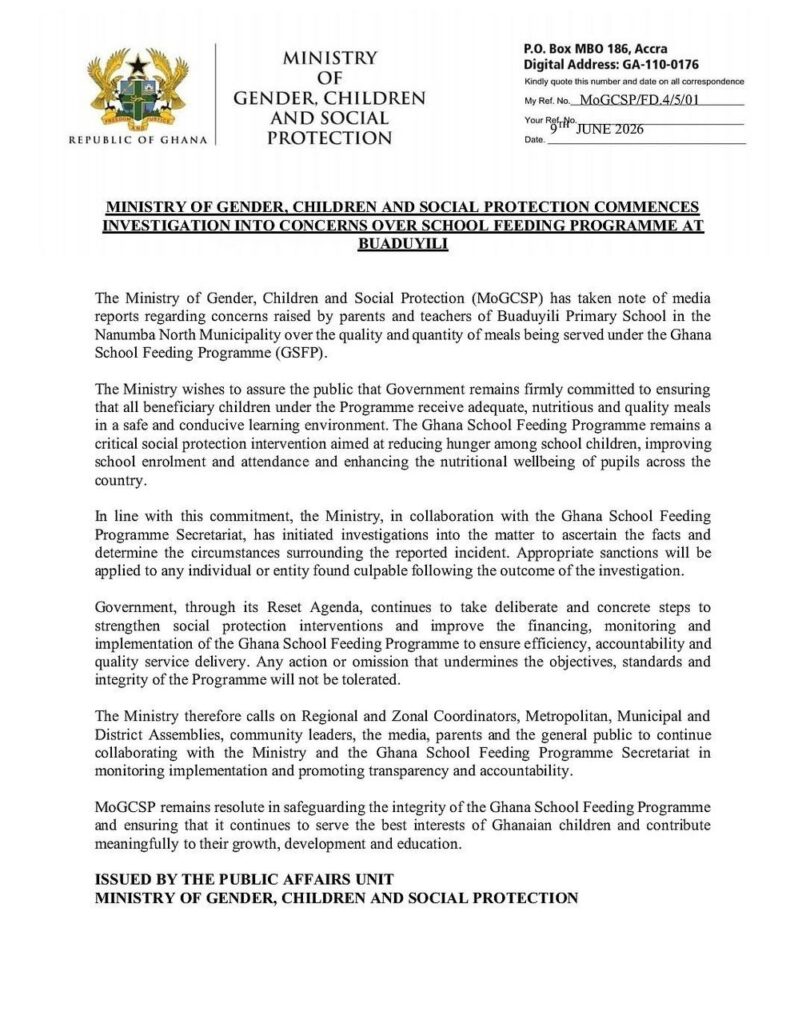
In a statement issued on June 9, 2026, the ministry said it had taken note of the concerns and had commenced a fact-finding exercise in collaboration with the Ghana School Feeding Programme Secretariat to establish the circumstances surrounding the allegations.
The ministry assured the public that the government remained committed to ensuring that all children benefiting from the programme receive adequate, nutritious and quality meals in a safe and conducive learning environment.
"The Ghana School Feeding Programme remains a critical social protection intervention aimed at reducing hunger among school children, improving school enrolment and attendance, and enhancing the nutritional well-being of pupils across the country," the statement said.
Fact-Finding Mission
According to the ministry, the investigation will determine whether the concerns raised by parents and teachers are justified and identify any lapses in implementation, monitoring or service delivery.
It stressed that appropriate sanctions would be imposed on any individual or organisation found culpable following the outcome of the investigations.
The ministry's intervention comes amid growing public interest in the effectiveness of the School Feeding Programme, which provides daily meals to hundreds of thousands of pupils in public basic schools across the country.
Education and child welfare advocates have consistently emphasised the importance of the programme in improving access to education, reducing absenteeism and supporting the nutritional needs of children, particularly in deprived communities.
Commitment to Reforms
The ministry reiterated that the government remains focused on strengthening social protection programmes under its broader development agenda and is taking deliberate measures to improve the financing, monitoring and implementation of the School Feeding Programme.
It said ongoing reforms are intended to enhance efficiency, accountability and quality service delivery while safeguarding the integrity of the intervention.
The statement warned that any act or omission that undermines the objectives, standards and credibility of the programme would not be tolerated.
"Government, through its Reset Agenda, continues to take deliberate and concrete steps to strengthen social protection interventions and improve the financing, monitoring and implementation of the Ghana School Feeding Programme to ensure efficiency, accountability and quality service delivery," the ministry stated.
Call for Collaboration
The ministry further appealed to regional and zonal coordinators, Metropolitan, Municipal and District Assemblies, community leaders, parents, the media and the general public to support efforts aimed at improving transparency and accountability in the programme.
It encouraged stakeholders to continue working closely with the ministry and the Ghana School Feeding Programme Secretariat in monitoring implementation and ensuring that beneficiary pupils receive the full benefits of the initiative.
The ministry reaffirmed its commitment to protecting the integrity of the School Feeding Programme and ensuring that it continues to serve the best interests of Ghanaian children.
It said government remained resolute in ensuring that the programme contributes meaningfully to children's growth, development and education while supporting national efforts to improve learning outcomes and social welfare.
The Ghana School Feeding Programme is one of the country's flagship social protection interventions and has played a key role in increasing school enrolment and attendance, particularly in rural and underserved communities, since its introduction nearly two decades ago.
Latest Stories
-
Finance Minister advises African governments to strengthen regional tax cooperation
1 hour -
NPP accuses NDC of master-minding demolition of Ho regional office fence
1 hour -
Ghana plans stronger regional power trade with Nigeria
1 hour -
GRA Commissioner-General calls for stronger tax cooperation to boost regional revenue mobilisation
1 hour -
NACOC needs more personnel to tackle drug trafficking – Toobu
1 hour -
Railway workers resist KMA eviction order, demand consultation
1 hour -
Legacy Leadership Africa Institute to host boardroom women’s leadership programme
2 hours -
Ghana needs a law to sustain constitutional reforms – CDD-Ghana
5 hours -
COVID fumigation audit: Auditor-General has a lot of questions to answer – Akwatia MP
5 hours -
Stranded Ghanaian medical graduates in Cuba appeal to Mahama for immediate return
5 hours -
GNFS contains fire outbreak at Teshie Lekma Road near Lekma Hospital
11 hours -
Samia Nkrumah rejects the narrative that Ghanaians were happy after Nkrumah’s overthrow
12 hours -
A Mother’s pain: Tribute by Ivan Baidoo’s mother
13 hours -
‘Forgive us for staying away’ — Samia Nkrumah leads family back to Nkroful, pledges to preserve Nkrumah’s legacy
13 hours -
Ernest Nuamah scores twice as Lyon beat Rennes
13 hours