

Audio By Carbonatix
The built environment professionals are calling for urgent reforms to Ghana's metropolitan governance system to address the growing challenges of urbanisation, infrastructure delivery, transportation, sanitation, flooding, and land-use management across the country's major urban centres.
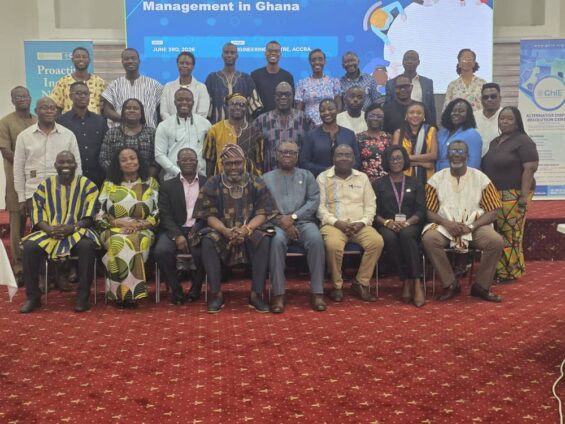
The call was made at the Built Environment Professionals Breakfast Roundtable on "Greater Metropolitan Area Management in Ghana: Towards Integrated Planning, Governance and Infrastructure Delivery," jointly organised by the Ghana Institution of Engineering (GhIE), Ghana Institute of Architects (GIA), Ghana Institute of Planning (GIP), and Ghana Institution of Surveyors (GhIS).
The forum brought together engineers, architects, planners, surveyors, governance experts, and urban development practitioners to deliberate on practical solutions for managing Ghana's rapidly expanding metropolitan areas, including Greater Accra, Greater Kumasi, and Greater Sekondi-Takoradi.
Participants observed that while decentralisation has increased the number of Metropolitan, Municipal and District Assemblies (MMDAs), it has also resulted in fragmented governance structures that often hinder coordinated planning, service delivery, and infrastructure development across contiguous urban areas.
Delivering the keynote address, Mr. Felix Agyei Amakye, Governance Expert and Lecturer at the Institute of Local Government Studies, underscored the urgent need for integrated metropolitan governance frameworks capable of coordinating planning, transportation, housing, sanitation, infrastructure development, and environmental management across multiple jurisdictions.
He noted that many of the challenges confronting Ghana's metropolitan areas including traffic congestion, flooding, waste management, unplanned urban growth, and inadequate infrastructure cannot be effectively addressed by individual assemblies acting in isolation.
Participants emphasised that Ghana's growing urban centres require governance systems that transcend administrative boundaries and facilitate collaboration among local authorities, government agencies, traditional authorities, the private sector, civil society organisations, and citizens.
The forum further noted that existing legislative frameworks provide opportunities for greater inter-jurisdictional cooperation but require stronger implementation mechanisms, institutional coordination, and political commitment to achieve their intended objectives.
The professionals also stressed the need for long-term metropolitan planning, improved land-use management, integrated transportation systems, climate-resilient infrastructure, and stronger enforcement of development regulations to promote sustainable urban growth.
The professionals also noted the ongoing discussions on local governance reforms and the proposed amendments to the Local Governance Act, 2016 (Act 936) and called on the Inter-Ministerial Coordinating Committee on Decentralisation (IMCC) to undertake a broader stakeholder consultation, especially on the need for greater clarity on the criteria for the creation and classification of Metropolitan, Municipal and District Assemblies (MMDA) in relation to the emerging issues on greater metropolitan governance and management.
At the conclusion of the meeting, participants agreed to develop a Joint Position Paper on Greater Metropolitan Area Management in Ghana. The document will provide policy recommendations aimed at strengthening metropolitan governance, improving infrastructure delivery, enhancing urban resilience, and supporting sustainable development.
The participating institutions also agreed to establish a collaborative platform to facilitate continued engagement on metropolitan governance and urban development issues.
The institutions reaffirmed their commitment to working with government, policymakers, development partners, traditional authorities, academia, and civil society organisations to promote integrated planning and coordinated management of Ghana's metropolitan regions.
Latest Stories
-
Two-week strike will not derail academic calendar – GNAT President
5 minutes -
Headmaster detained after BBC investigation into alleged sexual abuse of students
15 minutes -
GNAT pushes for clear implementation procedures of teachers’ conditions of service
34 minutes -
Recurrent strikes threaten quality of education and academic calendars – Prof Bokpin
38 minutes -
‘Cockroach’ group leaders among hundreds detained in Delhi protest
41 minutes -
Don’t let speed of information become your judgement – CJ tells new lawyers
1 hour -
World Cup visa scandal: People have leveraged public office to facilitate fraud – Senyo Hosi
1 hour -
Glut! Farmers count losses as prices crash, customers happy
2 hours -
GSA postpones auction of unserviceable vehicles
2 hours -
Man charged with attempted murder after stabbing
2 hours -
World Cup visa scandal: Senyo Hosi says issue goes beyond calls for Sports Minister’s resignation
2 hours -
Yaw Ampofo Ankrah hasn’t taken or received any money to facilitate visas – Lawyer insists
2 hours -
World Cup visa scandal: Senyo Hosi urges focus on constitutional accountability
2 hours -
La Beach demolition: Senyo Hosi condemns lack of consultation
3 hours -
Russian glide bomb attack on Zaporizhzhia kills at least 15 people
3 hours