

Audio By Carbonatix
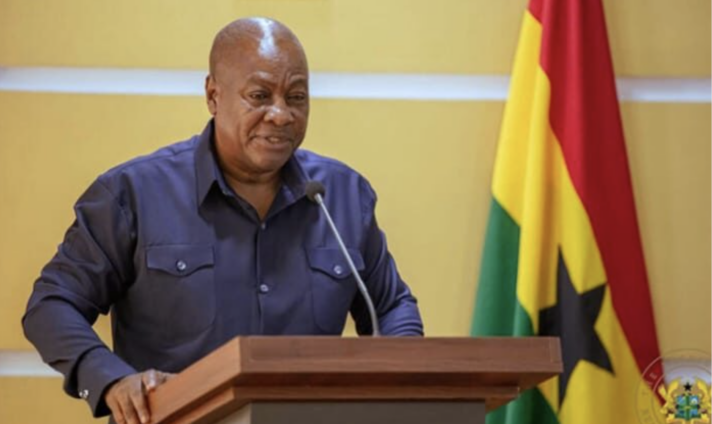
President John Dramani Mahama has called for a fundamental shift in how the transatlantic slave trade is documented and remembered, insisting that the experiences of enslaved women and girls must no longer be treated as “footnotes in history” but placed at the centre of global discussions on reparatory justice.
“The historical experiences of women and girls cannot remain footnotes in the global narrative. They must occupy their rightful place at the centre of truth-telling, remembrance and redress,” he said.
Addressing heads of states, foreign ministers, scholars and members of the African diaspora, the President said the legacy of slavery must be confronted with honesty, stressing that the experience of enslavement was not borne equally by all who endured it.
He noted that while millions of African men, women and children suffered the violence and indignity of the transatlantic slave trade, women and girls faced distinct and often hidden forms of brutality that have long been marginalised in historical accounts.
“As we reflect on this history, it is important to remember that the experience of enslavement was not borne equally by all who endured it,” he said.
The President observed that historical narratives often highlight slave ships, merchants and trading companies, while overlooking the lived realities of enslaved women.
“History remembers the names of the ships, the merchants and the trading companies,” President Mahama said.
“Yet far too often it forgets the woman whose body became a site of exploitation or the mother standing on the shore uncertain whether she would ever see her child again.”
He explained that for many enslaved women, exploitation went beyond forced labour, with their bodies turned into instruments of economic extraction.
“For many enslaved women, exploitation did not end just with providing labour. Their bodies themselves became instruments of economic extraction,” he said.
President Mahama further noted that the reproductive capacity of enslaved women was often exploited to sustain slavery across generations.
“Their capacity to bear children was transformed into a means of reproducing bondage across generations,” he added.
According to the President, much of this suffering was never properly recorded, resulting in what he described as historical erasure that has kept women’s experiences at the margins of global memory.
“Their suffering was often concealed from the official record, leaving them victims not only of their institution but also of historical erasure,” he said.
President Mahama stressed that correcting this imbalance requires recognising the role of women in both resisting oppression and sustaining communities through unimaginable hardship.
He paid tribute to historic female figures who played leading roles in resistance movements, including Nanny of the Maroons, Harriet Tubman, and Sojourner Truth.
“From Nanny of the Maroons in Jamaica, whose story is believed to have begun on the shores of present-day Ghana, to Harriet Tubman and Sojourner Truth, women have been at the forefront of resistance against oppression,” he said.
He also acknowledged countless unnamed women whose courage and sacrifices preserved families, communities and hope under extreme conditions of enslavement.
“Their courage was matched by countless others whose names history has failed to record and yet whose sacrifices helped preserve families, communities and hope in the most difficult of circumstances,” he noted.
The President further commended contemporary women—scholars, activists, jurists, policymakers, public servants and civil society leaders—whom he said continue to advance the reparations agenda.
“We also honour the women of our time… whose contributions have helped bring us to this historic moment and continue to shape the path that we must take ahead,” he said.
President Mahama emphasised that reparatory justice must be gender-responsive, warning that any framework that ignores women’s experiences would be incomplete.
He added that any process of truth-telling, memorialisation or reparatory justice that fails to recognise the specific experiences of women would remain fundamentally incomplete, stressing that the global conversation on slavery must now move from acknowledgement to inclusive historical justice.
Latest Stories
-
Cyber Security Authority, EY resolve satisfactorily matters relating to licence fees
29 minutes -
Illegal mining drives Ghanaian children from classrooms into hazardous labour
1 hour -
NACOC committed to strengthening border security – DG
1 hour -
DTI students showcase innovative solutions at 2026 Capstone Projects Exhibition
1 hour -
‘We let the athletes down’ – NSA boss on Ghana’s Commonwealth Games campaign
1 hour -
Jinapor prioritises exploration, investment to reverse Ghana’s oil production decline
2 hours -
Eric Tinkler highlights deep-rooted challenges at Asante Kotoko, admits club is aware
2 hours -
Next 15 years of Petroleum Commission must focus on transformation – John Jinapor
2 hours -
Bank of Ghana’s negative equity should not come as a surprise – Minority
2 hours -
US$3.5bn fresh investment shows renewed confidence in Ghana’s oil sector – Jinapor
2 hours -
Another centenary in Keta: Vodza RC School
2 hours -
GES engages teacher unions over concerns about 2025 promotion dates
2 hours -
Ghana must move from participation to ownership in petroleum sector – Jinapor
2 hours -
Government moves to restore investor confidence as Ghana seeks to revive oil production
2 hours -
Kingsley Agyemang calls for legally protected fund to tackle Africa’s flood risk
2 hours