

Audio By Carbonatix
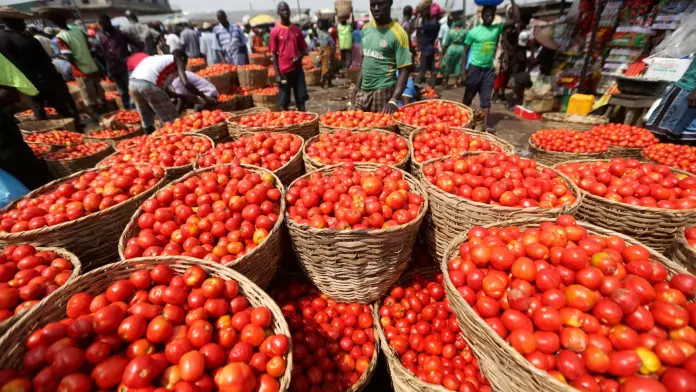
Government, through the Agriculture Ministry, has intensified efforts to increase local tomato production and reduce the country’s dependence on imports through targeted support programmes for farmers, George Batse, the Tema Metropolitan Director of Agriculture, has said.
Mr Batse said the interventions included the distribution of subsidised high-yield hybrid tomato seeds, technical training for farmers, and the promotion of dry-season farming through improved irrigation systems.
In an interview with the Ghana News Agency (GNA), he said the measures formed part of broader efforts to address recurring tomato shortages, stabilise market prices, and strengthen national food security.
According to him, the Ministry was encouraging farmers to adopt improved agronomic practices, including proper seed selection, nursery management, pest control, fertiliser applications, and post-harvest handling.
Mr. Batse anticipated that the introduction of improved seed varieties would enhance yields and improve the quality of locally produced tomatoes.
He said the government was also supporting year-round tomato cultivation, particularly in northern Ghana, through irrigation projects aimed at reducing seasonal supply shortages that often contribute to price increases.
“The objective is to improve local production and reduce the country’s reliance on imported tomatoes,” he said.
Meanwhile, Mr Abdullah Alhassan, a tomato farmer from Nanton in the Northern Region, has welcomed the interventions and said access to improved seeds and technical support could significantly increase production.
He said programmes such as the Feed Ghana Programme and the Vegetable Development Project, known as Yeredua, had the potential to improve productivity and strengthen the local tomato value chain.
However, Madam Saada Adams, a vegetable farmer from Kumbungu, said inadequate irrigation infrastructure remained a major challenge to tomato production.
She noted that the absence of functional dams and irrigation systems limited farmers’ ability to produce during the dry season when demand for tomatoes was often high.
Madam Adams called also for increased access to climate-resilient seed varieties and continuous technical training to improve yields and competitiveness.
She observed that Ghanaian farmers generally recorded lower yields than some neighbouring countries, including Burkina Faso, due to limited access to quality inputs and modern farming techniques.
Agriculture experts believe that sustained investment in farmer training, irrigation infrastructure, and improved planting materials will be critical to increasing local tomato production and ensuring a stable supply throughout the year.
Latest Stories
-
Joy FM to host maiden Back-to-School PrayerFest ahead of new academic year
2 minutes -
Ghana must legislate minimum community development obligations for mining companies – Mireku Duker
12 minutes -
GoldBod costs could have been minimised with better planning – Prof. Bokpin
14 minutes -
GoldBod operations imposing losses on BoG balance sheet – Prof Bokpin
17 minutes -
Mining must improve lives in host communities, not just national figures – Presidency
26 minutes -
Nigeria influencer arrested after seizure of cocaine worth $28m destined for the UK
40 minutes -
Gender Minister inspects nutrition training for School Feeding caterers in Northern Region
42 minutes -
GoldBod to fund rehabilitation of six water treatment plants affected by mining
46 minutes -
ORC challenges CSA cybersecurity sanction, says penalty was premature and procedurally unfair
48 minutes -
GoldBod to introduce gold traceability system by end of 2026 – Sammy Gyamfi
55 minutes -
Photos: Eleventh batch of Ghanaian evacuees arrive from South Africa
57 minutes -
GETFund explains mandate as EFPI expands partnerships to support Ghana’s education sector
1 hour -
US$4.8bn SME financing gap exposes Ghana’s credit challenge — A call for swift implementation of open banking, open finance reforms
1 hour -
Ghana is open to responsible mining, investment – Minerals Commission
1 hour -
Driver busted with cocaine at Accra International Airport
1 hour