

Audio By Carbonatix
Stakeholders at this year’s National Justice Conference have called for sustainable financing of child protection systems, warning that inadequate funding could undermine efforts to combat child labour exploitation and trafficking in Ghana.
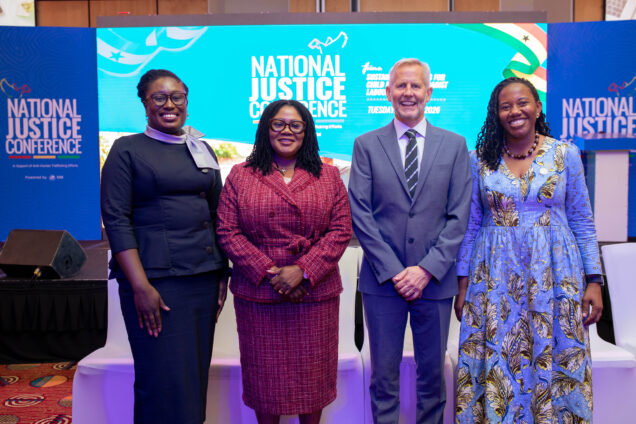
The conference, held in Accra under the theme “Sustainable Funding for Child Protection Against Labour Exploitation,” brought together government officials, lawmakers, civil society organisations, faith leaders, survivors and development partners to discuss ways of strengthening long-term interventions for vulnerable children.
Delivering the welcome address on behalf of International Justice Mission (IJM), the Director of the organisation’s West Africa Programme, Anita Budu, said sustainable funding had become an urgent requirement rather than a future ambition.
“Sustainable funding is no longer a future aspiration; it is an immediate necessity,” she told delegates.
Ms Budu said the conference was intended to serve as a platform where ideas are translated into practical action rather than just discussions.
She noted that child trafficking and labour exploitation continue to grow in scale and complexity, placing additional pressure on systems already struggling with limited resources.
“Even the best-designed interventions cannot be scaled, institutionalized, or sustained” without predictable financial commitment, she said.
The conference brought together key stakeholders including the Minister for Gender, Children and Social Protection, Dr Agnes Naa Momo Lartey; Finance Minister Dr Cassiel Ato Forson; IJM Regional President for Africa-Europe, Andy Griffiths; and Director-General for Special Duties and Marine Affairs of the Ghana Police Service, DCOP Raymond Wejong Ali Adofiem.
Ms Budu highlighted progress made since the previous conference, including the continued rollout of the Social Welfare Information Management System (SWIMS), supported by UNICEF, and assistance to the Ministry of Labour, Jobs and Employment’s Child Labour Unit to improve data collection and reporting.
She also commended the Ghana Police Service for strengthening its data management systems, describing the move as an important step in improving efforts to identify and respond to exploitation and trafficking cases.
According to her, effective child protection requires strong collaboration among state institutions, civil society organisations, traditional and religious leaders, survivors and development partners.
She acknowledged the contributions of institutions including the Ghana Statistical Service, the Institute of Statistical, Social and Economic Research (ISSER) of the University of Ghana, the Judicial Service, the Human Trafficking Secretariat, the Department of Social Welfare and the Ghana Survivor Network.
The conference will continue with sessions expected to focus on policy direction, financing mechanisms and commitments aimed at improving Ghana’s child protection systems.
Stakeholders are expected to use the discussions to develop strategies that ensure child protection interventions are adequately funded, coordinated and sustained.
Latest Stories
-
Vice President urges Methodist Church to add digital skills to women’s training programmes
1 hour -
Forestry Commission arrests 12 illegal miners in Atewa Forest
1 hour -
NPP National Treasurer aspirant involved in accident during campaign
2 hours -
Treat coastal communities as partners in sea turtle conservation – Dr Agyekumhene
2 hours -
The Chief Justice is not a Touring Minister: Baffoe-Bonnie’s SOE visits are unconstitutional officiousness
2 hours -
Enforcing environmental laws carries political cost, while offenders go unpunished – Frimpong-Boateng
2 hours -
Galamsey fight collapsed after safeguards introduced in 2018 were abandoned – Prof Frimpong-Boateng
2 hours -
Jail officials who approve projects in wetlands and forest reserves – Prof Frimpong-Boateng
3 hours -
Ghana needs $21bn to restore lands damaged by illegal mining – Frimpong-Boateng
3 hours -
Law student killed in hit-and-run on Tema Motorway; family offers GH¢50,000 bounty
3 hours -
Gas explosion near Larteh school contained after fire outbreak
3 hours -
Nigerian-British businessman dies after penis enlargement procedure in Thailand
3 hours -
CHEAP JUSTICE? – Occasional Kwatriot Kwesi Yankah writes
4 hours -
WASSCE 2026: English performance decline requires urgent action – EduWatch
4 hours -
Old Tafo MCE pledges action as residents raise alarm over faulty drainage systems
4 hours