

Audio By Carbonatix
Ghana has officially declared three cocoa-growing communities in the Ashanti and Western North Regions as the country’s first Child Labour-Free Zones (CLFZs), marking a major milestone in efforts to eliminate child labour.
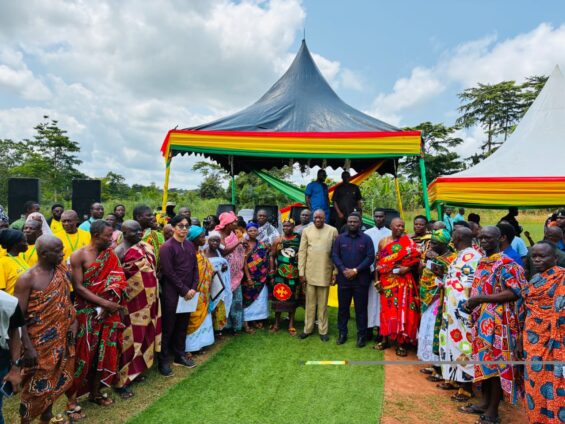
The declaration was made by the Minister of Labour, Jobs and Employment, Dr Abdul-Rashid Hassan Pelpuo, at a ceremony held at Kuffour Camp in the Atwima Mponua District of the Ashanti Region.
The communities declared as Child Labour-Free Zones are Subri in the Bibiani Anhwiaso Bekwai Municipality of the Western North Region, as well as the Kuffour Camp Area Council and Tano Dumase Area Council in the Ashanti Region.
The achievement follows a partnership between the Government, the Japan International Cooperation Agency (JICA), local authorities, traditional leaders, communities and other development partners.
The Child Labour-Free Zones model seeks to create sustainable community systems that protect children from labour, improve access to education and strengthen child protection mechanisms.
The initiative was introduced in Ghana in 2018 under the National Plan of Action for the Elimination of the Worst Forms of Child Labour, leading to the development of guidelines and protocols for establishing Child Labour-Free Zones in 2020.
Since 2024, JICA has supported the Ministry of Labour, Jobs and Employment in implementing the guidelines through institutional strengthening, assessment systems and community-level interventions.
Chief Representative of JICA Ghana, Uchiyama Takayuki, described the declaration as a significant step towards ensuring that children can learn, grow and realise their full potential without being exposed to labour.
He said Ghana’s achievement demonstrates how global commitments to eliminate child labour can be translated into practical action at the community level.
Dr Abdul-Rashid Hassan Pelpuo said the Child Labour-Free Zones model provides a practical approach to reducing child labour in Ghana.
He disclosed that assessment results awarded Subri a score of 77.7 per cent and Kuffour Camp 83.62 per cent, allowing both communities to attain Grade B status and qualify for the declaration.
The Minister said government intends to expand the initiative to more communities through an “umbrella cover” approach to create a wider protective environment for children.
He commended the Government of Japan for its financial, technical and logistical support, describing the partnership as crucial in protecting vulnerable children.
“Children are our hope and must be removed from the farms to secure their future,” Dr Pelpuo said.
The Child Labour-Free Zones initiative brings together government institutions, district assemblies, traditional authorities, schools, civil society organisations, communities and private sector actors to eliminate child labour and promote education.
The government says lessons from the first three zones will guide efforts to expand the programme nationwide.
Latest Stories
-
NPP Delagates Congress: Confusion delays voting at Ashanti Region TESCON centre
19 minutes -
Fire ravages shops, houses near Koforidua Central Police Station
26 minutes -
NPP Delegates conference: The wisdom of the masses will prevail – Napo
59 minutes -
Flydubai co-pilot attacked captain with axe, UAE official says
1 hour -
NPP Bosome Freho Constituency Chairman reportedly arrested over ballot paper incident
1 hour -
Medical plane with 6 on board missing off Massachusetts coast
1 hour -
Bolt driver jailed 25 years for robbing beautician
2 hours -
Happy 76th Birthday to the Daily Graphic!
2 hours -
Amin Adam celebrates Prof. Alhassan Musah on appointment as KAAF University Vice-Chancellor
2 hours -
Mahama reaffirms commitment to Volta development at Asogli Te Za
2 hours -
Bawumia urges NPP aspirants to accept results, reunite party after elections
2 hours -
Double fibre cut disrupts Telecel services, 72,754 subscribers affected
2 hours -
Bawumia demands probe into financiers behind Ghana-linked cocaine shipments
2 hours -
Spain beat Czech Republic to maintain winning run
3 hours -
Ronaldo ‘greatest symbol’ of Portugal – Fernandes
3 hours