

Audio By Carbonatix
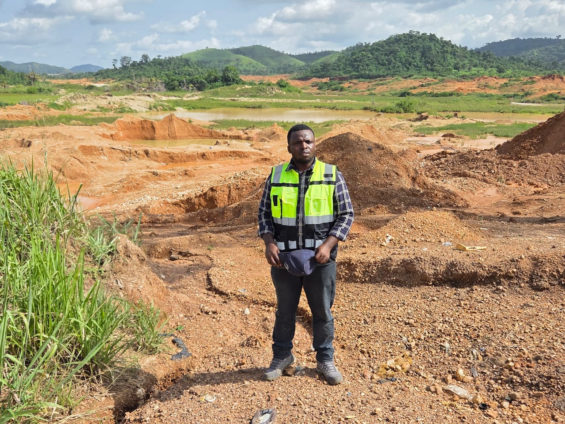
For years, Ghana's fight against illegal mining has been fought where everyone can see it. Brown rivers. Destroyed forests. Collapsed farmlands. Excavators tearing through riverbanks.
Every rainy season, new photographs emerge showing once-clear rivers transformed into muddy channels carrying sediment, chemicals, and the scars of uncontrolled mining. Public outrage follows. Government agencies announce operations. Political debates dominate the news.
Yet while our attention remains fixed on the rivers we can see, another crisis may already be unfolding beneath our feet. It is quieter. It is slower. And it could prove far more difficult to reverse.
The greatest long-term threat from river pollution may not be the rivers themselves. It may be Ghana's groundwater.
The Invisible Resource That Keeps Ghana Alive
Most Ghanaians rarely think about groundwater, because it is hidden. It does not dominate television screens after heavy rains or appear dramatically in newspaper photographs. It arrives silently, through boreholes, hand-dug wells, and community water systems.
Yet it is one of the country's most valuable natural assets. Rural communities draw it from hand-dug wells and boreholes. Schools rely on it for safe drinking water. Health centres need it for sanitation and patient care. Farmers turn to it when surface water becomes unreliable during the dry season. Groundwater provides roughly one-third of the world's freshwater supply, and it remains the principal source of drinking water for thousands of communities across Ghana. In many of them, it is not simply another source of water; it is the source of water.
Because groundwater is usually clear and odourless, many assume it is naturally protected from pollution. Hidden does not mean protected. Science tells us otherwise.
Underground Is Not Isolated
One of the biggest misconceptions about water is that rivers and groundwater exist independently of each other. They do not. Hydrologists describe them as parts of a single interconnected system, linked through soils, sediments, and fractured rock.
When rain falls over a catchment, some water flows across the land into streams and rivers, while another portion infiltrates through soil and rock to replenish underground aquifers. Rivers can also lose water to these aquifers, and groundwater may later return to feed rivers during the dry season. The two systems are constantly exchanging water, which means pollution rarely stays confined to where it first appears. When a river becomes contaminated, groundwater is not automatically insulated from it in many geological settings; it simply receives the pollution later. The process is slow, often taking months or years, but it is relentless. Nature keeps records. Every contaminated drop has somewhere to go.
Time Is Not the Same as Safety
This delay is both a blessing and a danger. A polluted river changes colour almost immediately and is impossible to miss. A contaminated aquifer can remain unnoticed for years. A borehole may continue supplying apparently clean water long after contaminants have begun moving underground.
This creates a dangerous illusion. Communities believe they are safe because nothing looks different. Governments believe interventions are working because routine inspections detect no obvious problems. Meanwhile, beneath the surface, contaminants may be migrating slowly through fractures in rock, porous sediments, and underground flow paths that few people ever see.
By the time contamination is finally detected in community boreholes, it may have already spread through underground formations that are extraordinarily difficult in some cases practically impossible to clean. That is why groundwater scientists often say that prevention is far cheaper than remediation. Unlike rivers, which are flushed and diluted by seasonal floods, aquifers hold on to what enters them.
Heavy Metals Do Not Simply Disappear
Heavy metals such as mercury, arsenic, lead, and cadmium do not behave like ordinary waste. They cannot simply be diluted away. Some attach themselves to mineral surfaces before being released years later, as underground chemical conditions change. Others migrate slowly through fractures and accumulate in sediments, vegetation, and aquatic ecosystems before eventually entering food chains and reaching wells that had previously supplied safe water. Mercury, for instance, can be transformed into forms even more toxic than the original substance. These contaminants can remain in the environment for decades.
Unlike plastic bottles or floating debris that can be physically removed from a river, dissolved heavy metals require sophisticated and expensive treatment technologies. Once an aquifer (groundwater) becomes contaminated, the challenge shifts from pollution prevention to pollution management, a far more costly undertaking. Today's "clean" borehole is not necessarily tomorrow's safe water source. That possibility should concern every Ghanaian.
A National Development Crisis, Not Just an Environmental One
Discussions about illegal mining tend to focus on lost revenue, environmental destruction, or weakened law enforcement. These are important concerns. But water security deserves equal attention, because a nation cannot achieve sustainable development while compromising the quality of its drinking water.
Losing our groundwater would not simply create an environmental problem; it would create a national development crisis. Communities would spend more time searching for alternative water sources instead of pursuing productive economic activities. Healthcare costs associated with heavy metal exposure would rise. Agricultural productivity would decline. Water utilities would face higher treatment costs. Economic inequalities would deepen, as poorer communities struggle hardest to find alternative supplies. Hospitals would struggle, schools would suffer, and businesses would face higher operating costs. The consequences extend far beyond environmental conservation; they affect national development itself.
We Need to Think Beyond Today's Headlines
Environmental policymaking often reacts to visible crises. A polluted river triggers public concern. Fish kills generate media attention. Floods provoke emergency responses. Groundwater rarely creates such dramatic moments; instead, it changes gradually, and public policy often struggles to respond to slow-moving threats.
Yet some of history's most expensive environmental disasters began quietly. Around the world, countries that delayed groundwater protection have spent decades and billions of dollars trying to restore contaminated aquifers (groundwater) after failing to act early. Many have never fully succeeded. Ghana still has the opportunity to choose prevention over cleanup.
That opportunity begins with recognising that groundwater protection is not merely a water-sector responsibility; it is a matter of national planning. Mining regulation, land-use planning, environmental protection, agriculture, public health, and local governance all intersect beneath the ground in ways our institutions often fail to appreciate.
A New National Conversation
Protecting groundwater requires more than occasional water quality testing. It requires a shift in national thinking.
Recharge zones, the landscapes through which rivers replenish groundwater, should become nationally significant environmental assets in their own right, not an afterthought to river protection. Environmental monitoring should move beyond measuring river pollution alone to include long-term, routine surveillance of groundwater quality, rather than treating it as an emergency response. Water quality data should be made publicly accessible, so communities understand the condition of the resources they depend upon and can participate meaningfully in protecting them. Research institutions should receive sustained investment to expand hydrogeological mapping, contaminant transport modelling, and early-warning systems across the country's major river basins. And mining regulation must recognise that environmental damage extends far beyond what is immediately visible.
Above all, groundwater should become part of mainstream environmental policy, not a specialist scientific concern, and environmental policy must begin to think beyond election cycles. Groundwater does not respond within months. It responds over years, sometimes decades. The decisions made today about mining, river protection, and land management will determine the quality of Ghana's drinking water long after today's policymakers have left office.
The Legacy We Leave Beneath Our Feet
Every generation inherits natural resources from those who came before. Our responsibility is not merely to use them; it is to ensure they remain available for those who follow. Groundwater forms over years, decades, and sometimes centuries. Destroying it can happen far faster than replacing it.
We often say that water is life. But we rarely ask where tomorrow's water will come from. If Ghana continues to pollute the rivers that recharge its aquifers, the answer may eventually be simple. Nowhere.
Future generations will not judge us solely by how much gold we extracted or how much economic growth we recorded. They will also ask a simpler question: did we protect the water that sustained life?
The country's next water crisis may not arrive with dramatic floods or empty reservoirs. It may arrive one borehole at a time, and by then, the warning signs we ignored on the surface may already have disappeared beneath the ground.
Dr. Evans Manu is a Research Scientist and Hydrogeologist at the Water Research Institute of the Council for Scientific and Industrial Research (CSIR), Ghana. He holds a PhD in Hydrogeology from the University of Potsdam and its affiliate GFZ Helmholtz Centre for Geosciences, Germany. His research focuses on groundwater systems, hydrogeochemistry, contaminant transport, and sustainable water resources management in mining-impacted environments. He is passionate about translating environmental science into evidence-based public policy and public understanding. He can be reached via email: evans.manu2@gmail.com - Tel: 0202255630
Latest Stories
-
Beach Soccer AFCON 2026Q: 60 players called up as Ghana steps up preparations
37 minutes -
Today’s front pages: Tuesday, September 8, 2026
59 minutes -
FIFA, CAF halt Nigeria football elections over governance crisis
1 hour -
13-year-old Prince George set for first day at Eton College
2 hours -
NPP national election: ‘Something shocking is about to happen in Kumasi’ – Sylvester Tetteh
2 hours -
‘Judge me on my commitment, not whom I supported during presidential primary’ – Sylvester Tetteh to NPP
2 hours -
Family demands answers after dialysis patient dies at TTH during power outage
2 hours -
Foreign Ministry repatriates nearly 7,000 distressed Ghanaians since 2025 – Ablakwa
2 hours -
Gender Ministry steps up community campaign against social vices
3 hours -
Police bust armed robbery gang targeting gold dealers, mining sites in Ashanti and Western regions
3 hours -
Galamsey causes 1 in 4 fibre cuts in Ghana – Sam George
3 hours -
Police link Labone bank robbery suspects to earlier attacks on customers
3 hours -
Accra-Kumasi Expressway will be Mahama’s major road legacy – Agbodza
3 hours -
Ghana spends over US$20m repairing fibre cuts – Sam George
4 hours -
GACL wins two awards at ACI World Airport Experience Summit
4 hours