

Audio By Carbonatix
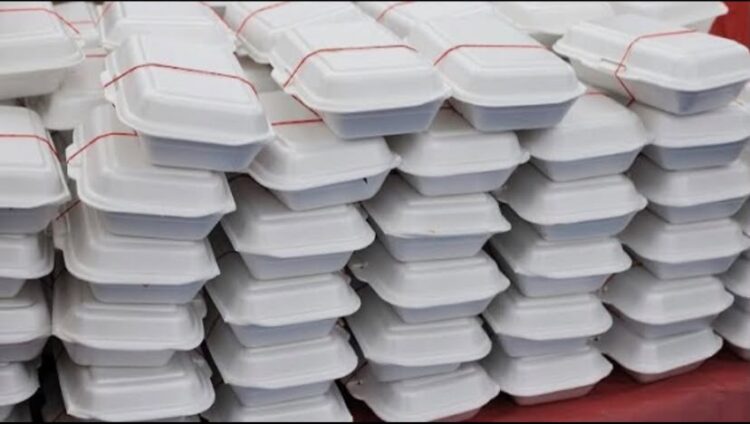
The Environmental Protection Authority (EPA) says it will intensify nationwide public education and stakeholder engagement ahead of Ghana's planned ban on single-use styrofoam food packaging, with the aim of achieving voluntary compliance before the policy takes effect on January 1, 2027.
Speaking during the eighth edition of the Loud and Green X Spaces, the EPA's Director of Human Settlement, Hope Smith Lomotey, said the Authority has spent years engaging stakeholders across the plastics value chain and will continue its awareness campaign in the months leading up to the implementation date.
"It's not going to affect anybody as such, but it will affect, because we are doing a shift. We are shifting from polystyrene or the single-use styrofoam to an alternative which is environmentally friendly," Mr Lomotey said.
He urged Ghanaians to look beyond the immediate cost of environmentally friendly packaging and consider the long-term environmental and public health benefits of the transition.
"Let's be mindful about the cost. The cost, not only the money, the long-term cost, the health cost, the environmental cost, and all the other damages are also part of this. That led us to this point to decide that we are supposed to shift to environmentally friendly packaging material," he stated.
Mr Lomotey said the EPA has already engaged importers, manufacturers, hoteliers, restaurants, food vendors and other businesses expected to be affected by the policy.
"We have done a lot of engagement and the engagement will still continue with the importers, because we cannot import any raw material for the production of styrofoam without approval from EPA. We have engaged all the importers. We know them. We have engaged the manufacturers. We engaged the hoteliers, the food vendors, and the engagement will still continue," he said.
As part of its intensified awareness campaign, the Authority plans to take its message directly to traders and consumers in major commercial centres across the country.
"Come Tuesday, next week, we are going to the market. We are having a very big campaign at Makola, and we will have some float as well to the principal streets of Accra... and the regions as well are also doing their own campaign," he revealed.
According to him, the campaign will also highlight environmentally friendly packaging alternatives already available on the market while encouraging businesses to transition before the deadline.
"Already, most of them are already manufacturing or even using [the alternatives]. Some people have started using it... Manufacturers are shifting gradually. And we are hoping that come 1st January, 2027, we'll completely shift to these alternatives," he said.
Addressing concerns about the higher cost of biodegradable packaging, Mr Lomotey acknowledged that greener products are currently more expensive than styrofoam but expressed confidence that prices would fall as production and demand increase.
"It is true. Anything green, anything environmentally friendly is a little bit expensive because it is better as far as the environment and public health is concerned... After the ban, if a lot of people are on board importing, manufacturing and using it, the demand becomes high. But definitely, the price will gradually stabilise and drop."
While emphasising that public education remains the EPA's preferred approach, he said the Authority is prepared to enforce the ban where necessary once it comes into force.
"It is our prayer that nobody will violate the ban," he said.
He warned that prohibited styrofoam products imported after January 1, 2027, would not be cleared at Ghana's ports and would be confiscated by the authorities.
"If you bring the product, you cannot clear it. You can't clear it... It will be confiscated at the port."
Despite the enforcement powers available to the EPA, Mr Lomotey expressed confidence that widespread compliance would make punitive action largely unnecessary.
"I have faith in Ghanaians because this is not the first time we are banning something. People welcome it. And I know we will not get to the point [of] going market to market arresting people that they are still using styrofoam. Everybody will comply."
He noted that Ghana has previously implemented successful environmental reforms, including the phase-out of leaded fuel and restrictions on plastic packaging within parts of the cement industry, expressing optimism that the country's transition away from styrofoam would achieve similar success.
Latest Stories
-
Tema Fire Commander calls for private-sector support
5 minutes -
Adaklu is not a safe haven for environmental degradation – DCE
9 minutes -
Judiciary urged to expedite corruption cases
13 minutes -
Adenta-Accra travel time improves significantly under contra-flow – GAPTE
17 minutes -
SEND-Ghana, UCC students march for mandatory food warning labels
24 minutes -
Auditor-General vows tough surcharges, unveils tracker, AI audits
30 minutes -
Government vows no political protection for drug trafficking suspects
41 minutes -
Government clarifies Interior Minister’s ‘involvement’ comment in drug probe
1 hour -
Mahama orders security agencies to make Ghana’s ports ‘ironclad’ against drug trafficking
1 hour -
Government admits turf war among security agencies is undermining port security
2 hours -
Government rejects ‘Cocaine Coast’ label, says drug busts show security agencies are working
2 hours -
Banks NPL ratio of 16.1% is still too high – S&P
2 hours -
US death row inmate Christa Pike taken to hospital after surviving two lethal injections, says lawyer
2 hours -
Japan raises residency fee for foreign nationals by twenty-fold
2 hours -
Nollywood actor CJay Nwoks dies in Lagos hospital
3 hours