

Audio By Carbonatix
There's a particular kind of exhaustion that comes from using an app that was never designed with your nervous system in mind. The autoplaying video that arrives without warning.
The infinite scroll built to override self-regulation. The notification badge that won't let a mind at rest stay at rest. For most users, this is just background friction.
For neurodivergent users, autistic people, those with ADHD, and others whose sensory and cognitive processing differs from the neurotypical norm the platforms were built around, it can be the difference between a tool that works and one that works against them.
Kofi Ofori-Mensah has spent the past several years building a career, and now a company, around that difference.
From frontline care to research
Ofori-Mensah's path into this work didn't start in a lab. Before he was a researcher, he was, and still is, a support worker for autistic and neurodivergent adults in the UK, a role he's held for close to two years alongside his academic and entrepreneurial commitments.
That shows in how he talks about the problem. It isn't an abstract design flaw to sketch out in a workshop. It's something he watches play out in the lives of the people he supports, day after day.
That closeness to lived experience fed directly into his academic work. As a postgraduate researcher on an MSc in Digital Marketing at the University of Roehampton, Ofori-Mensah wrote a dissertation on how neurodivergent adults in the UK actually experience social media marketing, using an interpretivist framework and reflexive thematic analysis to let participants' own accounts define what "engagement" and "harm" mean, rather than platform metrics.
Most research into platform design starts from the assumption that a neurotypical user is the default and treats everyone else as an edge case. Ofori-Mensah's work starts from the opposite assumption.
Kofi Ofori-Mensah earned a Roehampton Futures Award this year, alongside his post as a research assistant at the university. It puts him inside the same institutions that shape how digital marketing and platform design get taught, even as his broader work pushes those institutions to question their own defaults.
Building the alternative
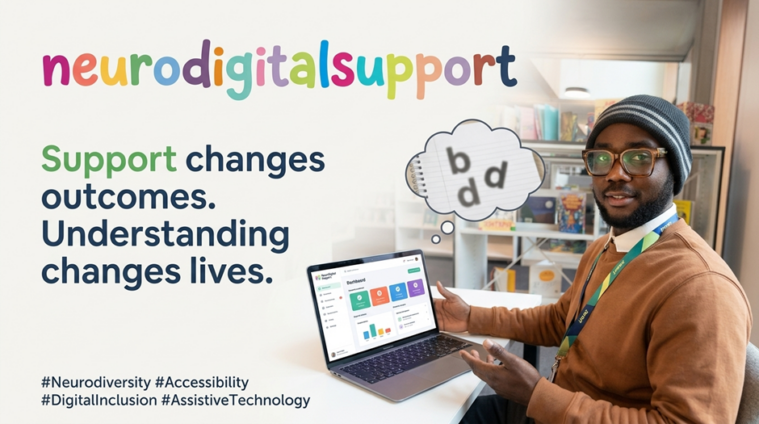
Research rarely changes how a product gets built on its own. So Ofori-Mensah founded NeuroDigital Support, a UK-based venture built around a line that's become something close to a mission statement: “changing digital environments, changing outcomes”.
The company's flagship product, NuroTok, is a sensory regulation and digital wellbeing app for neurodivergents. It's designed around the specific triggers, unpredictable stimulation, poorly signposted transitions, and feeds optimised for engagement over wellbeing that Ofori-Mensah's research and frontline work kept turning up as recurring sources of harm.
Behind it sits a wider set of planned tools for advocacy, research, and care coordination, though the company has deliberately kept its near-term focus on the one flagship product rather than launching everything at once.
A body of writing
Alongside the venture, Ofori-Mensah has published two books, The Invisible Users and The Invisible Struggle, which take the same argument out of the register of app design and into a wider public conversation about who gets designed for and who's left to adapt.
It's the same thread running through the dissertation, the product, and the books: platform design isn't neutral, and its costs have landed hardest on users whose minds weren't in the room when the products were built.
An argument still being made
None of this is finished business. NeuroDigital Support is still an early-stage company, and NuroTok hasn't yet reached the scale that would prove the model works at the size of the platforms it's arguing against.
But it's an unusual combination: a researcher with frontline care experience, an academic base, an innovative product, and a public voice, all aimed at the same target, the quiet assumption built into most platforms billions of people use every day that a mind that processes the world differently is something for the user to manage rather than something for the product to fix.
Whether that argument changes how platforms get built is still an open question. That it's being made by someone who has actually sat with the people affected by the answer is, on its own, worth paying attention to.
Latest Stories
-
New iPhones, new features: Is it time to upgrade?
29 minutes -
Scaling Enterprise AI across Africa: From technology to real-world impact
33 minutes -
Fibre Broadband isn’t complicated: You’re just overthinking it
37 minutes -
Arrest all officials who handled cocaine-linked container – Nitiwul
1 hour -
DTI inaugurates Academic Council, Industry Advisory Committees to strengthen TVET delivery
1 hour -
DTI, Ghana TVET Service partner to promote TVET education and youth employment
1 hour -
Large crowd of mourners attend one-week observation of Kessben; final funeral rites set for November 26–28
2 hours -
Nitiwul calls for GPHA boss Paul Tanye-Kulono to step aside over cocaine probe
2 hours -
Over 90 apprentices, master craftspersons in Wa East receive industrial tools under National Apprenticeship Programme
2 hours -
SOL Energy, subsidiary of Star Oil, secures provisional BIDEC licence from NPA
2 hours -
Six other people in custody as Ghana investigates drug trafficking through ports – Felix Kwakye Ofosu
2 hours -
Suicide Prevention Awareness Month : Before another young Ghanaian says goodbye
2 hours -
Revolutionizing education in Kenyasi No. 1: The visionary leadership of Nana Osei Kofi Abiri
2 hours -
Climate-vulnerable countries spend nearly 25 times more on debt than climate action – ActionAid report
2 hours -
Queen Mothers congratulate Ayariga, seek greater inclusion in traditional affairs
2 hours