

Audio By Carbonatix
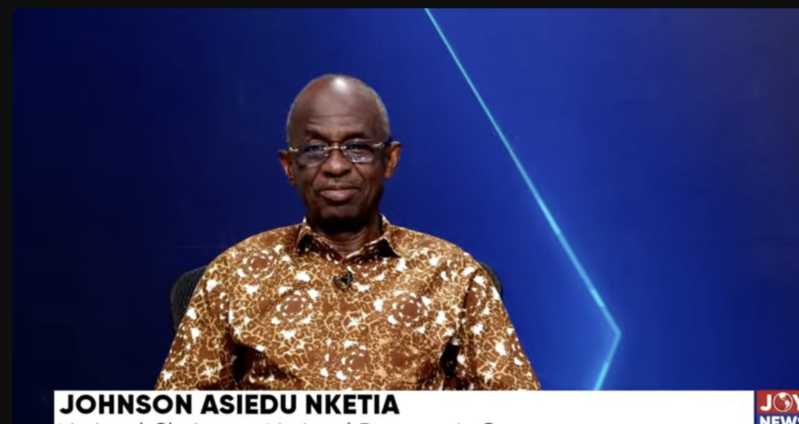
NDC National Chairman Johnson Asiedu Nketia has described the government's proposal on the election of Metropolitan, Municipal and District Chief Executives (MMDCEs) as a "middle way" between those who oppose any contest for the position and those who want completely open elections.
Speaking on PM Express with Evans Mensah on JoyNews, Mr Asiedu Nketiah explained that the government's position is not being forced on anyone and will be subject to parliamentary debate.
"This is more of government indicating that this is what we believe in. We are not going to force it on the neck of anybody because there will be opportunity for our position and even the report itself to be debated openly in parliament," he said.
He noted that Parliament will not be bound to adopt the government's position, and the debate will allow for broader input from the Ghanaian public.
"Sitting in the cabinet, we may not know all the implications of whatever decision we take. But when you bring it to the wider Ghanaian community, the debate will go on. Some of the things we have agreed on will be accepted. Some may be rejected. And we'll be cool about it if it represents what the nation wants," he stated.
Mr Asiedu Nketiah outlined the competing views on the issue, explaining why the government opted for a compromise position.
"There are people who think that we should not open up the DCE position for any contest at all. It is dangerous. It can lead to national disintegration. It can lead to a situation where DCEs in an opposition area, if government doesn't have any control over them, you can't predict what they will be doing," he said.
"There are others who think that, look, allow everybody to file, let the people choose. The other extreme," he added.
He explained that the middle line the government has adopted is to allow the people to choose, while scrapping the electoral college that confirms the DCE. However, the people will have a choice among three or so nominees.
"When there is a voting, and one emerges, he becomes the DCE. It will come with its own implementing challenges," he acknowledged.
Mr Asiedu Nketiah said the implementing challenges will emerge during parliamentary debate.
"For instance, if the government is going to or the president is going to nominate and there's a suggestion for us to also remove the term limits for the DCE, the two-term limits. If you remove it and a DCE has two terms and the president who nominated him is no longer there, a new president comes. The DCE has the opportunity to go again. The people want him. Would the president be forced to include him in the nominees?" he asked.
"These are all implementing challenges that in the course of the debate will [emerge]," he said.
When pressed on whether this proposal differs from the NDC's 2019 position, Mr Asiedu Nketiah insisted it is the same.
In 2019, the NDC campaigned for a "No" vote in the referendum that sought to amend Article 55(3) of the Constitution to allow political party participation in district-level elections. The party's position at the time was that MMDCEs should be elected on a non-partisan basis, with individuals contesting on their own merit rather than party sponsorship.
"We never said that the people he appoints will be partisan people. But the president appoints judges. Are judges partisan?" Mr Asiedu Nketiah asked, defending the proposal.
He added that not every president's appointee must necessarily be a party person.
The government has committed to allowing citizens to elect their MMDCEs on a non-partisan basis . Cabinet has approved reforms that will amend Article 243(1) of the 1992 Constitution to transfer the power of selecting MMDCEs from the President to the electorate.
A referendum and related reforms are expected to take place between 2027 and 2029 to pave the way for the election of MMDCEs.
The Constitutional Review Committee, chaired by Professor H. Kwasi Prempeh, submitted its final report to President Mahama in December 2025, proposing a phased rollout of elections rather than a simultaneous national exercise across all 261 districts.
Latest Stories
-
Mr President, Ghana was mentioned at the UN; why aren’t we talking about it?
1 hour -
Accra to convene Africa’s regulators and markets on tokenisation at AVAS 2026
1 hour -
The Paradox of Plenty — When every smartphone becomes a newsroom
2 hours -
GTA sensitises taxi drivers in ‘Know Ghana’ tourism campaign
3 hours -
Archbishop Agyinasare calls for responsible speech amid growing social media abuse
3 hours -
‘It will be inexcusable for gov’t not to honour payment of teachers’ arrears by 30th October’ – Haruna Iddrisu
3 hours -
Forbes’ World’s Best Employers 2026: No Ghanaian firm ranked among 900 companies
3 hours -
Electronic processing of teachers’ data: ‘The decision is the Controller’s’ – GES boss
3 hours -
Teachers’ Strike: Haruna Iddrisu questions paper-based processing of promoted teachers’ data
4 hours -
Savannah Region: Kunfusi bridge collapses again, leaving nearly 4,000 residents cut off
4 hours -
Teachers’ strike: GES targets Monday deadline to submit promotion data to Controller
4 hours -
Inflation to average 11.3% in 2027 – Fitch Solutions
4 hours -
‘I didn’t campaign for NDC to come and do this nonsense’ – Kpebu on EOCO’s conduct
4 hours -
Fitch Solutions maintains policy rate forecast of 14% by December 2026
4 hours -
Diaspora Nasara Caucus congratulates Mohammed Ali Suraj, new NPP executives
6 hours