

Audio By Carbonatix
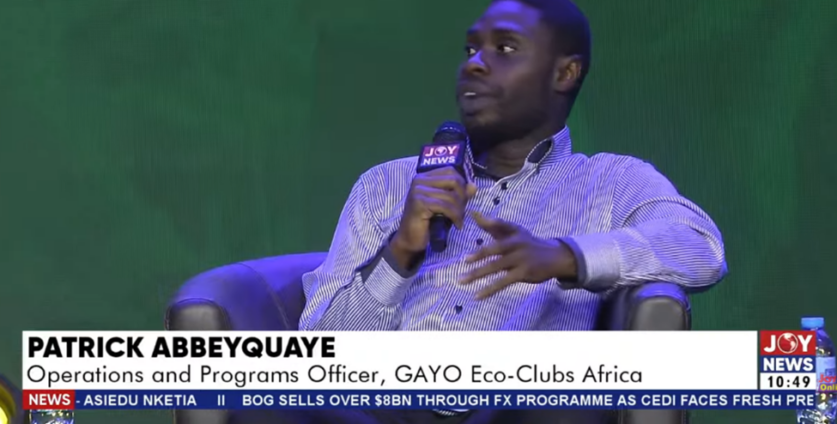
Operations and Programs Officer of GAYO Eco-clubs Africa, Patrick AbbeyQuaye, has said climate change education must go beyond classroom discussions and focus more on practical activities that enable young people to understand and respond to environmental challenges.
Speaking at WaterAid and JoyNews National Dialogue, Mr AbbeyQuaye said there was still a worrying gap in climate change awareness among young people, including students at the tertiary level.
Reflecting on an awareness exercise he participated in at the University of Ghana, he said only a small number of students demonstrated an understanding of climate change.
“Out of like 10 people that you meet or had the conversation with, it was only about two people that knew about climate change, and that was because of the courses they were doing,” he said on Wednesday, August 12.
He said the situation was particularly concerning because the exercise involved university students who were expected to have greater exposure to environmental issues.
Mr AbbeyQuaye said his own understanding of climate change deepened when he studied Marine and Fisheries Science at university, after first encountering the subject through a climate-focused club at the senior high school level.
He welcomed efforts by the Ghana Education Service to integrate climate science into the education system but stressed the need for practical learning.
“I'm more interested in the practicality of it. Hard education, you don't do much of the talking. You go to the field,” he said.
He urged schools to involve children in simple environmental projects that demonstrate how they can contribute to solving climate-related challenges.
According to him, activities such as building simple water filtration systems, waste segregation and basic energy projects could help children develop problem-solving skills and environmental awareness from an early age.
He said practical activities could also encourage curiosity among children and inspire them to think about solutions to environmental problems within their communities.
Mr AbbeyQuaye acknowledged that some efforts were already being made but said much more needed to be done to ensure climate education translated into action.
“I think that it's still not enough. A lot of effort still needs to be put into it,” he said.
He called for more climate-related competitions and practical programmes in schools to complement existing sanitation and environmental initiatives.
Latest Stories
-
Trump says he is considering firing US ambassador to Greece
3 hours -
Man City bananas ‘brought fun back’, says Varadi
3 hours -
Meta releases Muse Wonder AI models to challenge Anthropic and OpenAI
3 hours -
Daily Insight for CEOs: The CEO as Chief Decision Maker
3 hours -
Burnham had formal meeting with Man City chair while mayor
3 hours -
Is Ghana producing too many lawyers? What is the best lawyer-to-citizen ratio?
3 hours -
NDC sinking Ghana’s democracy with Emelia Agbenyo’s appointment – Miracles Aboagye
3 hours -
Seedorf back in football as Corinthians head coach
3 hours -
Hincapié and Zubimendi injured in post-match training session
4 hours -
Fridges in French supermarkets hit by cyberattack
4 hours -
Qantas flight grounded after bedbug outbreak
4 hours -
Reality Zone with Vicky Wireko: International Day of the Girl, shaping today’s girl for tomorrow’s future – ZONTA Clubs lead the way
4 hours -
Global health must be led by countries, not designed for them – Mintah Akandoh
5 hours -
Mahama honoured at 2026 World Health Summit in Berlin for global health leadership
5 hours -
Breast cancer is not a death sentence – Besease Kontire Obaapanin, Magmina Foundation lead awareness campaign
5 hours