

Audio By Carbonatix
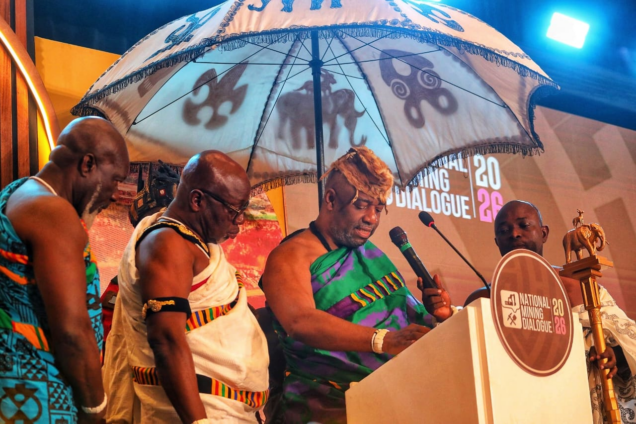
The Ga Mantse, King Tackie Teiko Tsuru II, has called for a fundamental shift in the way Ghana approaches mining, insisting that the closure of a mine must not translate into the collapse of the communities that depend on it.
Speaking at the National Mining Dialogue event organised by Asempa 94.7 FM and its flagship programme, Ekosiisen, in partnership with Semmis DS and the Ministry of Lands and Natural Resources at the Kempinski Hotel in Accra on Tuesday, August 18, the Ga Mantse said mining must be undertaken in a manner that creates enduring opportunities for host communities rather than leaving behind economic hardship and environmental degradation when mineral extraction comes to an end.
“At the end of the day, a mine will eventually close, but the community must not close with it,” he said.
The traditional ruler warned that the pursuit of immediate economic gains from mineral resources should not come at the expense of the prospects of future generations.
“We cannot dig for today’s future in a manner that buries tomorrow’s future. We cannot dig today’s wealth in a manner that buries tomorrow’s future,” King Tackie Teiko Tsuru II said.
He argued that the economic fortunes of communities hosting mines should not be tied exclusively to the operational life of a particular mining project.
Mines, he noted, are ultimately temporary enterprises. Mineral deposits can be exhausted, operations can become commercially unviable, and companies can eventually leave. Communities, however, remain.
The Ga Mantse therefore called for mining policies and agreements to ensure that host communities are equipped to thrive after mining operations have ceased.
“Generations and generations after we are gone will come to suffer,” he cautioned.
King Tackie Teiko Tsuru II also drew attention to a proposed catchment charter, which he described as a compact between mining companies and host communities.
He said the charter should not become another declaration that fades after the conclusion of the dialogue but should serve as a commitment against which the mining industry and other stakeholders can be held accountable.
“At the close of this deliberation, we will be asked to adopt a catchment charter, a compact between industry and host communities,” he said.
The Ga Mantse urged participants to commit themselves to implementing and monitoring the agreement after the dialogue.
“Let us agree here, report upon it, return edition after edition across airwaves, boardrooms, until the promise we make here and reclaim [the] stewardship of our lands in this hall is honoured and this honour kept,” he said.
His appeal effectively called for sustained public scrutiny of commitments made by mining companies and other stakeholders, with progress regularly reported and discussed beyond the conference hall.
He urged stakeholders to keep the commitments made at the dialogue alive through continuous engagement, including public reporting and discussions in the media and corporate boardrooms.
Such an approach, he implied, would help ensure that agreements relating to mining communities, land reclamation and development were not forgotten once the event ended.
Despite his strong warning about the risks associated with mining, the Ga Mantse acknowledged that mineral extraction would remain an important part of Ghana's economy.
“Mining will continue in Ghana as long as the earth beneath us holds what the world needs,” he said.
About the National Mining Dialogue 2026
Senior government officials, regulators, traditional authorities, mining industry leaders, small-scale miners, civil society organisations and media practitioners have converged on the Kempinski Hotel for the National Mining Dialogue 2026 aimed at reshaping the conversation around Ghana’s mineral resources and their impact on host communities.
The conference will provide a major platform for stakeholders across the mining value chain to examine how the country can derive greater economic and social benefits from its mineral wealth while addressing persistent concerns in mining communities.
The event comes at a critical juncture for Ghana’s mining sector, with reforms around local content and participation, the formalisation of small-scale mining, gold traceability, national reserve accumulation and local value retention increasingly shaping the industry’s future.
Latest Stories
-
Give indigenous landowners control to curb irresponsible mining – Dr Nana Kwao Adarkwa
3 minutes -
Interior Minister urges religious leaders to protect Ghana’s tradition of tolerance
5 minutes -
In photos: Dignitaries, stakeholders gather for National Mining Dialogue 2026
12 minutes -
BoG inaugurates Financial Advisory Council to drive non-interest banking in Ghana
14 minutes -
Mineral right is a privilege, not an absolute right – Minerals Commission
15 minutes -
Ablakwa seeks Russian support for Africa-led fight against Sahel extremism
27 minutes -
Host mining communities are partners in development, not obstacles – GJA President
28 minutes -
Ghana to sign 5 new petroleum agreements soon – Energy Minister
29 minutes -
GJA President urges Ghana to weigh environmental and social costs alongside mining revenues
41 minutes -
Irresponsible mining: The land is not your own – Prof Mike Oquaye cautions
48 minutes -
62 Ghanaians killed, 15 missing in Russia-Ukraine war – Ablakwa
49 minutes -
GJA President urges responsible, sustainable mining
50 minutes -
Ghana must take charge of its mineral resources – Prof. Mike Oquaye
56 minutes -
KickedIn uses technology to connect African football talent with global opportunities
57 minutes -
GoldBod did not record GH¢22bn loss; audited accounts show GH¢5.44bn surplus – Institute of Fiscal Policy Governance
1 hour