

Audio By Carbonatix
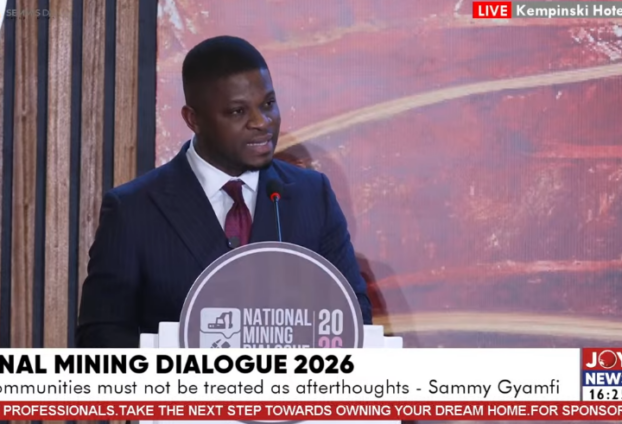
Chief Executive Officer of the Ghana Gold Board (GoldBod), Sammy Gyamfi, has called for greater local ownership and participation in Ghana’s mining industry, arguing that communities where mineral resources are extracted must benefit more directly from the wealth generated.
Speaking at a National Mining Dialogue on the theme “Rethinking the Social License to Operate”, organised by Asempa FM in partnership with GoldBod, the Ghana Medical Trust Fund and other stakeholders, Mr Gyamfi said mining communities should no longer be treated merely as locations where resources are extracted but must be recognised as key partners in the development of the sector.
“Mining communities must be treated as development partners and economic shareholders,” he said.
He questioned why, after more than a century of commercial gold mining in Ghana, many mining communities continue to have limited ownership and participation in the value generated from the country’s mineral resources.
According to him, Ghana’s mining sector has historically been largely foreign-led, with significant portions of the value generated from mining leaving the country through ownership structures, financing arrangements, imported inputs and offshore services.
“Ghana has mined gold commercially for more than a century. Yet for most of this long history, Ghanaians have not been the real owners of the mines,” Mr Gyamfi said.
He cited Obuasi as a clear example of the gap between mineral wealth and local development, questioning why the mining town has not achieved comparable levels of industrial development, investment and economic opportunities seen in other major mining cities such as Johannesburg.
Mr Gyamfi stressed that the mere presence of mineral resources does not automatically translate into economic transformation.
“Mines do not build niches by themselves. Niches build value through deliberate ownership, comprehensive partnerships, infrastructure linkages and disciplined policy management,” he stated.
He said Ghana must pursue policies that increase local ownership, strengthen domestic supply chains and promote value addition within the country.
According to him, the focus should be on ensuring that more of Ghana’s minerals are processed and transformed locally rather than exported in raw or minimally processed forms.
“If we want a new story, we must own more, provide more, process more, fabricate more and retain more. It’s as simple as that,” Mr Gyamfi said.
He argued that such an approach would enable mining communities and the wider Ghanaian economy to retain a greater share of the wealth generated from the country’s natural resources.
Latest Stories
-
Ghana must legislate minimum community development obligations for mining companies – Mireku Duker
7 minutes -
GoldBod costs could have been minimised with better planning – Prof. Bokpin
9 minutes -
GoldBod operations imposing losses on BoG balance sheet – Prof Bokpin
13 minutes -
Mining must improve lives in host communities, not just national figures – Presidency
21 minutes -
Nigeria influencer arrested after seizure of cocaine worth $28m destined for the UK
35 minutes -
Gender Minister inspects nutrition training for School Feeding caterers in Northern Region
37 minutes -
GoldBod to fund rehabilitation of six water treatment plants affected by mining
42 minutes -
ORC challenges CSA cybersecurity sanction, says penalty was premature and procedurally unfair
44 minutes -
GoldBod to introduce gold traceability system by end of 2026 – Sammy Gyamfi
51 minutes -
Photos: Eleventh batch of Ghanaian evacuees arrive from South Africa
52 minutes -
GETFund explains mandate as EFPI expands partnerships to support Ghana’s education sector
57 minutes -
US$4.8bn SME financing gap exposes Ghana’s credit challenge — A call for swift implementation of open banking, open finance reforms
1 hour -
Ghana is open to responsible mining, investment – Minerals Commission
1 hour -
Driver busted with cocaine at Accra International Airport
1 hour -
GoldBod to launch digital gold platform for Ghanaians, Africans
1 hour