

Audio By Carbonatix
China has completed the first phase of construction on Antelope Reef in the Paracels archipelago, building a man-made island in the hotly-disputed South China Sea that analysts say will form part of its largest military base.
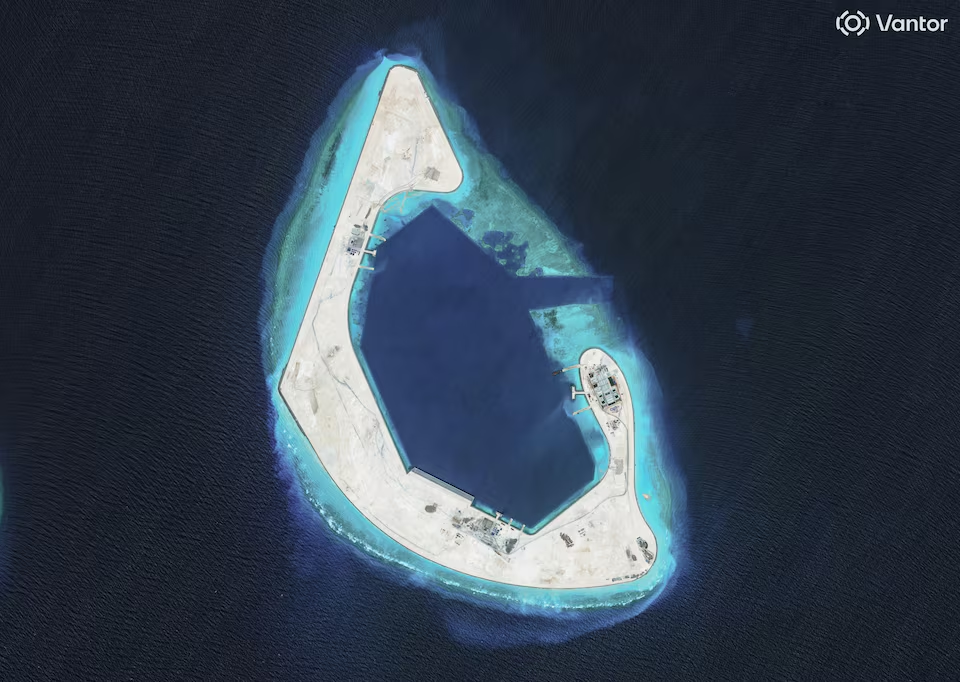
Satellite images reviewed by Reuters show the reclaimed feature in outline for the first time, with barges and dredgers having left after at least six months of work in the busy waterway.
The completion shows the South China Sea as an increasingly militarised arena of competition between China and the United States and its allies, as both sides jostle for advantages that could prove critical in any future conflict over Taiwan.
"The northern part of the South China Sea would be particularly important in a Taiwan conflict scenario, so Antelope is ideally placed," said Ben Lewis, founder of the open-source data platform PLATracker.
Construction of buildings work has started in the southeast corner of the island, including a helicopter pad, in the July 19 images taken by Vantor, a commercial provider of satellite images.
China's defence ministry did not immediately respond to a Reuters request for comment.
China has yet to acknowledge construction of a new military base, while state media have said Antelope will serve civilian needs such as weather forecasting and scientific research.
LIKELY TO STRENGTHEN CHINA'S MILITARY HOLD
Regional security analysts and military attaches say it is more likely to strengthen China's military hold on the northern part of the vital waterway.
The images show a reclaimed island nearly 6 km (4 miles) long, with a straight line of coast longer than 3 km (2 miles) that some analysts see as a potential runway.
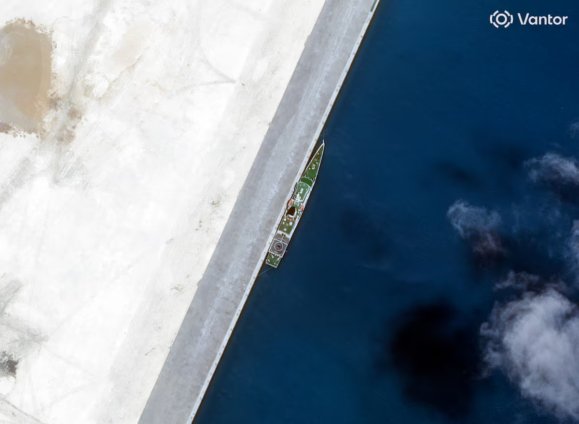
A wharf stretching 680 m (740 yards) fronts a deep water harbour, with one Vantor image showing a coast guard ship alongside.
In a study this week, the Washington-based Center for Strategic and International Studies said the first excavation work for a new runway appeared to have already started.
Open source intelligence tracker Damien Symon, who first highlighted dredging at the reef on X in early January said he spotted initial signs of work last December.
Lewis said he believed Antelope Reef could prove to be one of the Chinese military's most important features in the South China Sea, larger than neighbouring Woody Island and easier to defend than a network of bases further south in the Spratlys archipelago.
"I think the importance of the South China Sea and the Southern Theater Command has been elevated in the last year by the Central Military Commission largely as it relates to Taiwan," Lewis added, referring to China's top military panel, headed by President Xi Jinping.
KEEPING BOMBERS CLOSER TO THE MAINLAND
China's military planners might feel more comfortable keeping some weapons, such as its H-6 strategic bombers, in the Paracels and closer to the Chinese mainland rather than on the Spratlys further south.
The construction work was "modest", Chinese South China Sea scholar Ding Duo said in an opinion piece published in the official China Daily in June.
"Rather than militarisation, the purpose is peaceful and constructive - making the waters safer for everyone who depends on them," Ding wrote.
The comments mirror China's previous explanations of its build-up in the Spratlys in waters also claimed by Southeast Asian neighbours Vietnam, the Philippines, Malaysia, Taiwan and Brunei.
Woody Island has served as the traditional administrative centre for China in the South China Sea, housing at times jet fighters and surface-to-air missiles. Triton Island, also in the Paracels, hosts extensive long-range surveillance devices.
China has occupied all the Paracels since 1974, when it forced off the navy of the former South Vietnam. Vietnam, which claims the entire grouping as its own, has moved in recent years to expand its own network of bases in the Spratlys.
Vietnam's foreign ministry did not immediately respond to Reuters requests for comment. It has previously asserted its sovereignty claims to Antelope, saying in March it "resolutely opposes such actions (and) has made representations".
Antelope could also help support any bid by China to create so-called bastions or protected ocean areas in the South China Sea to defend its nuclear-armed ballistic missile submarines, said Singapore-based security scholar Collin Koh.
Koh said the island buildup, likely to house extensive surveillance equipment, could potentially complicate submarine operations by the United States and Vietnam, which are both active in the area.
Such bastions close to home ports would protect China's submarines from exposure to rival attack, avoiding having to send them out into the western Pacific.
Some analysts believe the South China Sea was chosen for China's test firing last month of a long-range missile from a submarine.
Once complete, the Paracels facilities would strengthen China's ability to monitor the United States and allies in peace time, and add complexity in a conflict, said Carl Thayer, a professor at the Australian Defence Force Academy.
"It's one more thing the United States would have to take care of, and something they could attempt to defend from the Chinese mainland."
Latest Stories
-
EOCO’s handling of arrests could cost NDC power – Kpebu
9 minutes -
Health sovereignty a priority for 1.4b Africans – President Mahama declares
22 minutes -
NACOC begins pre-screening checks at Accra International Airport
25 minutes -
‘I was stepping up into an alliance’ – Sammy Crabbe clarifies John Boadu backing
28 minutes -
Turn CSIR research into commercially viable products for national dev’t – Dr Agyeman-Rawlings
50 minutes -
Baffour Awuah thanks Bawumia, NPP supporters after GH¢10m bail
52 minutes -
Ghana gaining notoriety for drugs – Bawumia demands bipartisan probe
1 hour -
Government urges SMEs to embrace digitalisation for growth and job creation
1 hour -
Ghana’s university libraries urged to lead change in digital age
1 hour -
NPP National Delegates Conference: Nhyiaeso MP calls for unity and peace
1 hour -
Cargill Ghana renovates, equips ICT laboratory for Ahmadiyya Basic School
1 hour -
GH¢6,500 cocoa promise has turned out to be a scam – Bawumia
2 hours -
Firefighters battle blaze behind Amasaman China Mall
2 hours -
We’ll pursue accountability despite intimidation – Afenyo-Markin
2 hours -
‘Ghana Jollof’: Restoring the flavor
2 hours