

Audio By Carbonatix
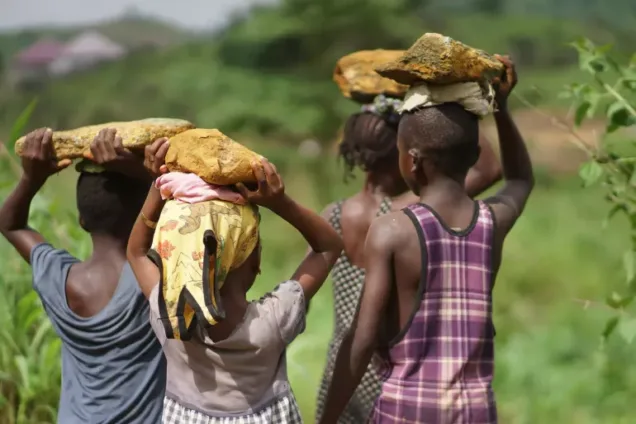
Across Ghana’s agricultural value chain, particularly in the cocoa sector, thousands of children continue to be in the worst forms of child labour, impeding their physical, social, educational, and mental growth.
In 2022 alone, reports suggested that approximately 21% of Ghanaian children aged 5–17 were involved in child labour, with over 1.2 million engaged in hazardous work, primarily in agriculture, fishing, and domestic services.
Over the past years, the country has progressed significantly in eliminating child labour, especially the worst forms, through the adoption of local and international strategies.
Ghana has ratified international laws and conventions, constituted legal frameworks for the protection of children and the elimination of child labour, developed child labour monitoring systems and the integrated social services and social welfare information management systems – all aimed at fighting child labour.
But in the last few years, the country adopted the Child Labour Free Zone (CLFZ) initiative and the Ghana Accelerated Action Plan Against Child Labour.
For stakeholders in the sector, the formulation of child labour-free zones has proven to be an effective means to militating against the menace, especially in rural Ghana.
Principal Labour Officer at the Child Labour Unit of the Ministry of Labour, Jobs and Employment, Rhodalyn Gyamfua Amaning, believes that the approach is the “way to go”.
Child Labour Free Zones
The CLFZ is a geographical area (either town, zonal, or area Council) in which there exist the necessary conditions and functional structures, support systems, and child development facilities aimed at eliminating all forms of child labour and the total development of children.
Three (3) cocoa-growing communities in the Ashanti and Western North regions have officially been declared as the country’s first Child Labour-Free Zones (CLFZs).
The communities are Subri in the Bibiani-Anhwiaso-Bekwai municipality of the Western North Region, as well as the Kuffour Camp Area Council and Tano Dumase Area Council, both in the Ashanti Region.
In these communities, traditional leaders, civil society organisations, district assemblies, child protection structures, farmer groups, and private sector partners played significant roles in ensuring that the prevalence of child labour is at its barest minimum.
According to Rhodalyn Amaning, the CLFZ utilizes integrated area- and participatory-based approaches while employing existing structures within the districts and communities to tackle the menace.
“As a community, we give them the tools and criteria to follow, ensuring that they take ownership and responsibility. Within the communities, there exist structures at the district level, and the same is done at the national level. So, they do not create new structures. It’s a way of strengthening the government systems that exist,” she noted.
The Child Labour-Free Zones model seeks to create sustainable community systems that protect children from labour, improve access to education, and strengthen child protection mechanisms.
The initiative was introduced in 2018 under the National Plan of Action for the Elimination of the Worst Forms of Child Labour, leading to the development of guidelines and protocols for establishing Child Labour-Free Zones in 2020.
It ensures a holistic approach in eliminating child labour not only in one sector of the economic value chain but in every sector present in a specific community.
“So, regardless of how you enter a community, either as a government official or whoever in a district, you don’t fight child labour in cocoa alone but fight it in other sectors where it is too,” she noted.
Child labour prevalence begins to drop
Child Labour and its worst forms continue to be a concern for the government and various stakeholders in the fight to eliminate the menace along the agricultural value chain.
According to a 2025 International Labour Organization (ILO) and UNICEF report, nearly 138 million children were engaged in child labour in 2024. This includes around 54 million in hazardous work likely to jeopardize their health, safety, or development.
Out of this number, sub-Saharan Africa leads with about 87 million children engaged in child labour. This is about two-thirds of the global total.
The latest data show a total reduction of over 22 million children since 2020, reversing an alarming spike between 2016 and 2020.
Ghana has made a lot of progress in eliminating child labour, as the country has recently been declared an Alliance 8.7 pathfinder - going beyond the commitment but putting in place real action to fight child labour.
With its development partners like the ILO, the country’s Labour Department continues to institute progressive projects in a spirited fight against the menace.
The ILO, through the ACCEL Africa project, is accelerating efforts to eliminate child labour in cocoa and gold supply chains.
The project adopts an innovative systems approach to tackling child labour that moves away from project-based downstream interventions towards strengthening existing systems that are critical to tackling the root causes of child labour.
“At the national level, we are looking at how to strengthen policies and help in the formulation of policies that can help to fight child labour. We are working with the tripartite partners. At the district level, we are looking at tackling the root causes of child labour in cocoa and artisanal gold mining supply chains,” Robert Pwazaga, the National Project Officer for ACCEL Africa, noted.
Collaborative approach to end child labour
Beyond the policies, Mr. Pwazaga emphasized that a major contributory factor to child labour cases is poverty, which pushes many families to compel their wards into farming activities.
He noted that the project is facilitating livelihood support for families as well as providing social protection.
“Research has shown that poverty is one of the root causes of child labour. So, we are rolling out interventions that seek to give people alternative livelihoods,” he said.
He added that: “When people aren’t protected enough, especially the parents, when they go to the farm and get hurt, usually, they rely on the child to do some hazardous chores at home and on the farms”.
Despite this positive trend, the world has missed its target of eliminating child labour by 2025. The ILO suggests that child labour in sub-Saharan Africa could still be a problem even after 2030.
“If prevalence levels remain as they are today, the number of children in child labour in sub-Saharan Africa could continue growing, surpassing 100 million after 2030, stemming from projected population growth,” the report noted.
Many actors in the sector believe the historic reduction can only be sustained through effective partnerships, ensuring development partners and government do not work in silo in tackling child labour.
Mr. Pwazaga is positive that effective collaboration can help the country in attaining, if not all, the Goal 8.7 of the Sustainable Development Goals before its deadline in 2030.
“We should work to ensure that structures are put in place and continuously work. Also, we must ensure that the figures continue to come down. With the momentous in which we are moving, the collaboration and efforts put in place – there is a national action going on, and I have the firm belief that in very few years the figures will drop further.
Latest Stories
-
GJA @77: A nation without credible journalism is walking in the dark – GJA Vice President
2 minutes -
Over 500 attend National Mining Dialogue 2026 organised by Asempa FM
12 minutes -
State of the downstream: A quarterly briefing on Ghana’s downstream petroleum sector
15 minutes -
Hijab-wearing Muslim woman reportedly attacked in north London
21 minutes -
Daily Insight for CEOs: Leading Organisational Transformation
26 minutes -
Tourism Society of Ghana to launch Youth in Tourism Festival 2026
39 minutes -
Photos: Vice President joins Chartered Institute of Taxation conference to discuss tax reforms
42 minutes -
Livestream: GJA holds 77th anniversary symposium and lecture in Accra
51 minutes -
PSGH, NHIS bring healthcare relief to disaster-hit students and rural communities in Upper West
51 minutes -
PAHCCDEM takes climate change awareness to Alajo
1 hour -
GRA targets GH¢310 billion in tax revenue by 2028
1 hour -
Full text: Sammy Gyamfi’s response to Afenyo-Markin’s GoldBod allegations
1 hour -
The Jason Arday question: what do universities owe the people they celebrate?
1 hour -
Agbodza orders contractors to accelerate work on 17km Tema-Aflao Road
1 hour -
Kumasi commercial drivers back road traffic law but demand public education
1 hour