

Audio By Carbonatix
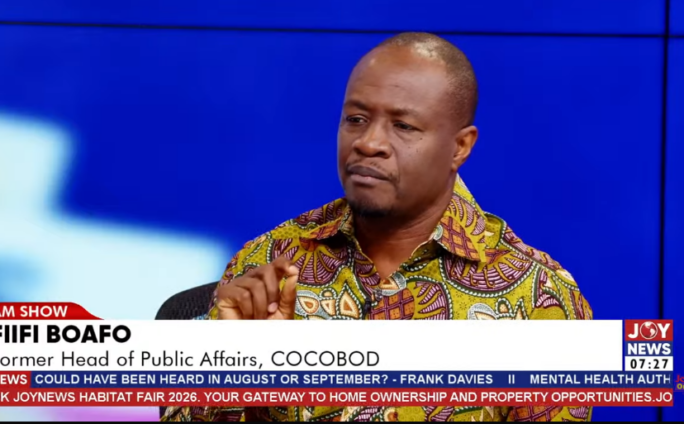
Former Head of Public Affairs at the Ghana Cocoa Board (COCOBOD), Fiifi Boafo, has criticised the National Democratic Congress (NDC) over the recurring power outages in the country, arguing that the party has not demonstrated the capacity to manage the power sector effectively.
According to Mr Boafo, the frequent disruptions in electricity supply under the current NDC administration are raising concerns among Ghanaians and undermining public confidence in the government’s ability to resolve the problem
Speaking on JoyNews' AM Show, Mr Boafo said the situation was particularly worrying because electricity is essential to virtually every aspect of daily life and economic activity.
“NDC has not been able to manage the power sector better,” he said, questioning why the country continues to experience power challenges whenever the NDC is in government.
Mr Boafo recalled a conversation he had with a 15-year-old boy after the change of government in 2024. According to him, the young boy expressed concern about the return of President John Dramani Mahama to power.
He said the conversation reflected the level of anxiety among some Ghanaians about the possibility of recurring power challenges.
Mr Boafo also questioned the effectiveness of measures introduced to support the electricity sector, particularly the additional levy consumers were required to pay on fuel.
He said consumers were told the levy was necessary to help ensure a stable supply of electricity, but argued that the recent outages suggested that the expected results had not been achieved.
“We are paying. The essence of that payment is to ensure that we have stable supply of power. Are we getting the same?” he asked.
According to him, the recent outages had, within a short period, affected large parts of the country, creating the impression that Ghana was “back to square one”.
Mr Boafo urged the government to consult people who previously managed the power sector successfully instead of attempting to resolve every challenge on its own.
“Whatever it is, government, the fact that you have power, it doesn't mean that every problem in the country, you must solve it on your own,” he said.
“Nothing stops them from going to the people who managed it better by asking them, how did you do this?”
He mentioned former government officials and individuals with experience in the energy sector, including Dr Matthew Opoku Prempeh, popularly known as NAPO, and Boakye Agyarko, saying their experience could be useful in addressing the current challenges.
“They should go to them and ask them. And let them show them how they did it,” he added.
Mr Boafo said the government’s explanations for the outages were not enough to reassure the public that the problem would be permanently addressed.
He compared the situation to football, saying there are players who enter the field but fail to inspire confidence that they can solve the problems confronting their team.
“For me, that worries. They are giving us reasons, excuses here and there. But there is nothing about the NDC that gives me the confidence that they are in a position to solve their problems,” he said.
Mr Boafo stressed that the impact of power outages extends beyond households, affecting businesses, students, workers and institutions.
“Power is everything,” he said.
He cited students who are unable to study when there is no electricity, hairdressers who cannot work, and welders who are unable to operate their businesses.
He also pointed to the effect of power outages on media organisations, particularly those that have to rely on generators to remain operational.
“The fact that there is no light, you have to own the generator. When you own the generator, that's an extra cost to the media house,” he said.
He noted that some smaller media organisations could not afford generators, meaning that prolonged power outages could prevent them from operating and potentially deny citizens access to information.
Mr Boafo therefore called on the government to demonstrate greater competence and provide the public with confidence that the recurring power challenges would not become a permanent feature of the NDC administration.
“Learn to manage it. Give us confidence. Let us believe that when you are in power it is not going to do so all the time,” he said.
Latest Stories
-
I’ll consider review — Oppong Nkrumah hints at next move after Supreme Court dismisses injunction
19 minutes -
Bodies of two hikers missing for decades found after Swiss glacier melts
35 minutes -
NSMQ 2026: North East Region denied one-eighth stage as Kumasi High kicks out Nalerigu
39 minutes -
Useless Column: ‘Weytin do Akosua?’
43 minutes -
Context Matters: Understanding the Tony Elumelu First-Name Debate – Afanyi Dadzie writes
46 minutes -
Microwaving is safe, but minimise aluminium foil use – Food Scientist advices
53 minutes -
Supreme Court clears way for legal vacation criminal trials, dismisses Oppong Nkrumah’s injunction bid
1 hour -
Restaurant portions, surplus food worsening Ghana’s food waste problem — Food Scientist
1 hour -
NPP extends 2026 National Officers Elections filing deadline to August 29
1 hour -
NDC has not shown it can manage power sector effectively — Fiifi Boafo
1 hour -
Ghana secured US$2.6bn FDIs in 2025 – GIPC Report
1 hour -
GRIDCo restores power nationwide after August 20 blackout, says grid strengthening measures ongoing
2 hours -
Journalism must prioritise public interest over attention — Kwesi Pratt
2 hours -
Ghana Mineworkers Union demand suspension of contract mining directive, threaten industrial action
3 hours -
ADB Ghana Medicals constructing and equipping new Cardiothoracic Centre at Komfo Anokye
3 hours