

Audio By Carbonatix
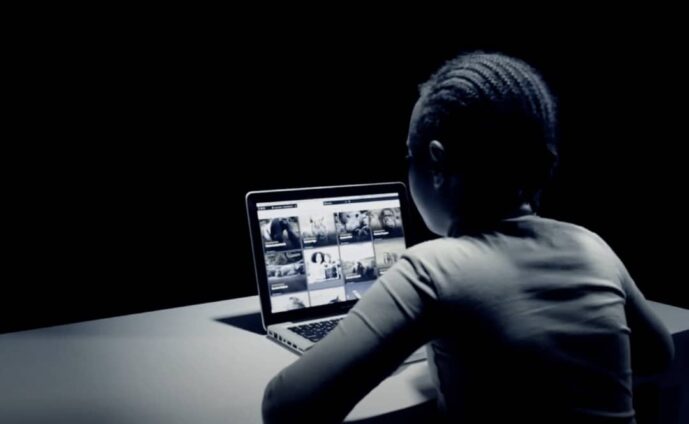
Constance* was 14 years old, living with her aunt in Accra, when the neighbour first sent her a follow request on TikTok. He was 28, living with his girlfriend and younger siblings who played with Constance in the dusty streets of the community. He told her she was pretty. He told her she was mature for her age. He told her not to tell anyone; it would be their secret.
For months, Constance believed him.
The messages started innocently enough. Compliments. Questions about her day. Then came the questions about her body. Did she have a boyfriend? Had she ever kissed a boy? Would she send him a photo? Just a small one? If she really liked him, she would prove it.
She was scared. She was curious. She was 14.
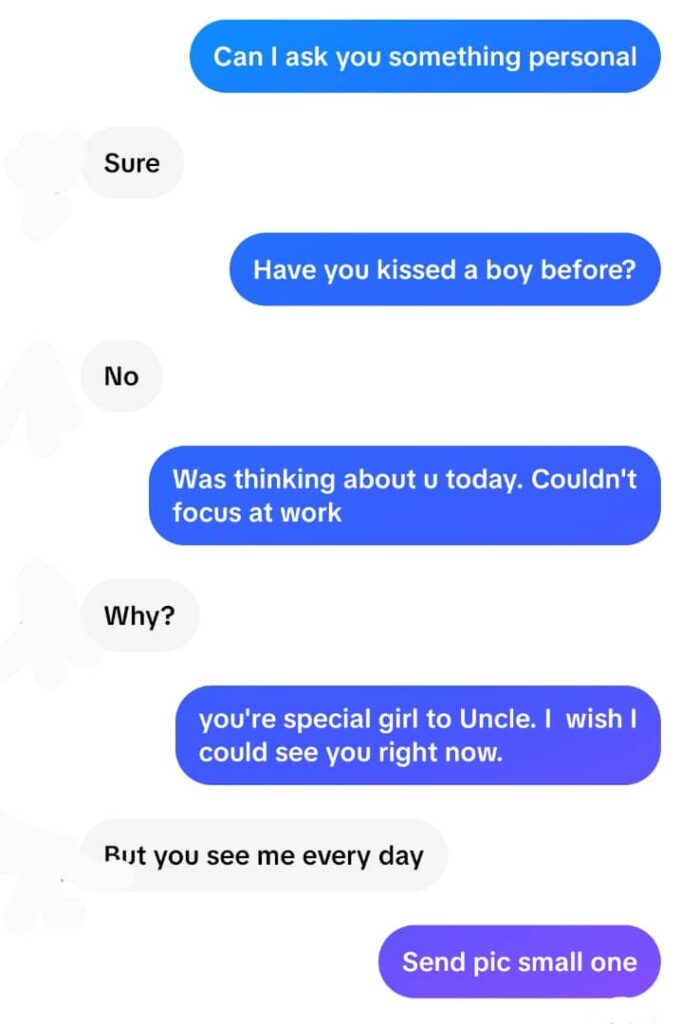
Her aunty had not taught her about online predators. She had not warned her that the friendly neighbour was the same man who would demand naked videos of her in the dark of night.
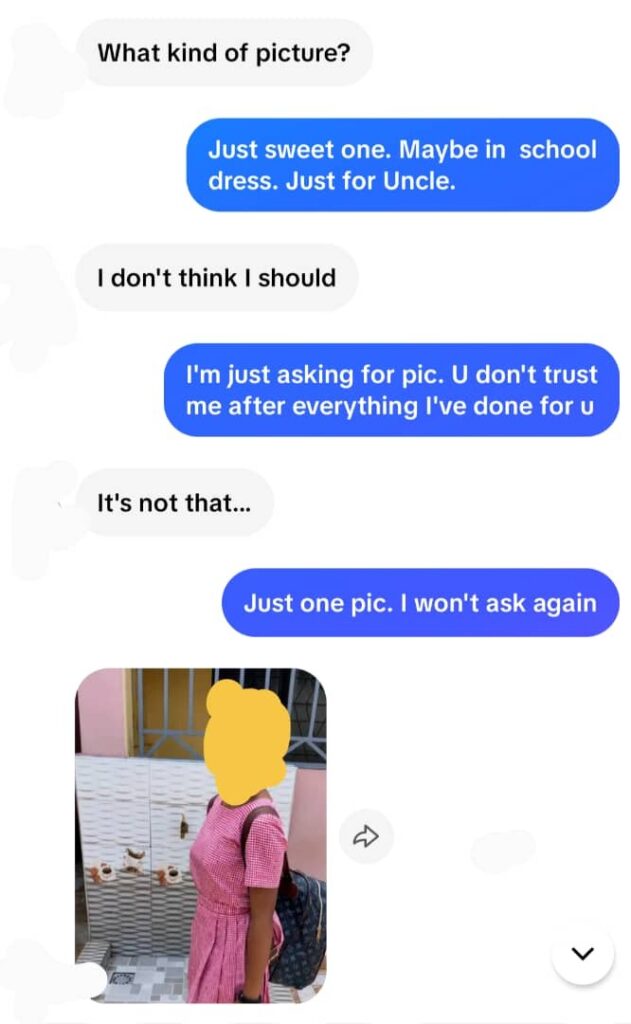
She sent the first photo because she was afraid to say no. The neighbour knew where she lived. He knew her aunt. He had access to her. He reminded her of this often.
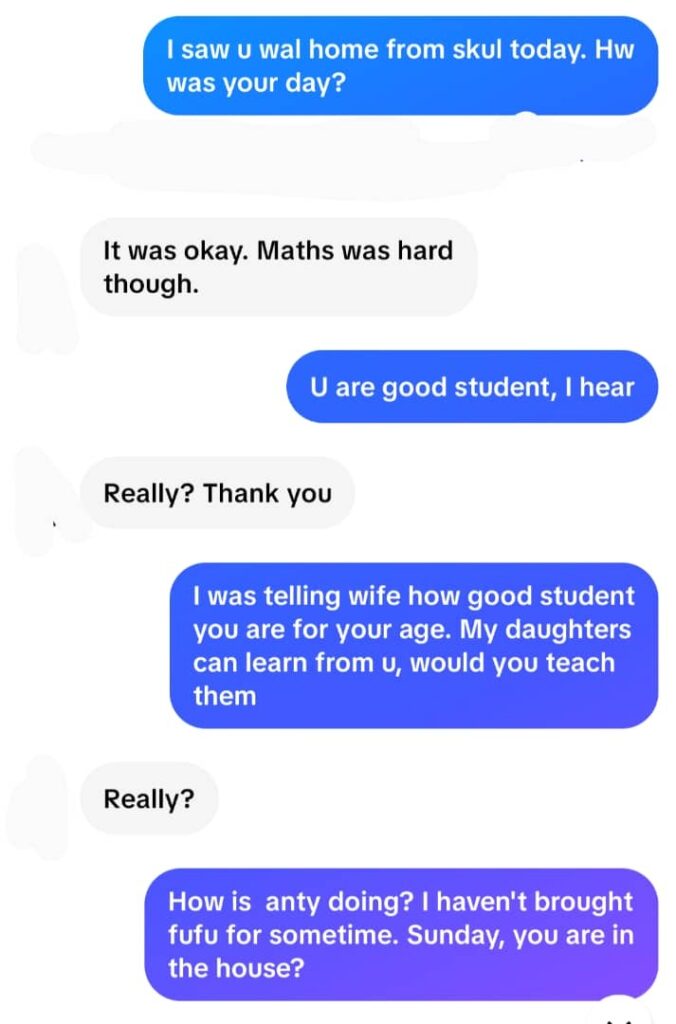
After the photo, his demands escalated. He wanted more. He wanted videos. He threatened to come to her aunt's house and expose their "relationship"—a word he used to describe what she knew, even at 14, was something else entirely.
When Constance finally told a friend at school, the friend told a teacher.
The teacher reported to DOVVSU. The officers requested that the neighbour report to the office. They questioned the neighbour. He denied everything. He said Constance was a liar. He said she had sent the photos to him; he was the victim, really, of a seductive child.
And the DOVVSU officers believed him.
Constance's case was closed. The neighbour went back to his family. Constance went back to her aunt's house, to the street where she saw him every day, to the messages that had stopped, but to the fear that had not.
She is one of thousands. And almost none of them will see justice.
Where Things Stand Now
Two months after the case was closed, Constance still lives with her aunt in Taifa. Her aunt still sells roasted plantain "Kofi Brokeman" on the same dusty street, the same work that once left too little time to notice what was happening on her niece's phone, and that still leaves little room for anything beyond keeping food on the table.
The neighbour still lives next door. Constance sees him most days walking to school, running errands, playing with the younger siblings she once considered friends.
"He doesn't look at me anymore," Constance told a volunteer from Defence for Children International, a local child protection organisation that visited the community.
"He acts like I don't exist. Like nothing ever happened. I don't know if that's better or worse."
Her aunty now limits Constance's phone access.
"Sometimes I still check the messages," Constance said. "To see if he sent anything new. He hasn't. But I still check."
Did Anyone Follow Up?
A social worker from the Department of Social Welfare visited Constance's aunt's home three weeks after the case was closed. The visit lasted fifteen minutes.
"The case is closed. There's nothing more we can do," the social worker reportedly told the aunt.
"We have too many cases. We can only focus on those that are active."
No one from DOVVSU followed up. No one from the school followed up. The teacher who reported the case was transferred to a different school at the end of the academic year, and with her went the only adult who had taken Constance seriously.
A local NGO, Songtaaba, one of several operating in the Greater Accra Region, attempted to offer counselling services.
But Constance's aunt declined.
"She said she didn't want to keep bringing it up," the NGO worker later noted in a confidential report.
"She wanted Constance to forget."
The Number: 23,626
In 2024 alone, Ghana was linked to 23,626 reports filed with the global cyber tip line that flags suspected child sexual abuse material online—a figure UNICEF Ghana confirmed in a report published in December 2025.
To put that number in perspective, in 2016, that figure stood at just 750 . The increase represents a staggering 3,050% surge in less than a decade.
The 23,626 figure is not a measure of online abuse in Ghana. It is a measure of what the global reporting system catches.
Separately, UNICEF Child Protection Specialist Hilda Mensah told Myjoyonline that 45,409 child sexual abuse materials appeared online in Ghana's cyberspace between 2023 and 2024, material either produced in-country, distributed here, or accessed from abroad.
And a survey cited by the Ghana Chamber of Telecommunications found that one in three senior high school girls in Accra had been subjected to digital blackmail, either for money or for sex.
Law enforcement's own numbers point to the same widening gap between reports and response.
DCOP Lydia Yaako Donkor, Director-General of the Criminal Investigations Department, disclosed in July 2025 that police had logged more than 10,000 cyber incidents — including sextortion, CSAM, and online fraud — between 2023 and 2024 alone.
Yet what happens to those 23,626 reports after they are filed remains largely invisible. No government agency publishes a conviction count tied to CSAM cases. This investigation sought that number directly, filing requests under the Right to Information Act. As of publication, no response had been received.
The Face of the Syndicate
In May 2026, the Ghana Police Service uncovered a disturbing syndicate operating in the Ashanti and Bono Regions, where nude videos and images of minors were allegedly being sold to individuals in Australia.
An Australian suspect arrested in 2025 had allegedly received child sexual exploitation material from facilitators based in Ghana.
The investigation led to the arrest of three Ghanaians—including a mother and her son—for allegedly participating in the sale of nude images and videos involving victims aged between six and 13.
Two of the suspects, the CID Director-General revealed, were close relatives of the victims, including an older sibling and a parent legally responsible for the care of the children.
Four children were rescued.
The case highlighted a horrifying reality: those entrusted with care are often the perpetrators.
The Law With No Teeth
Ghana passed its Cybersecurity Act in 2020 (Act 1038), criminalising the production, distribution and possession of child sexual abuse material.
Sections 62 to 68 of the Act set out clear penalties: a minimum of five years' imprisonment and a maximum of ten years for those found guilty of taking, producing, publishing, streaming, or possessing indecent images of children on any digital platform or electronic device. On paper, prosecutors have what they need.
"The internet is not a lawless space," the acting Director-General of the Cyber Security Authority, Mr. Divine Selase Agbeti, declared.
"Ghana will not allow criminals to turn the digital environment into a hunting ground for our children."
But the paper has not translated into practice.
The Cyber Security Authority, established under the same Act, has developed a National Child Online Protection Framework in consultation with UNICEF and the International Telecommunication Union.
Yet the framework remains just that—a framework. Implementation lags far behind ambition.
The CRI Report: Evidence of a System in Crisis
A new report by Child Rights International (CRI), titled "Perfidy of Justice Against Children: Evidence from Child Abuse Cases in Ghana," has uncovered "significant gaps in the delivery of justice for child victims across the country" .
The report, which covered 899 cases across 10 regions and 193 communities, found that at least 286 child protection cases are currently before the courts, with some remaining unresolved for as long as two to ten years.
The report documented that 51% of child abuse cases remain under investigation, 32% have been referred to court, and 16% have no traceable status at all. Defilement emerged as the most prevalent crime against children, accounting for 59.4% of all reported cases—534 out of 899.
The Greater Accra Region alone accounted for 33.5% of all reported cases, significantly higher than other regions.
These delays are not administrative inconveniences. They are forms of secondary victimisation.
The CRI report warns that prolonged court processes "not only deepen harm to victims but also undermine public confidence in the country's child protection system." Children appearing repeatedly in court suffer "psychological distress, trauma, and anxiety," their education disrupted, their recovery delayed.
The Cost of Justice
Families pursuing justice face financial strain that often proves insurmountable.
The CRI study estimates that the total expenses for a single case may range between GH¢4,000 and GH¢10,500. These costs include transportation, medical examinations, forensic reports, court-related expenses, and loss of income.
"Families are often unable to sustain the financial demands of pursuing justice, especially those in low-income and rural communities," said Bright Appiah, Executive Director of Child Rights International. In some cases, families are forced to abandon cases or settle them informally due to financial and emotional strain, "weakening accountability and perpetuating cycles of abuse" .
The 23,626 reports are only what the global tip line catches. The full picture is far darker.
A 2022 CSA survey found that 64.35% of students reported receiving pornographic materials in various forms, including images, words, and videos. Across all categories of child abuse, the picture is consistent: a system overwhelmed.
In one case documented by the Ghana News Agency, a 14-year-old girl was defiled by a 37-year-old farmer who was already married with children.
The girl dropped out of Junior High School when she became pregnant. Her mother, a single trader, did not pursue prosecution; she only wanted the man to take responsibility for the unborn child .
"If there was a coordinated system, a 14-year-old pregnant girl who visits the clinic for antenatal enrolment should be connected to the Police for investigations so that the man involved would be made to face the law," said Madam Esther Tawiah, Director of the Gender Centre for Empowering Development.
But no such system exists.
In another case that shocked the nation in 2026, a police inspector was accused of sexually abusing his biological teenage daughter, allegedly impregnating her and forcing her to terminate the pregnancy.
The abuse, the wife alleged, started when the victim was about 10 to 11 years old. The case was reported, and for months, nothing happened.
"We reported the matter to the police, but nothing was done for months," the wife said. "We have done all we can, but justice is still not served" .
The Child Rights International report offers a clear path forward. It calls for mandatory timelines for case resolution, the establishment of specialised child protection courts, and the development of a "national digital case tracking system to improve transparency, accountability, and the effective monitoring of cases from reporting to final judgment".
The Cyber Security Authority is also taking steps. The Authority has intensified outreach programmes in schools and communities to educate children, parents, and guardians on identifying and responding to online threats. The CSA's support line 292 is available 24 hours a day for reporting.
The Distribution of Responsibility
Among the most persistent errors in this debate is the impulse to assign responsibility to a single actor. Parents blame platforms.
Governments blame parents. Platforms blame regulators. The operational result is that children fall through the gaps between institutions, each of which believes the obligation lies elsewhere.
Effective protection demands that all parties act simultaneously:
Hajia Lamnatu Adam, a development practitioner and human rights activist, said in an interview with Myjoyonline that the government must enact preventive laws governing access conditions, not merely post-hoc criminalisation. It must fund enforcement capacity and hold platforms to legally binding safety standards.
She also said that platforms must redesign products with child protection as a default principle, not a compliance checkbox.
"Real age verification, safe-by-default settings, and meaningful human moderation of high-risk content are not technical impossibilities."
Irene Sam, who is an executive with the Parents and Teachers Association, said in an interview with Myjoyonline that parents and caregivers must become active digital guides, not passive bystanders.
"This does not mean confiscating devices. It means sustained, open conversation before the first incident, not after."
*"Constance" is a pseudonym. Her name and identifying details have been changed to protect her identity as a minor victim of sexual abuse.
Latest Stories
-
Beyond the Numbers: Understanding the Bank of Ghana’s Domestic Gold Purchase Programme(DGPP)
16 minutes -
AI can’t replace lawyers, Supreme Court nominee Anthony Forson warns
31 minutes -
Teacher unions threaten strike over automatic promotion deadline
37 minutes -
Over 400 companies ready to join 24-Hour Economy – Dr Rashid Pelpuo
43 minutes -
Zanetor proposes CSIR funding for cassava, hemp-based alternatives to plastics
49 minutes -
‘Judges don’t mingle with appointing authorities’ – Amoako Asante defends judicial independence
55 minutes -
‘We’re getting close to A’ – Pelpuo rates government’s job creation B+
1 hour -
Suspended Catholic priest found at Koforidua Police Training Centre – Diocese
1 hour -
90% of planned strikes were called off under my tenure – Pelpuo
1 hour -
Petrosol has never defaulted on bank support in 12 years, says CEO
1 hour -
Mahama backs crackdown on airport workers begging visitors for tips
1 hour -
ICT can help clear court backlog – Supreme Court nominee Forson
1 hour -
Police ban concrete mixer trucks from Accra, Tema roads for three days
1 hour -
Education Ministry to amend law to restore faith -based representation on GES Council
1 hour -
‘I have no problem with Public Tribunals Act’ – Supreme Court nominee Forson
2 hours