

Audio By Carbonatix
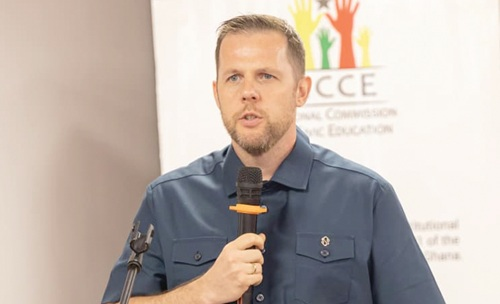
The Deputy European Union (EU) Ambassador to Ghana, Jonas Claes, has stated that the media and the National Commission for Civic Education (NCCE) have critical roles to play as the country prepares for a historic constitutional review process.
He said the process, including proposals on decentralisation, greater accountability, and human rights, would require extensive civic education to enable citizens to understand the issues and participate meaningfully.
He cited the proposed abolition of the death penalty as one of the significant issues under consideration.
Mr Claes was speaking at an encounter with the media and stakeholders organised by the NCCE in Accra on the theme "Strengthening Civic Education through Strategic Partnerships."
NCCE mandate
He said the NCCE had a critical constitutional mandate to educate citizens on their rights, obligations, and responsibilities.
He said the EU remained committed to supporting Ghana’s civic education efforts and the fight against corruption and disinformation.
“Providing objective, accurate information will make both Ghana and Europe a stronger and safer place,” he said.
Press freedom
Mr Claes said Ghana remained in a relatively strong position on press freedom, ranking 39th out of 180 countries in the 2026 World Press Freedom Index.
He said the position enabled journalists to report facts and provide citizens with accurate information to make informed choices, particularly during elections.
He stressed the need to preserve an independent press as a cornerstone of a free and democratic society.
Mr Claes described information manipulation, commonly referred to as disinformation or fake news, as one of the major threats to free and democratic societies.
He said deliberate attempts to mislead citizens could poison public debate, fuel suspicion and undermine trust in democratic institutions.
On his part, the Executive Secretary of the National Media Commission (NMC), George Sarpong, called for stronger collaboration among the media, civic education institutions, and other stakeholders to protect Ghana's democracy from the growing threat of disinformation.
He said closer partnerships were particularly important as Ghana confronted increasing digital challenges, media polarisation and preparations for a constitutional review process.
Mr Sarpong said the media, the NCCE, and Parliament had complementary roles in building responsible citizenship, shaping public discourse and translating national consensus into laws and policies.
He said those roles made it necessary for the institutions to create more opportunities to interact and work together.
Information integrity
He said the media constituted the public sphere where national conversations on citizenship, governance, and the direction of the country took place.
He said while the NCCE prepared citizens for responsible participation in national affairs, the media facilitated the conversations that helped build consensus, with Parliament providing the institutional framework for decision-making.
He said the situation in parts of the Sahel, where disinformation had accompanied instability, should serve as a warning to Ghana.
Latest Stories
-
‘Ghana became Ghana only eight years ago?’ – Tampuli challenges Chief Justice
9 minutes -
Local Government Service partners Celltel to accelerate digital transformation
14 minutes -
CJ’s role includes building working relationships with state institutions — NDC’s Hamza Suhuyini
15 minutes -
Police intercept vehicle carrying suspected contraband at Jema
16 minutes -
BOSTenergies pays first-ever GH¢34.2m dividend to government
17 minutes -
Accra–Kumasi Expressway: 170km of corridor cleared, only 6km remains – GAF
25 minutes -
Maritime security and naval cooperation in a changing international order
26 minutes -
Over 8,000 candidates compete for just 800 places at Aburi Girls’ SHS – CSSPS
27 minutes -
‘Did he lie? I don’t see anything political about Chief Justice’s comments’ – Franklin Cudjoe
30 minutes -
NDC’s Hamza Suhuyini accuses NPP of hypocrisy over Chief Justice’s remarks
30 minutes -
Sekondi-Takoradi records 152 new HIV infections in 2025
40 minutes -
Agbodza orders Wa-Bulenga road contractor back to site
41 minutes -
The Last Embers Are Burning: On Ali Mazrui and the scholarship we forgot to save
45 minutes -
GIF calls for more forest guards as attacks on frontline officers escalate
50 minutes -
GMR records 12,172 patient service touchpoints in Ho West medical mission
1 hour