

Audio By Carbonatix
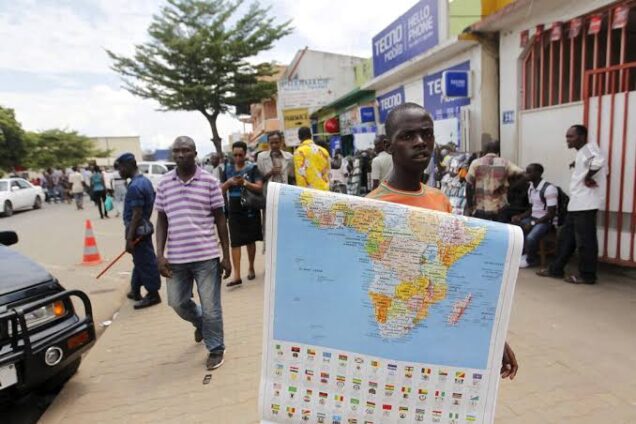
The United Nations on Friday voted for a shift away from the 16th-century Mercator global map towards one more accurately reflecting countries' true size, a resolution sponsored by African states to counter perceptions that the continent is peripheral.
Togo led the initiative to further the African Union campaign to limit use of the Mercator map, which distorts the relative size of land masses by expanding those nearer the poles. It makes Greenland appear roughly the same size as Africa, though Africa is about 14 times larger.
The Reuters Daily Briefing newsletter provides all the news you need to start your day. Sign up here.
"A fair world begins with a fair map," Togo's Foreign Minister Robert Dussey told Reuters ahead of Friday's vote.
The resolution promotes the Equal Earth projection, which more accurately portrays the size of the continents.
It is not legally binding and it "in no way challenges the use of the Mercator projection for maritime and aerial navigation, for which it remains fully suited," the Togolese ministry said in a statement.
The resolution passed in the U.N. General Assembly by a vote of 164 to 1 with 6 abstentions.
The United States, the only country to vote against the resolution, said it promoted an "ideological agenda" and was a distraction from the "genuine problems of international peace, prosperity or good relations".
TOGO TO CHANGE MAPS IN SCHOOLS THIS YEAR, MINISTER SAYS
The Mercator map remains widely used in classrooms, but Togo hopes to change its school geography materials by the end of the year, Dussey told Reuters.
"Togo will be the first country to change our own geography books," Dussey said.
"In the classroom, we need to change it to give an example to all the countries in the world."
Togo will press other governments, schools, international organisations and technology companies to move away from the centuries-old Mercator projection, Dussey said, adding that Equal Earth offers "the best perception" of the world.
Togo plans to meet African Union member states and supporters from other regions within the next six months to agree on how to promote wider adoption, Dussey said.
Dussey said the discussion about next steps would need to include companies operating mapping, GPS and other location-based technologies.
Dussey linked the campaign to adopt the map to wider African efforts to confront colonial-era legacies, while saying it was not an attack on Europe or any other civilisation.
The Mercator map's widespread use is a consequence of colonization, he said.
"The world is changing. Africa also is changing."
Latest Stories
-
I don’t think we have an industry – Patchbay Band manager
5 minutes -
Patchbay Band questions recognition of live bands in Ghana’s music industry
5 minutes -
Newsfile to discuss SOEs’ GH¢19.8bn profit, dissolution of 9 boards, CJ’s visits to SOEs, GH¢70k gift rejection
13 minutes -
BoG warns against spraying, defacing and using cedi notes for decorations
17 minutes -
Adwumawura: Selected applicants to receive notifications from today – NEIP CEO
20 minutes -
‘Fake memo’ fabricated to smear me – Patricia Appiagyei
35 minutes -
ATLF206: Culture, investment and tourism take centre stage as Africa’s tourism leaders gather in Polokwane
1 hour -
TI-Ghana and GACC demand full disclosure over alleged GH¢70,000 Appointments Committee payment
1 hour -
UN approves resolution in support of map that shows Africa’s true size
1 hour -
Spring Agro Industries urges Ghanaians to choose local rice as imports dominate market
2 hours -
Youths in Oti push for stronger policies on SRHR and gender-based violence
2 hours -
Rev Samuel Anthony Kofi Dunya calls for stronger action against child labour and trafficking
2 hours -
Where the bins are missing: How poor waste management is affecting Ghanaian communities
2 hours -
Joy FM Back-to-School Fair 2026 draws shoppers as Day One winds down
2 hours -
AfriYAN Ghana calls for greater youth participation in local governance
2 hours