

Audio By Carbonatix
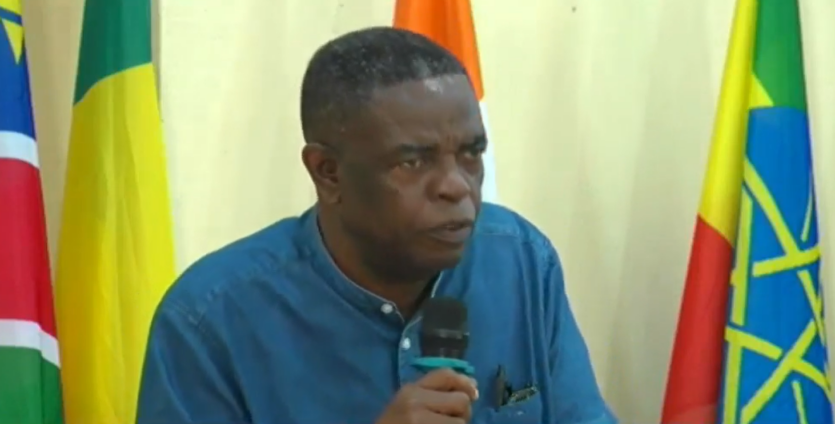
Veteran journalist Kwesi Pratt Jnr has called for a fundamental transformation of the global political and economic order, arguing that Africa’s reparations struggle must go beyond financial compensation to secure equal rights, control over the continent’s resources and greater collective self-reliance.
Speaking at the Youth Forum on Debt and Reparations at the ISSER Conference Hall, University of Ghana, Legon, on Saturday, September 5, under the theme “Reclaiming Africa’s Wealth, Resisting Neocolonial Bondage,” Mr Pratt said Africans had gathered not to plead for assistance but to fight for what he described as their legitimate interests.
“We have gathered here today not to complain. We have gathered here today not to beg, not to plead,” he said, insisting that the struggle for reparative justice was one Africa could ultimately win because it was just.
He said recent developments at the international level demonstrated that the continent could make progress when African countries and their allies acted collectively.
Mr Pratt cited the UN General Assembly resolution on reparations as a major achievement, saying its significance lay particularly in the unity demonstrated by African and Caribbean countries.
He said the resolution, which he described as recognising the transatlantic slave trade, colonialism and neocolonialism as crimes against humanity, showed that African countries could overcome their historical divisions when they pursued a common objective.
He contrasted that with the divisions that characterised the establishment of the Organisation of African Unity in 1963, saying African countries had often struggled to speak with one voice.
According to him, the unity demonstrated at the United Nations represented a significant step in the continent’s quest to reshape the international system.
He nevertheless warned that African governments were undermining such gains by entering defence and intelligence agreements with foreign powers shortly after international victories on reparations.
He noted that some governments had signed defence cooperation agreements with the European Union and the United States, while others had entered intelligence cooperation arrangements with Ukraine.
Mr Pratt described that as evidence of a lack of strategic focus among African leaders, questioning how countries could campaign against historical exploitation while deepening security relationships with some of the same geopolitical powers.
Mr Pratt also hailed what he described as another victory achieved the previous day concerning the representation of the world on maps.
He said the decision to adopt a map that more accurately reflects the relative dimensions of continents was important not merely for geography but also for African psychology.
According to him, Africans have traditionally been conditioned to believe that their continent is much smaller than it actually is, citing the widespread misconception that Greenland is larger than Africa.
He argued that Africa’s true size and geographical importance should be reflected more accurately, saying the continent is significantly larger than both Europe and the United States.
Mr Pratt said correcting those perceptions could help Africans develop greater confidence in the continent and its potential.
Mr Pratt cautioned against measuring reparative justice simply by the return of African human remains and artefacts from European museums or by financial payments from former colonial powers.
He said such gestures would not amount to victory unless they contributed to a fundamental transformation of the international system.
“Our victory will come when we reset this world,” he said.
He argued that the objective should be a world in which all people are treated as equal citizens regardless of their race or geographical location.
“What we demand is not compensation. What we demand is equal rights,” Mr Pratt said.
He added that reparations should also help create a society in which no child is forced to go to bed hungry, describing that as a central purpose of the reparative justice campaign.
Mr Pratt also urged Africans to reassess values and institutions that, in his view, were imposed or reinforced during periods of slavery and colonialism.
He criticised the historical role of the Catholic Church in providing religious and legal justification for European expansion and the enslavement of Africans.
He referred to papal decrees that sanctioned Portuguese expansion and the subjugation and enslavement of people who resisted European efforts to “civilise” them.
Mr Pratt argued that Africans should understand these historical connections rather than embracing inherited institutions without critically examining their role in the continent’s past.
His broader argument was that the struggle for liberation required an accompanying transformation in African consciousness and values.
Mr Pratt said Africa’s present underdevelopment was closely connected to the consequences of the transatlantic slave trade.
He argued that the people taken from Africa were not simply numbers but included economically productive members of African societies, describing them as engineers, doctors, architects and other skilled and productive people.
He cited figures indicating that at least 12.6 million Africans were captured and transported to Europe and the Americas, where they were subjected to forced labour.
According to Mr Pratt, the wealth generated through that labour contributed to accumulation that later supported the development of Western capitalist economies.
He therefore challenged the argument that African countries should simply copy the economic development models of Britain, Germany, France or the United States.
Mr Pratt questioned how Africa could reproduce Western development experiences when those economies were built, in his account, partly through centuries of slavery, resource extraction and unpaid African labour.
He asked who Africans would enslave or whose resources they would appropriate to recreate those historical conditions.
“The British model of development is not available to the African people,” he said.
He argued instead for collective self-reliance and Pan-Africanism, with African countries combining their economic and political strength to serve their own interests.
Mr Pratt invoked the ideas associated with leaders including Kwame Nkrumah and Patrice Lumumba, calling for a more integrated Africa capable of acting collectively.
He advocated the vision of a united continent with stronger common institutions, including the long-standing Pan-African aspiration for common financial and security structures.
For Mr Pratt, greater control over Africa’s natural resources must remain central to the reparations campaign.
He argued that Africa cannot achieve meaningful development while its mineral wealth is extracted primarily to benefit external interests.
He maintained that Africans must have greater ownership of their resources and ensure that the value generated from them is used to improve living standards across the continent.
He said reparations should therefore be understood as part of a much wider struggle against economic dependency and continued exploitation.
Mr Pratt returned repeatedly to the importance of unity, saying the UN reparations resolution demonstrated what Africa could achieve when its governments and people acted collectively.
He said the participation of African countries alongside Caribbean states represented a particularly important example of solidarity among people whose histories had been shaped by slavery and colonialism.
However, he warned that diplomatic and security decisions taken by individual African governments could weaken the unity required to sustain such gains.
He urged African leaders to ensure that their international partnerships aligned with the continent’s wider objectives of sovereignty and self-determination.
Mr Pratt ultimately framed the reparations campaign as a struggle to transform the rules governing the international system.
He said Africa’s success should not be judged by isolated acts of restitution, but by whether the continent and its people eventually achieve genuine equality, greater control over their natural wealth and the political power to determine their own development path.
He insisted that the objective was not to perpetuate existing systems of exploitation under a different arrangement, but to create “an entirely new world” based on different principles.
“We are here to fight and we will win the struggle because it's a just struggle,” Mr Pratt said.
Latest Stories
-
Road inspections not a witch-hunt against contractors — Agbodza
8 minutes -
HTU clinic upgraded to primary hospital after HeFRA inspection
9 minutes -
“When I am gone, people will appreciate” – Kurt Okraku
35 minutes -
“I love people who are not only critical but constructive” – Kurt Okraku
39 minutes -
TECNO’s Modular Phone and TAURUS win gold at IFA 2026, recognising breakthroughs in mobile and gaming technology
53 minutes -
Youth Forum in Accra calls for debt cancellation, reparations and African economic independence
60 minutes -
Dr Abu Sakara urges African youth to seize global upheaval for economic emancipation
1 hour -
Fulham booed off after third defeat in a row
1 hour -
Joy FM Back-to-School Fair 2026 ends in massive success after two days of discounts and one-stop shopping
1 hour -
Man City maintain 100% start with win over Coventry
2 hours -
Kwesi Pratt urges African youth to reject ‘Gen Z revolution’, reclaim Africa’s resources
2 hours -
Forest and Tottenham both still looking for first win after scrappy draw
2 hours -
Inter Milan mount stunning comeback to beat Napoli
2 hours -
PPF urges African youth to demand debt cancellation and reparations
2 hours -
Kwesi Pratt says reparations must deliver equal rights, African self-reliance
2 hours