

Audio By Carbonatix
In Part 1 of this series, we examined the hidden risks facing Ghana’s digital expansion: the "AI Layoff Trap," the erosion of the white-collar PAYE tax base, foreign currency extraction via API licensing fees, and an entry-level talent crisis triggered by automated workplace workflows.
Technological progress is inevitable, but human displacement is a choice shaped by public policy. If Ghana’s National AI Strategy is to build an inclusive economy rather than accelerate graduate unemployment, Parliament and state policymakers must act immediately to close these execution gaps.
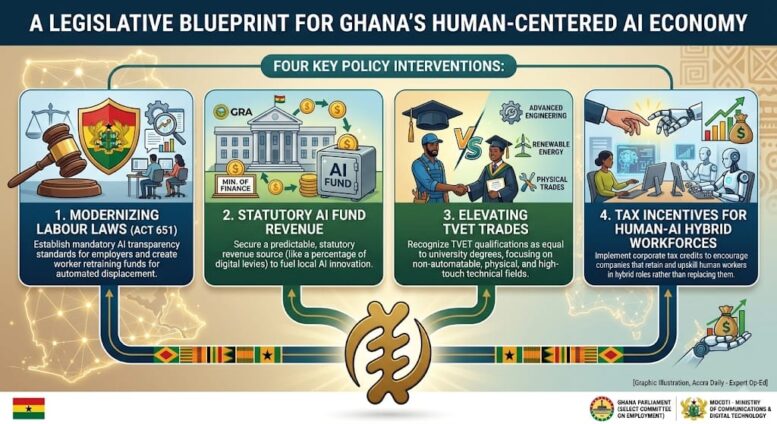
A Four-Point Policy Framework
To align our national strategy with local workforce realities, lawmakers should focus on four structural levers:
1. Modernize Labour Legislation (Act 651)
Parliament must amend the Labour Act (Act 651) to explicitly define "Algorithmic and Technological Displacement." The law should require corporate employers above a certain threshold to maintain transparent reporting on AI integration, provide advance notice of workforce restructuring, and contribute to a co-financed national retraining fund for displaced workers.
2. Provide Statutory Backing for the National AI Fund
The proposed GH¢5 billion National AI Fund must not rely on volatile donor funding or discretionary budgetary allocations. A fixed percentage of existing digital communications levies should be statutorily earmarked to capitalize this fund, guaranteeing predictable local venture capital for Ghanaian AI startups building sovereign, locally hosted solutions.
3. Elevate TVET to True Strategic Parity
The Ministry of Education must rebalance funding away from basic software coding and toward advanced Technical and Vocational Education and Training (TVET). Equipping trade centers with advanced industrial machinery ensures young Ghanaians master non-automatable, physical skill sets—such as industrial electrical engineering, renewable energy grid maintenance, and specialized mechanics—that digital software cannot execute.
4. Incentivize Human-AI Hybrid Retention
The Ministry of Finance should introduce tax credits for enterprises that demonstrate structured human-AI hybrid workflows—retaining junior talent and investing in internal mentorship programs rather than executing immediate workforce cuts to maximize short-term margins.
A Call for Human-Centered Governance
Ghana stands at a critical junction: we can either remain passive consumers of imported automation—eroding our tax base and widening graduate unemployment—or actively structure our regulatory environment to protect human labor and build local technological sovereignty.
The ultimate measure of Ghana's digital transformation will not be found in broad GDP projections alone. It will be measured by whether our policies build a stable, resilient economy where Ghanaian workers are empowered to direct technology, rather than be replaced by it. Our lawmakers must act now to ensure our digital future serves our people—before the entry-level pipeline disappears entirely.
The writer is a technology policy specialist and economic researcher focusing on digital transformation, labor market shifts, and emerging technology governance across sub-Saharan Africa. The writer, Mawuli Dzodzome Agbenorto, is a Public Servant & IT Consultant. He can be reached via: Mdmawuli@gmail.com
Latest Stories
-
‘I made the decision for him’ – Adebayor on Senaya representing Ghana
11 minutes -
Livestream: Ecobank-Joynews financial dialogue series
17 minutes -
AFCON 2027Q: Ghana face ‘difficult’ Ivory Coast clash without Kudus – Adebayor
41 minutes -
Daily Insight for CEOs: Understanding the Competitive Landscape
41 minutes -
IFC partners with Absa Bank Ghana and Complete Farmer to expand agricultural finance in Ghana
56 minutes -
The thing that transforms An Image into Art is The Point of View
1 hour -
Mahama: Ghana’s health reset will prioritise local drug production
1 hour -
Mahama lists maternal and child health as first test of Accra Reset
1 hour -
Beyond the GH¢500b Target: A legislative blueprint to protect Ghana’s workforce (Part 2)
1 hour -
Alan Kyerematen explains why he contested 2024 election under Movement for Change
1 hour -
+233 to host Pat Thomas’ 80th birthday concert
2 hours -
EPA warns climate resilience plans face $22.6bn financing demand
2 hours -
Today’s front pages: Tuesday, September 22, 2026
2 hours -
Alan: ‘NPP has abandoned values of UP tradition, but I believe in those values’
2 hours -
Sustaining economic gains is Mahama’s real test – Alan Kyerematen
2 hours