

Audio By Carbonatix
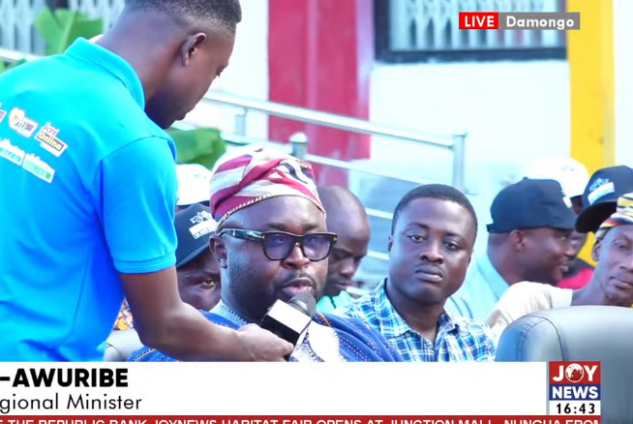
Savannah Regional Minister Salisu Be-Awuribe has called for clear guidelines to distinguish between vote-buying and genuine acts of generosity, saying Ghana must establish what constitutes an electoral offence.
Speaking to JoyNews in Damongo, the Regional Minister, who also chairs the Savannah Regional Security Council, said he had heard allegations of vote-buying but had personally not witnessed the practice.
“I’ve heard it, but I’ve not witnessed it,” he said.
Mr Be-Awuribe, however, acknowledged that Ghana’s electoral laws prohibit acts intended to influence voters.
He referred to provisions under the Representation of the People’s Law, 1992 (PNDCL 284), which prohibit attempts to induce a person to vote, refrain from voting or influence another person’s electoral decision.
“We’ve been doing politics. We do the best of what we think we can. But as to whether or not they are vote-buying is another aspect of it,” he said.
The Minister was responding to concerns about the growing discussion around vote-buying in Ghanaian politics and whether financial or material support provided to voters could amount to electoral inducement.
Mr Be-Awuribe said the difficulty was determining when an act of generosity or support becomes an attempt to influence a person’s electoral decision.
He explained that politicians and community members often engage in exchanges that may not necessarily have an electoral motive.
He cited an example from his experience as a Regional Minister.
“I’ve visited a community, and the community possibly might be interested in getting development, and they want me to be a friend of that community,” he said.
He explained that following such a visit, community members might offer gifts as a gesture of appreciation.
“I come home, they are giving me some tubers of yam, a goat, and some other dishes, as a show of appreciation of the fact that the Regional Minister has come to their community,” he said.
According to him, such a gesture, on its own, may not necessarily amount to an attempt to influence an electoral decision.
“That in itself, they may be having some intent, which might not be explicit to me,” he explained.
“But at any point in time that you make your intent expressed in that, there is a likelihood that, of course, you put yourself in those shoes,” he added.
Need for clearer rules
Mr Be-Awuribe said the behaviour of politicians and prospective candidates could also influence how communities interpret their actions.
He noted that when someone who was previously not known for regularly visiting communities or providing assistance suddenly changes their behaviour, people may interpret the change as an indication that the person intends to contest an election.
“Your behaviour, sometimes the community can read between the lines, that by this new act or behaviour that you have put up, you are likely to stand for some position,” he said.
He said such a person could suddenly become more generous or more involved in the affairs of a community.
“You have now introduced some sense of generosity, which you were not known for,” he said.
“You were not visiting the communities, or you were not visiting them, but now you are regular. You are now interested in actually paying for their medical bills and others.”
Asked whether paying the school fees of a constituent’s child, settling a person’s medical bill or providing other forms of assistance could amount to vote-buying when the beneficiary is a potential voter, Mr Be-Awuribe said Ghana needed clear and practical guidelines on the issue.
“I think that as a country, we have the need for it there,” he said.
He acknowledged that there were instances where people provided financial assistance while pursuing political ambitions, but stressed the need to clearly identify which actions should be considered prohibited.
“We must come up with clear, defined guidelines as to what are or which elements are we considering as prohibitive acts,” he said.
The Minister said the issue could not simply be determined by examining one isolated act.
Instead, he said there should be clear standards to determine whether an action amounts to an attempt to influence an election, with a practical distinction between legitimate community support and conduct intended to induce voters.
Mr Be-Awuribe also stressed that conduct prohibited by electoral law could have legal consequences.
“It doesn’t matter that one thing in a way. If this didn’t happen, that is actually a criminal offence under the PNDCL 284,” he said.
His comments come amid growing discussions about vote-buying and the use of money and other forms of assistance in Ghanaian politics.
For the Savannah Regional Minister, the key issue is not simply whether politicians or individuals give money or other items to people, but whether such acts are intended to influence electoral choices.
Latest Stories
-
GNFS launches 2026/27 National Anti-Bushfire campaign in Atebubu, records 62.8% reduction in bushfire cases
17 minutes -
I’ll vote for a female president; women are less likely to steal from the state – Okyeame Kwame
18 minutes -
More public education needed to stop vote-buying – Savannah Region MP
27 minutes -
Absa Bank commissions new head office, commits to strengthening operations in Ghana
30 minutes -
Republic Bank-JoyNews Habitat Fair clinic: Day 1 ends on positive note as patrons explore housing solutions at Junction Mall
34 minutes -
Vanderpuye: NDC welfare system needed to support former officials, cadres
38 minutes -
Chamber of Mines extends support to Akropong, Mampong Special Schools
41 minutes -
Tumu chiefs, MP back clearance of road corridor for Ghana-Burkina road corridor
46 minutes -
‘Democracy Is Not For Sale’: Monetisation of elections could lead to wrong people entering Parliament – UDS lecturer
57 minutes -
COCOBOD increases cocoa producer price to GH¢42,400 for 2026/27 season
1 hour -
Atebubu College of Education receives GETFund boost after years of infrastructure neglect
1 hour -
64 arrested over alleged unlawful possession of firearms at Achimota lounge
1 hour -
Savannah Regional Minister calls for clear rules to distinguish generosity from vote-buying
1 hour -
TOR secures 950,000 barrels of Sankofa crude from GNPC
1 hour -
NAGRAT calls for probe into alleged inflation of School Feeding enrolment figures
2 hours