

Audio By Carbonatix
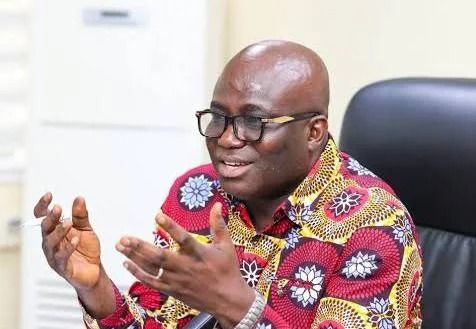
The Minister of Food and Agriculture, Eric Opoku, has dismissed reports of disagreements between his Ministry and the Ministry of Finance, saying both institutions remain committed to advancing the government’s Reset Agenda.
According to him, while misunderstandings and miscommunication may occur between institutions, it should not be interpreted as evidence that one ministry is working against another.
Speaking at a press briefing in Accra, Mr Opoku said the two ministries are working towards the same national development objectives.
“We are working to actualise the same agenda. The Reset Agenda introduced by His Excellency President Mahama,” he said.
The Minister acknowledged that misunderstandings can occur, even within families and smaller groups, but said such situations do not mean the parties are working separately.
“You know even in our families, in our small circles, misunderstandings and miscommunications do occur. That never suggests that we are doing separatists. We are working together to actualise the Reset Agenda,” he said.
Mr Opoku therefore urged the public not to create the impression that some government ministries are working against others.
“Let us not create that erroneous impression that other ministries are working against some ministries,” he added.
Government rules out total rice import ban
On rice imports, Mr Opoku has also ruled out a total ban, saying domestic production currently accounts for about 56 percent of Ghana’s total rice demand.
He said the remaining 44 percent supply gap would have to be met through imports while government works towards achieving rice self-sufficiency by 2028.
The Minister explained that Ghana imports food because domestic production is currently insufficient to meet demand.
“We import food because we are unable to produce. If tomorrow we are able to produce what we eat sufficiently, what is the essence of going to import food again? It doesn't make sense. So we import what we cannot produce,” he said.
Mr Opoku said the government’s approach is therefore to regulate imports rather than impose a complete ban.
“So we must import only the 44 percent. And we need to ensure that importation is regulated. It is not about banning,” he said.
He reiterated that the government’s ultimate objective is to achieve self-sufficiency in rice production by 2028.
Latest Stories
-
PAC Ranking Member accuses Health Ministry of ‘organised crime’ over GH¢10m outstanding car loans
5 minutes -
GAUA strike disrupts student registration at University of Ghana
9 minutes -
Tema is regaining its industrial glory days as Ghana’s industrial city – Mahama
12 minutes -
FBI says more than 130 detained in Ghana over scam operation targeting US victims
20 minutes -
BlaKid reflects on Shatta Wale collaboration and TGMA recognition
30 minutes -
When vulnerability shows up, run – Rev. Daniel Annan cautions women
33 minutes -
FDI rises from $624m to $2.62bn as Tema industrial activity picks up – Mahama
39 minutes -
Artificial stability or sustainable equilibrium? Rethinking the Cedi’s performance
49 minutes -
GIPA CEO calls for investment to support Ghana’s economic transformation
54 minutes -
Banks to suspend lending to public sector workers under Controller and Accountant General’s payroll
1 hour -
GAUA strike leaves some KNUST administrative offices operating below capacity
1 hour -
Three suspected illegal miners arrested in Tano-Boin Forest Reserve
2 hours -
AratheJay brings Nimo Live Experience to Cape Coast on October 11
2 hours -
UBIDS hosts WAC-SRT closing conference as regional partners push for sustainability beyond funding cycle
2 hours -
FIFA Ranking: Ghana drop five places to 70th following AFCON qualifying defeats
2 hours