

Audio By Carbonatix
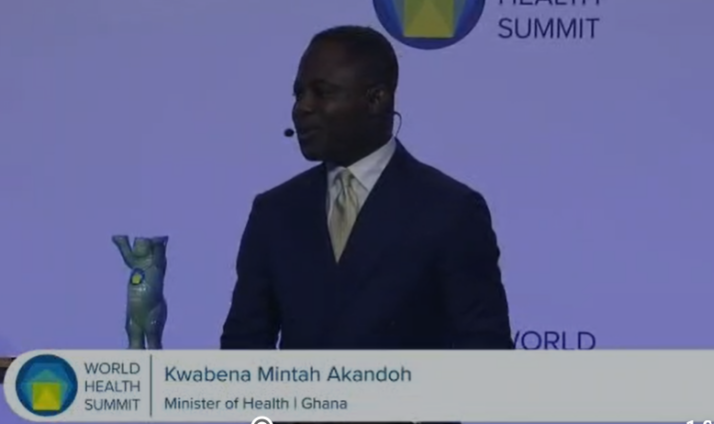
Ghana has renewed its call for a country-led global health system, with Health Minister Kwabena Mintah Akandoh telling the World Health Summit in Berlin that international health policies must be shaped with countries rather than imposed on them.
His remarks come after the government rejected a proposed US$109 million health compact with the United States, citing concerns about provisions involving Ghana’s health data, financing obligations and regulatory authority.
Addressing the summit in Germany, Mr Akandoh said countries must have a central role in determining the future of global health.
“The answer from Ghana is a clear one. Global health must not be designed for countries; it must be designed with countries and led by countries,” he said.
The position reflects the government’s emphasis on health sovereignty, including protecting national decision-making authority and strengthening domestic capacity to finance and manage healthcare.
Ghana rejected the proposed five-year US health compact in April 2026 after reviewing its terms.
President John Dramani Mahama subsequently explained that the agreement raised concerns over requirements relating to Ghana’s pathogen profile and citizens’ medical records. He also cited proposed counterpart funding obligations and provisions he said would restrict the Food and Drugs Authority’s ability to inspect medicines and other medical products supplied under the programme.
The proposed agreement was intended to provide about US$109 million in American health assistance over five years, as Washington sought to restructure aspects of its foreign health support and require recipient countries to assume greater responsibility for financing their health programmes.
The government’s rejection brought into focus the tension between securing external health financing and protecting national control over sensitive data, health regulation and policy decisions.
The issue remains open to further discussion. On October 10, President Mahama disclosed that the United States had approached Ghana to review the rejected compact, with the government prepared to engage on provisions it considers unacceptable.
At the Berlin summit, Mr Akandoh said Ghana’s position was consistent with President Mahama’s earlier address in Accra, which he described as a call to move “from dependency to dignity, from fragmentation to solidarity, from the promises of partnership to shared leadership”.
He cited the government’s free primary healthcare initiative, the Mahama Cares programme, increased investment in immunisation and domestic resource mobilisation as measures intended to translate that vision into action.
The minister did not provide specific funding figures or implementation details for the initiatives in his address.
Mr Akandoh argued that countries must develop the capacity to withstand health emergencies rather than rely primarily on external assistance.
“Resilience is not imported, and it is not donated. It must be built at home,” he said.
The position comes amid wider concerns about African countries’ reliance on external sources for vaccines, medicines, health financing and other critical supplies.
The COVID-19 pandemic exposed weaknesses in global access to medical products and differences in countries’ ability to secure supplies during emergencies.
For Ghana, the debate extends beyond the terms of one bilateral agreement to questions about sustainable health financing, domestic production capacity and the protection of national health information.
Mr Akandoh urged governments and other stakeholders to work together to improve health outcomes while allowing countries a greater role in setting priorities.
“At this point, I want to call up all of you from Accra to Jakarta to Berlin; let us all come together to reset to save more lives,” he said.
The World Health Summit brings together representatives from government, science, the private sector and civil society to discuss global health challenges and policy priorities.
Ghana’s intervention adds to its advocacy for a more equitable global health system in which countries have greater influence over the policies and partnerships shaping their healthcare systems.
At the same summit, President Mahama was honoured for his “outstanding leadership and commitment to advancing global health”. Health Minister Akandoh received the recognition on the President’s behalf.
Latest Stories
-
Reality Zone with Vicky Wireko: International Day of the Girl, shaping today’s girl for tomorrow’s future – ZONTA Clubs lead the way
26 minutes -
Global health must be led by countries, not designed for them – Mintah Akandoh
1 hour -
Mahama honoured at 2026 World Health Summit in Berlin for global health leadership
2 hours -
Breast cancer is not a death sentence – Besease Kontire Obaapanin, Magmina Foundation lead awareness campaign
2 hours -
EcoBank invests in digital education of 4 Garisson School to mark 40 years in Africa
2 hours -
AGI urges investment in skills and raw materials to strengthen local manufacturing
2 hours -
GPL 2026/27: ‘We have to rectify our mistakes’ – Boadu reacts to Aduana FC defeat
2 hours -
No disability access, no building permit – KMA declares
2 hours -
Asantehene to lead environmental restoration effort at Jimi Land Reclamation Site
2 hours -
Poor Ghanaians are being jailed because they cannot afford justice – Crime Check Foundation
2 hours -
No conflict in appointing Emelia Agbenyo as Deputy EC Chair – NDC
2 hours -
87-year-old man jailed 20 years for defiling 9-year-old girl at Ofankor
2 hours -
Sankofa Gold targets 70kg output after 9-month shutdown
2 hours -
Tamale, Bolgatanga had just one Legal Aid lawyer between them – Kwesimintsim MP
2 hours -
PAC orders eviction of former irrigation company MD from official residence
3 hours