


Audio By Carbonatix
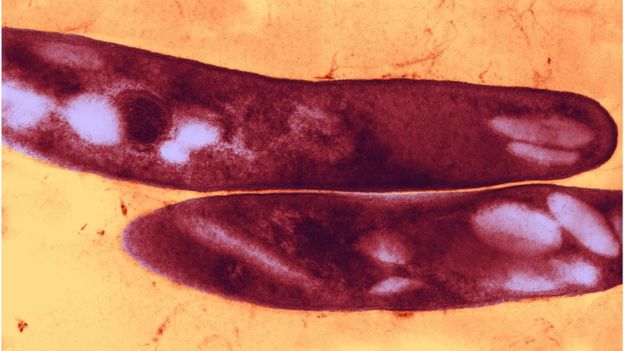
Tuberculosis now ranks alongside HIV as the world's most deadly infectious disease, the World Health Organization (WHO) says.
Each accounted for between 1.1 million and 1.2 million deaths in 2014.
The WHO said the tuberculosis figures were unacceptable for a disease that could be cured.
Medecins Sans Frontieres said the statistics were "disheartening" and warned the world was "losing ground" on tackling resistant forms of TB.
The WHO's Global Tuberculosis Report 2015 shows the huge strides that have been made in tackling TB, with the death rate being nearly halved since 1990.
And the number of infections has been falling by 1.5% a year since 2000.
Deaths from HIV/Aids have also been falling rapidly because of improved access to anti-retroviral drugs.
Dr Mario Raviglione, the WHO's tuberculosis director, told the BBC News website: "Tuberculosis and HIV are now competing to be the number one cause of death from infectious disease in the world.
"Tuberculosis now ranks alongside HIV."
Most new cases of TB are in China, India, Indonesia, Nigeria or Pakistan.
Deaths from HIV/Aids have been falling since the mid-2000s, and stand at 1.2 million a year.
Overall there were 1.5 million tuberculosis deaths in 2014.
But 400,000 of them are officially counted as Aids deaths as they were in HIV positive patients.
The WHO now considers TB and HIV to be effectively joint top killers.
WHO director-general Margaret Chan said there had been "tremendous impact" since 1990, but added that "if the world is to end this epidemic, it needs to scale up services and, critically, invest in research".
Dr Raviglione agreed, saying that if the international investment in TB matched that of HIV, then "we could have accelerated the decline in mortality".
Resistance
The report also highlights the dangers of tuberculosis becoming resistant to antibiotics.
About three in every 100 new cases of TB could not be treated with first choice antibiotics.
Dr Grania Brigden, from Medecins Sans Frontieres, said it was "yet another year of disheartening statistics" that should "serve as a wake-up call".
She added: "We're losing ground in the battle to control drug-resistant forms of TB, and without considerable corrective action, the vast majority of people with multi-drug resistant TB won't ever be diagnosed, put on treatment, or cured."
The World Health Organization will shift to its End TB Strategy next year, which aims to cut deaths by 90% by 2030.
Latest Stories
-
Government reform efforts yet to translate into improved SOEs financial performance – IMF
9 minutes -
Teacher unions demand apology from Muntaka over WASSCE forgery comments
26 minutes -
NSMQ 2026: From 9 points to ADO9 – PRESEC Legon survive thriller to claim 9th trophy
40 minutes -
Photos: Inside the thrilling NSMQ 2026 Grand Finale as PRESEC, AUGUSCO and Accra Academy battle for glory
1 hour -
Achimota, five other SHSs pilot waste segregation, clean-air initiative
1 hour -
More women attempt suicide, but men die by suicide more often – National Suicide Analysis Report
1 hour -
Three Ghanaian students launch e-commerce platform, Panta, to support small businesses
2 hours -
KMA passes by-law requiring Metropolitan Chief Executives to occupy official residence
2 hours -
Zoomlion rolls out disinfection, disinfestation exercise across Volta Region
2 hours -
Photos: Mahama swears in three new Supreme Court justices
2 hours -
$260 e-Visa fee could make Ghana less competitive – GHATOF
2 hours -
New Supreme Court justices pledge fairness, impartiality and fidelity to Constitution
2 hours -
Mahama urges Supreme Court to communicate decisions with ‘extreme clarity’
2 hours -
Techiman MCE residence abandoned since 2017; Regional Minister sets December deadline
2 hours -
Eni, Vitol sign MoUs with Ghana for two offshore blocks in Tano Basin
2 hours