


Audio By Carbonatix
A ban on plastic carrier bags has come into force in Kenya, which means that anyone found selling, manufacturing or carrying them could face fines of up to $38,000 or prison sentences of up to four years.
The government says the ban will help protect the environment.
But manufacturers of the bags have argued that 80,000 jobs could be lost.
A court on Friday rejected a challenge to the ban. Kenyans are estimated to use 24 million bags a month.
A number of other African countries have outlawed plastic carrier bags, including Rwanda, Mauritania and Eritrea.
Piles of waste plastic bags are a common site across Kenya, as in many African countries.
Animals often graze on the rubbish and the United Nations' Environment Programme says huge amounts of polythene bags are pulled out of livestock in Nairobi's abattoirs - as many as 20 bags per cow - raising fears of plastic contamination in beef.
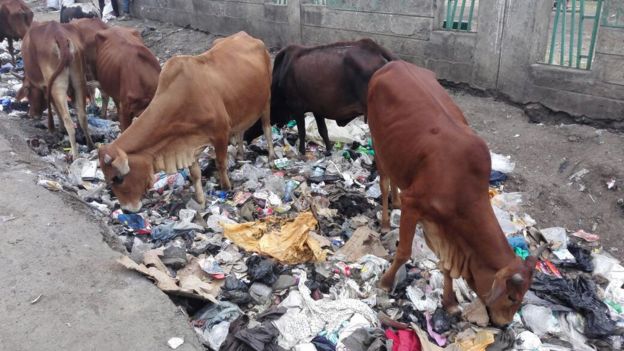
Cows in Kenyan abattoirs are often found with plastic bags in their stomachs
Kenya's Environment Minister Judy Wakhungu says the plastic bags take between 20 and 1,000 years to biodegrade.
"Plastic bags now constitute the biggest challenge to solid waste management in Kenya. This has become our environmental nightmare that we must defeat by all means," she told the BBC.
The BBC's Anne Soy in Nairobi says that supermarkets appear to have adjusted - they are selling fabric bags for 10 Kenyan shillings (10 US cents; 7 British pence).
However, traders in the City meat market are still using plastic bags, she says.
Travellers coming into Kenya with duty-free plastic shop bags will be required to leave them at the airport under the new rules, the National Environmental and Management Authority has said.
This is the third attempt in the past 10 years to ban plastic bags in Kenya.
The government had given a six-month window for adjustment which expired on Sunday night.
Manufacturers who use polythene to wrap products are exempted from the ban.
In its ruling last week, the High Court dismissed a case filed by two plastic bags importers urging it to drop the ban. The court ruled that environmental concerns were more important than commercial interests.
Research in Europe has shown that a paper bag must be used three times to compensate for the larger amount of carbon used in manufacturing and transporting it.
Likewise a plastic "bag for life" must be used four times, and a cotton bag must be used 131 times.
Latest Stories
-
Tate brothers officially indicted with trafficking and sex crimes in Romania
1 minute -
US envoys arrive in Moscow ahead of Ukraine talks
6 minutes -
Health Minister to brief media on Free Primary Healthcare programme on Monday
19 minutes -
‘It was inappropriate to make that comparison’ – Dr Pumpuni Asante on CJ’s SOE comment
32 minutes -
Photos: Final-day shopping continues at Joy FM Back-to-School Discount Fair
1 hour -
Darkey and Frimpong set up J30 Accra boys’ doubles final
1 hour -
When war takes more than territory: The human cost of conflict
1 hour -
Review SHS placement policy to give more BECE candidates access – Kwesi Kwarteng
1 hour -
Tano South Municipal Assembly moves to curb road carnage with speed ramps
1 hour -
Duvor Klu, Gakpo win J30 Accra girls’ doubles title
1 hour -
ITF Juniors Tournament: Duvor Klu claims with straight-sets victory over Gakpo
1 hour -
‘Decision to retire has been tough’ – Isaac Dogboe
2 hours -
Domelevo backs OSP probe into alleged GH¢70,000 payment to Appiagyei
2 hours -
Crowds swell as families make final shopping at Joy FM Back-to-School Fair
2 hours -
‘Apologise if you accept you erred’ – Political analyst tells Chief Justice
3 hours