

Audio By Carbonatix
Covid-19 and its enormous economic repercussions on Africa is putting serious strain on the continent’s Sovereign Wealth Funds (SWF) – which collectively hold some $87 billion in assets under management.
Experts at advisory firm Konfidants - which publishes the African Sovereign Wealth Funds Index – are projecting that COVID-19 could result in African SWFs suffering combined losses of $19 billion in a best-case scenario and about $27 billion in the worst-case scenario.
Soaring COVID-19-related public expenditure and plunging global oil prices is severely crushing the fiscal health of the oil-exporting countries that hold 74% of African Sovereign Wealth Funds’ assets.
This assessment is part of a bigger Konfidants global report spanning over 80 Sovereign Wealth Funds that projects Covid-19 to shrink global SWFs assets by at least $2 trillion in potential combined losses.
Sovereign Wealth Funds are suffering what Konfidants has termed “a triple-drain” on their assets: As SWFs are (a) liquidating assets to shore up government budgets to fight Covid-19, the funds are also simultaneously (b) losing money on investments (as corporate profits and stock markets tank) and (c) losing much of the annual funding allocations they receive in normal times (as a result of the collapse in prices of the commodities that feed many SWFs, and the fiscal crunch starving non-commodity SWFs).
Ghana has already withdrawn $219 million (48% of the Ghana Stabilization Fund) and Nigeria has withdrawn $150 million (43% of Nigeria’s Stabilization Fund), to shore up government budget. And Ghana’s proposal to drawdown the Ghana Heritage Fund is being debated.
Although there are minimal disclosures, aside Ghana and Nigeria, on how other SWFs on the continent are spending to support government budgets, it is almost certain that substantial adverse effects will be revealed over the course of time – because of the “triple-drain” dynamics on their assets.
“We can already tell a lot from how many countries are seeking IMF support. Already, 8 out of the 14 African countries with active SWFs are seeking IMF help – an indication of the extent of their fiscal distress.” Says Michael Kottoh, Managing Partner of Konfidants.
Even when oil prices were relatively higher before the crisis, Angola, Equatorial Guinea, and Gabon had already pursued IMF assistance.
Since the crisis struck, Nigeria, Senegal, Rwanda, Gabon, and Ghana have also sought IMF help. Outside of Africa, some of the world’s wealthiest SWFs are feeling the bite.
In Q1 2020 alone, Sovereign Wealth Funds suffered $1 trillion globally in combined losses. Norway’s SWF – the world’s largest SWF – lost $113 billion in Q1 of 2020 alone.
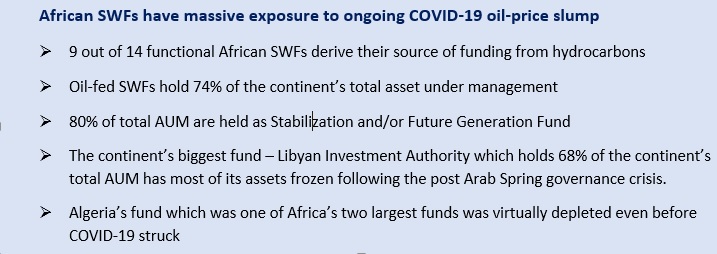
African SWFs have massive exposure to ongoing COVID-19 oil-price slump
Different types of SWFs will be impacted differently
The Konfidants analysis shows that Stabilization Funds will suffer the biggest impact in absolute terms – some risk being depleted to the last dollar if the crisis drags over the course of multiple budget cycles.
Savings/Future Generation Funds could end up losing more money than Stabilization Funds in the short term – because they have bigger exposures than Stabilization Funds to the massive wealth evaporation and volatility going on in the world’s stock markets.
Strategic Investment Funds will likely suffer the least impact – although for a while many will struggle to perform their core task of crowding-in private capital.
Recovery prospects for SWFs
How long will it take funds to recover their asset values? How soon will they be replenished by governments? It is not easy to tell but we project that in a best-case scenario, it will take at least 4 years for SWF assets to recover to pre-crisis valuation levels.
Replenishment of funds will depend on the recovery rate of commodity prices to pre-crisis level, speed of recovery from the recession, and speed of recovery of government finances– all of which depend on recovery from the pandemic.
While we can expect most funds to eventually replenish, nothing is guaranteed. Algeria is a cautionary tale of what could befall Sovereign Wealth Funds in the event of a prolonged fiscal crisis combined with plunging oil prices. Algeria’s fund, which was previously Africa’s largest SWF was virtually depleted even before COVID-19 struck.
While Stabilization Funds are more prone to such depletion, governments ought to ensure that SWFs – especially Future Generation Funds – are secured against depletion even in the worst of times.
For now, we expect most African SWFs to be impacted but not depleted – especially in light of the IMF support that has given governments some fiscal space. However, if the pandemic prolongs over multi-year infection waves with no viable vaccine, many African governments will have no option but to start depleting their SWFs.
It appears that the devastating effects of COVID-19 may well lead countries to dream up new types of Sovereign Wealth Funds as well as substantial modifications to the mandates, business models and architecture of existing funds.
Click here to download a copy of the report on COVID-19’s impact on African SWFs
Click here to read the full Konfidants Global Report on the impact of COVID-19 on SWFs
About Konfidants
Konfidants is an international advisory firm of consultants, scholars, and advisors that specializes in supporting companies, governments, and international organisations to achieve impact. Konfidants publishes the African Sovereign Wealth Funds Index.
Latest Stories
-
JoySports Exclusive: Steve McLaren in talks with GFA after expressing interest in Black Stars job
5 minutes -
Fire guts auto parts warehouse at Bubuashie, one fire officer injured
12 minutes -
I owe my victory to coach Ofori Asare – Allotey after winning WBA Africa Gold Super Flyweight belt
16 minutes -
Church of Pentecost supports over 2,000 BECE candidates in Obuasi with career guidance seminar
2 hours -
Brandon Asante and Coventry all but promoted to Premier League despite Sheffield Wednesday draw
2 hours -
GPL 2025/26: Late Kwartemaa strike downs Hearts in Tema
2 hours -
Ghana Faces Sierra Leone Moment as Prosecutorial Powers come under strain
2 hours -
Don’t consume fish or seafood from Tema Shipyard until further notice – FDA warns
3 hours -
Why volunteering might be Africa’s most underrated career accelerator
3 hours -
ActionAid Ghana raises concern over gender gaps in Feed Ghana Programme
3 hours -
Windstorm wreaks havoc in Gushegu, displacing nearly 2,000 residents and damaging schools
3 hours -
Friends of Bridget Bonnie Marks her 35th birthday with donation to Kasseh Model Health Centre
4 hours -
From Ekumfi Kokodo to the Pulpit Stage: Essi Donkor’s gospel journey takes shape
4 hours -
Landfilling waste management creates no value, it’s an economic waste
4 hours -
Photos: Speaker Bagbin Commissions MPs constituency office under parliamentary decentralisation programme
4 hours