

Audio By Carbonatix
The Governor of the Bank of Ghana has stated that all customers of the nine failed banks and over 95 per cent of customers of Specialised Deposit-taking Institutions (SDIs), which were affected by the banking sector clean-up have received their deposits.
Dr Ernest Addison said the first phase of the banking sector clean-up involved the revocation of licenses of nine banks, for which all depositors were paid in full.
“The second phase has to do with the SDIs – these are the savings and loans, microfinance institutions and finance houses. In their case, for individual depositors who have been fully paid, the data that we have suggests that more than 95% of depositors have been fully paid,” he said.
The Governor continued, “So there are just about 5% depositors who have large amounts, these are the high net worth individuals that were settled with loans which were to be retired over five years. So, we think that most of it has been done.”
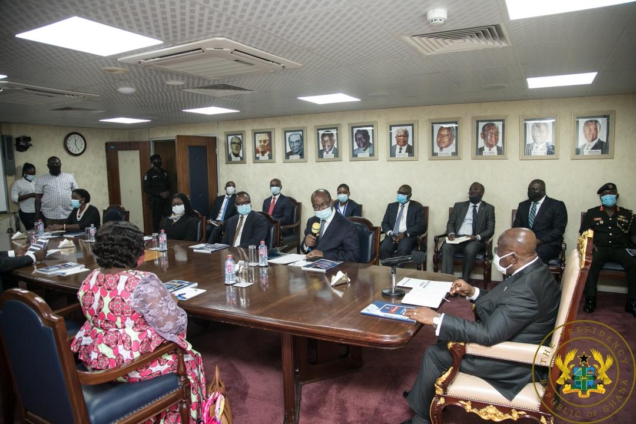
Dr Ernest Addison said this on Tuesday, when the President, Nana Akufo-Addo, visited the Bank of Ghana to familiarise himself with the operations of the Bank.
Touching on deposits of customers of GN Savings and Loans and First Allied Savings and Loans, the Bank of Ghana Governor noted that, over the last three weeks, all customers have been paid.
“The Government has provided a bond worth ¢1.7 billion, for which we have monetized ¢700 million. So, the receiver is also working at clearing the last few customers that are left in that segment. So, I think that we have made a lot of progress, Mr. President, with this depositor issue,” he added.
On helping to ensure the maintenance of a strong banking sector in the country, and to prevent the recurrence of a banking crisis, Dr Ernest Addison told President Akufo-Addo that the first step taken has been to pass the new corporate governance directive.
This, he said, had become necessary because, at the heart of the financial sector crises, was a breakdown in corporate governance in the various banks whose licenses were revoked.
“The second one has to do with misreporting of data, because of a lot of falsification of data by the financial institutions to the Central Bank.
So we have brought in a new technology which will allow us to get the data directly from sources, so that no human interventions will be in there to distort the data that they send,” the Governor indicated.
The third step, he added, “has to do with the capital verification process, because a lot of the banks reported that they had capital when, in fact, they didn't have any capital at all.”
He continued, “So we have reviewed the entire capital verification process of the bank, and it's almost impossible now for us to have a bank that doesn't have any capital, and yet it's allowed to operate, and, of course, in addition to that, for all the staff of the banking solution department we have had a lot of training programmes with the IMF and other technical assistance have been provided.”
To the President Akufo-Addo, the BoG Governor thanked him on behalf of the country’s banking sector for the role he played in sanitising the space, which has brought in its wake more confidence.
“Your clear leadership and understanding of the role of the financial sector in the government’s transformation agenda, gave the leadership of the Bank the confidence and courage to embark on the comprehensive banking sector reforms over the last three years, which saw an increase in the minimum capital requirements, clean-up of the financial sector by the revocation of licenses of weak and insolvent institutions, and a revamp of the regulatory framework to stabilise and strengthen the sector,” he added.
The clean-up of sector, he stressed, has resulted in a stable financial sector with fewer banks and Specialized Deposit-Taking Institutions (SDIs) that are well capitalised, liquid, and solvent, and better able to support our nation’s economic growth agenda.
“These efforts helped to earn the Bank international acclaim as the Central Bank of the Year in 2019.
“By the end of 2019, all the financial sector soundness indicators showed strong improvements as capital adequacy ratio, profitability, and liquidity levels increased significantly while non-performing loans declined,” he added.
Latest Stories
-
Fire guts auto parts warehouse at Bubuashie, one fire officer injured
5 minutes -
I owe my victory to coach Ofori Asare – Allotey after winning WBA Africa Gold Super Flyweight belt
9 minutes -
Church of Pentecost supports over 2,000 BECE candidates in Obuasi with career guidance seminar
2 hours -
Brandon Asante and Coventry all but promoted to Premier League despite Sheffield Wednesday draw
2 hours -
GPL 2025/26: Late Kwartemaa strike downs Hearts in Tema
2 hours -
Ghana Faces Sierra Leone Moment as Prosecutorial Powers come under strain
2 hours -
Don’t consume fish or seafood from Tema Shipyard until further notice – FDA warns
2 hours -
Why volunteering might be Africa’s most underrated career accelerator
3 hours -
ActionAid Ghana raises concern over gender gaps in Feed Ghana Programme
3 hours -
Windstorm wreaks havoc in Gushegu, displacing nearly 2,000 residents and damaging schools
3 hours -
Friends of Bridget Bonnie Marks her 35th birthday with donation to Kasseh Model Health Centre
3 hours -
From Ekumfi Kokodo to the Pulpit Stage: Essi Donkor’s gospel journey takes shape
4 hours -
Landfilling waste management creates no value, it’s an economic waste
4 hours -
Photos: Speaker Bagbin Commissions MPs constituency office under parliamentary decentralisation programme
4 hours -
Black Stars technical advisor Winfried Schäfer sacked as GFA shakes up backroom staff
4 hours