

Audio By Carbonatix
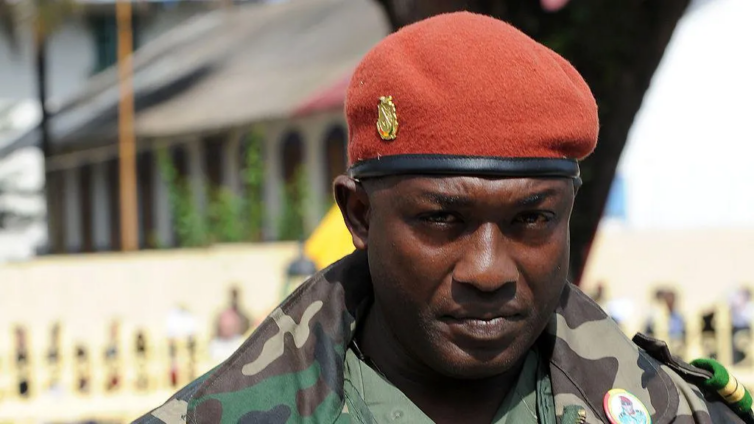
One of the key military figures convicted of crimes against humanity for his involvement in Guinea's 2009 stadium massacre has died in custody, authorities say.
Aboubacar Sidiki Diakité - also known as Toumba - died early on Wednesday in hospital following a medical emergency, the prison administration said.
He was serving a 10-year sentence for his role in one of the darkest episodes in Guinea's history in which more than 150 people were killed in the capital, Conakry, as they demanded an end to military rule. At least 109 women were also raped.
While in custody, Diakité remained a controversial figure, creating a political party and attempting to run for president.
Last year, he declared his intention to stand in the presidential elections, which was rejected by the Supreme Court after it ruled he was ineligible.
At the time of the massacre, Diakité was commander of the presidential guard and a close ally of Guinea's then military ruler, Moussa Dadis Camara.
According to the prison administration, Diakité was declared dead at the Samory Touré Military Hospital in Conakry, where he was taken late on Monday.
Citing his medical report, the administration said he presented symptoms characterised by gastric swelling, abdominal pain and constipation.
His death has prompted mixed reactions in Guinea where memories of the 2009 violence remain politically sensitive, with people still waiting for justice.
One political expert likened his death to "the end of an era", telling the BBC: "He died, but the full truth died with him."
Tens of thousands of people had gathered at a stadium on 28 September 2009 to protest against the possibility of Camara running for president.
On Camara's orders, security forces opened fire on the crowd. More than 150 people were killed and hundreds more injured.
According to judicial findings, at least 109 women and girls were also raped.

Camara survived a shot to the head shortly after the massacre, which was blamed on Diakité, according to the AFP news agency.
Diakité later fled the country and in December 2016, he was arrested in Senegal, where he was living under an assumed identity. A year later, he was extradited to Guinea.
After being shot, Camara spent 12 years in exile before returning to face justice. Following a 22-month trial, he and seven of his commanders were convicted in 2024.
Camara was sentenced to 20 years in prison for crimes against humanity, but pardoned in March last year by the current leader, Mamady Doumbouya - less than a year into his imprisonment - for health reasons.
His killing has underlined the unresolved tensions in Guinea's political landscape, where former military figures have continued to exert influence long after leaving power, and where the boundaries between justice, reconciliation and political ambition remain contested.
Guinea has experienced repeated periods of instability since independence, marked by military coups, contested elections and violent crackdowns on dissent.
Although the country has formally returned to civilian rule, efforts to address past abuses have been slow and, at times, deeply divisive.
In 2010 - shortly after the massacre - Alpha Condé won a presidential election. He was ousted in the country's most recent coup in 2021 by Doumbouya, who went on to win presidential elections last year.
Diakité's death raises fresh questions about the legacy of accountability and about the fate of those held responsible for one of the darkest episodes in Guinea's recent history.
Latest Stories
-
Tiptoe Lane’s tech takeover: The story behind Ghana’s booming informal phone market
1 hour -
Abanga vows to use social media to counter NDC messaging ahead of 2028 elections
1 hour -
Okai Mintah seeks Sabah Zita Benson’s support for NDC National Youth Organiser bid
1 hour -
Okai Mintah vows to strengthen NDC campaign machinery ahead of 2028
2 hours -
Mother of four and Jasikan teacher among new Telecel M’ahitti Promo winners
2 hours -
International Youth Shakers Conclave 2026 set to bring global young leaders to London
2 hours -
Gov’t is committed to addressing teachers’ conditions of service, deprived-area allowance – Education Minister
2 hours -
GoldBod’s structure encouraging galamsey – Afenyo-Markin
2 hours -
Tullow starts selling Jubilee, TEN crude to Ghanaian refineries
2 hours -
Local Government Service authorises rationalisation, redistribution of staff
2 hours -
PURC assures consumers of working to ensure quality services in Northern Region
2 hours -
Ghana develops US$4.28bn water financing framework
2 hours -
Christian Council calls for protection of mission schools’ religious identity
2 hours -
Mahama holds discussions with India’s External Affairs Minister
2 hours -
Even when you cough, they come after you — Abanga accuses Mahama govt of criminalising free speech
2 hours