


Audio By Carbonatix
Madagascar's embattled President Andry Rajoelina has appointed an army general as the new prime minister in a bid to end youth-led protests against his rule.
He said the nation needed a premier "capable of restoring order and the people's trust" before naming Gen Ruphin Fortunat Zafisambo to the post.
Coming days after the president expressed fears of a coup attempt, the general's appointment marks a significant militarisation of the government and appears to be an attempt by Rajoelina to secure the army's backing at a time of heightened tensions.
The protest movement, known as Gen Z Mada, rejected Gen Zafisambo's appointment, and gave Rajoelina 48 hours to resign.
"As long as Rajoelina remains in power we will continue the struggle," Gen Z Mada said in a statement.
The protests began on 25 September, triggered by public anger over repeated water and power cuts and have since morphed into wider dissatisfaction over corruption, high unemployment and the cost-of-living crisis.
Last week, Rajoelina dismissed Prime Minister Christian Ntsay, a civilian, and his entire cabinet in an attempt to placate the protesters.
In a declaration at the presidential palace late on Monday, Rajoelina announced the appointment of Gen Zafisambo, saying the prime minister needed to be "someone clean" and "ready to save Madagascar".
Gen Zafisambo was the director of the military cabinet in the prime minister's office until this appointment.
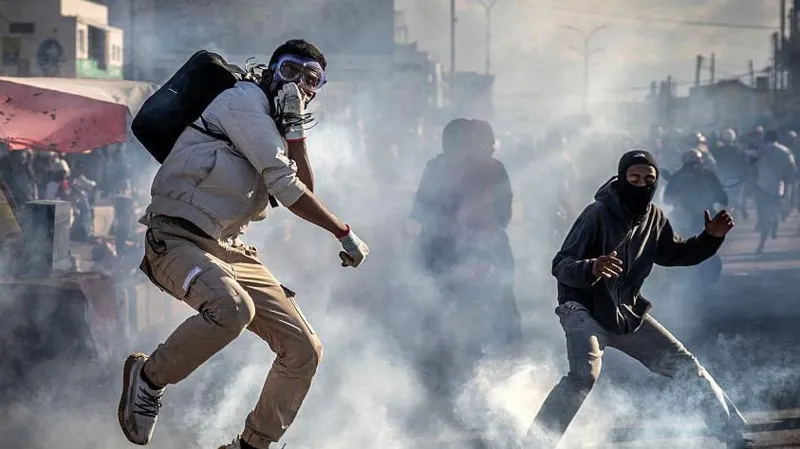
Last week, the UN said that at least 22 people had been killed and more than100 injured in the protests, but the government rejected the figures, describing them as based on "rumours and misinformation".
On Monday, security forces clashed with demonstrators in several cities, as unrest on the Indian Ocean island entered its third week.
Several hundred youths, mostly university students, marched from the outskirts of the capital, Antananarivo, to the city centre.
One young man was wounded and taken to hospital following clashes with the security forces who had erected barricades, AFP news agency reported.
Clashes also took place in the southern city of Toliara and the northern city of Diego Suarez.
Former President Marc Ravalomanana, along with other opposition leaders, has come out in support of the protesters.
He told the BBC that the biggest problem with Rajoelina was that he "doesn't listen".
Ravalomanana added that Gen Zafisambo's appointment "won't make a difference", as he had previously been in the prime minister's office and could not solve the crisis that has hit Madagascar.
He said he was opposed to military intervention and was willing to return to office if the people wanted him to.
Madagascar has been rocked by multiple uprisings since it gained independence in 1960, including mass protests in 2009 that forced Ravalomanana to step down and saw Rajoelina come to power.
Rajoelina governed for four years and then returned to power after the 2018 election. The protests mark the most significant challenge he has faced since his re-election in 2023.
Despite its natural resources, Madagascar is one of the poorest countries in the world, with 75% of people living below the poverty line, according to the World Bank.
Only about one-third of Madagascar's 30 million people have access to electricity, according to the International Monetary Fund (IMF).
Latest Stories
-
The job interview question you don’t have to answer
1 hour -
Trump unveils ‘Super Intelligence Force’ to oversee AI policy
1 hour -
[Video]‘I have asked God to take me when it is time’ – Pete Edochie on health struggles
4 hours -
Manager remanded over $1m auto fraud
4 hours -
Mr President, Ghana was mentioned at the UN; why aren’t we talking about it?
4 hours -
US Marine arrested over murder of woman in Okinawa, Japan
4 hours -
Accra to convene Africa’s regulators and markets on tokenisation at AVAS 2026
4 hours -
Indian police accused of sexually harassing journalists at protest
5 hours -
Jeffrey Archer returns to his former school library
5 hours -
France to close up to 500 schools on Monday over student protests
5 hours -
The Paradox of Plenty — When every smartphone becomes a newsroom
5 hours -
Australia investigating Flydubai co-pilot’s links to country
5 hours -
GTA sensitises taxi drivers in ‘Know Ghana’ tourism campaign
6 hours -
Archbishop Agyinasare calls for responsible speech amid growing social media abuse
6 hours -
‘It will be inexcusable for gov’t not to honour payment of teachers’ arrears by 30th October’ – Haruna Iddrisu
6 hours