

Audio By Carbonatix
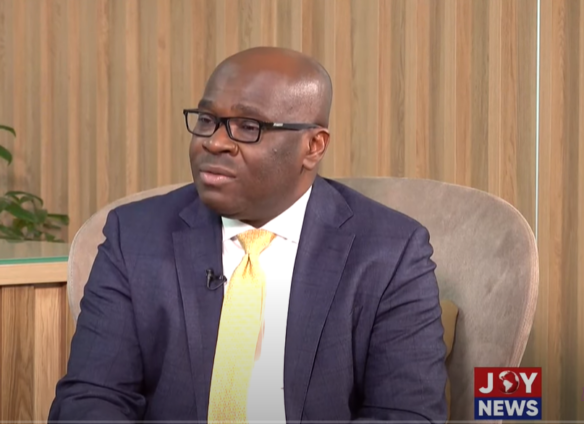
The Ghana Association of Banks president, Kwamina Asomaning, has stressed the urgent need for banks to reinforce ethical standards in the industry.
Speaking on Joy News’ PM Express Business Edition on Thursday, March 20, the Managing Director of Stanbic Bank Ghana passionately called for continuous ethics training and sensitisation, warning that the temptations within the banking sector are too numerous for complacency.
“What we sell as banks is trust, and it's embarrassing, and it's a big shame when we breach the trust of our customers, our employers, and our shareholders to put our hands in the cookie jar effectively,” Mr Asomaning stated.
He stressed that ethical lapses not only damage individual institutions but also erode public confidence in the entire financial sector.
He acknowledged that the environment within which banks operate exposes employees to significant moral tests.
“You know there’s a biblical saying that the love of money is the root of all evil, and we’re right in the midst of money. So you can imagine that it brings out the very worst in people.
"And unfortunately, we’re finding that some of our colleagues are unable to control themselves when they see these vast sums,” he lamented.
To address this, Kwamina Asomaning called for a heightened industry-wide focus on ethics training.
He revealed that collaborative efforts with the National Banking College and the Chartered Institute of Bankers are already in motion to instil greater ethical discipline among banking professionals.
“In fact, I engaged with the Chartered Institute of Bankers a few days ago, and they have a module that they’re offering free of charge to banks to provide ethics training to all staff. And it should be made mandatory,” he said firmly.
While many banks already have internal ethics programs, Mr Asomaning believes more must be done.
“Ethics is an area where you cannot have too much of because the temptations you face daily, the pressures you’re facing from customers and other parties—some people, from family members—is excessive. And so being reminded of the need to constantly maintain that high line is extremely important.”
His remarks come at a time when concerns over financial misconduct and ethical breaches in Ghana’s banking sector have become more pronounced.
Kwamina Asomaning urged banks to remain vigilant and proactive, reinforcing ethical culture through training, leadership accountability, and a firm commitment to integrity.
As the banking industry continues to recover from recent economic shocks, his message serves as a stark reminder that financial stability is not only about strong balance sheets but also about maintaining public trust through unwavering ethical standards.
Latest Stories
-
GAEC must retain nuclear scientists for Ghana’s nuclear ambitions – Minister
19 minutes -
Man reportedly mistaken for game and shot by hunter dead in forest
21 minutes -
19-year-old mason jailed 15 years for defiling seven-year-old pupil
26 minutes -
Ghana’s banking sector assets rise 20.47% to GH¢500.2bn – BoG Governor
30 minutes -
22 injured as Sprinter bus overturns at Sege after tyre burst
31 minutes -
UN housing expert urges Ghana to strengthen Rent Control Department amid housing affordability concerns
40 minutes -
Delta-BCI partnership reaches 166,000 people with breast cancer education
49 minutes -
Power restoration fault suspected in Kumasi Central Market fire
6 hours -
The 7-foot giant of Ngleshie Amanfro: Seven-foot Ghanaian Ephraim Saawa dreams of joining the national basketball team
7 hours -
Government promises support for Kumasi Central Market fire victims
7 hours -
Vibes The Movie: Big Ghun’s Ghanaian film earns five nominations at 2026 REFFA
7 hours -
‘I’m a fulfilled man’—Justice Korbieh on missing out on Supreme Court despite two nominations
7 hours -
MamaCare CEO warns unresolved conflicts among health workers could undermine maternal and neonatal care
8 hours -
Health professionals urged to translate medical knowledge into practice to save mothers
8 hours -
Retired judge Justice Francis Korbieh charges 1,568 new lawyers to uphold integrity
9 hours