

Audio By Carbonatix
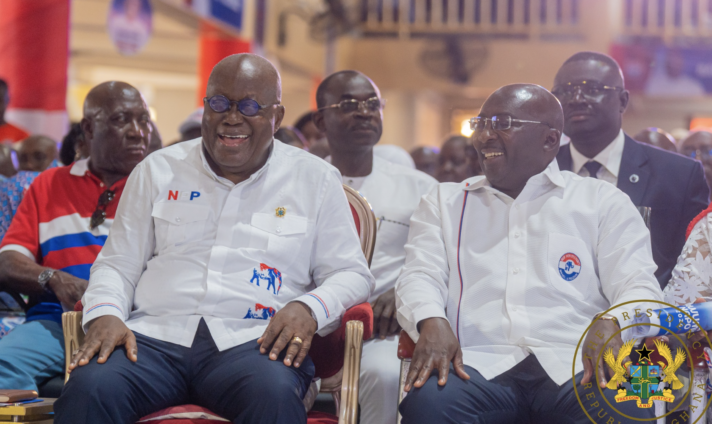
President Nana Addo Dankwa Akufo-Addo has called on Ghanaians to overwhelmingly support Dr. Mahamudu Bawumia, the Vice President and presidential candidate for the ruling New Patriotic Party (NPP), in the upcoming December 7 General Election.
He said that Dr. Bawumia possessed the expertise and vision necessary to lead the nation towards sustainable development and progress.
“I have one more request from you as far as my successor is concerned. When I take a look at all those contesting to be president, I firmly believe that the only one among them who can bring continuity and progress is Dr Bawumia,” the President noted in a Facebook post.
Dr. Bawumia is the fourth individual to be elected as the flagbearer of the New Patriotic Party (NPP), a centre-right, liberal-conservative political party, since its formation under the Fourth Republican Constitution.
The NPP has been one of Ghana’s two dominant political parties, alongside its main rival, the centre-left National Democratic Congress (NDC).
This year’s presidential and parliamentary elections hold significant importance, with the NPP aiming to retain power amidst ongoing economic challenges.
Polls leading up to the 2024 elections indicate a highly competitive presidential race, as former President John Dramani Mahama, the NDC’s flagbearer, seeks to make a return to office.
Vice President Dr. Bawumia is campaigning under the slogan “It is possible,” with a commitment to lead the New Patriotic Party (NPP) in achieving its goal of “Breaking the Eight.”
This ambition reflects the Party’s determination to break the historical pattern where no Ghanaian political party has remained in power for more than eight years over the past three decades.
Dr. Bawumia has promised to guide the nation towards a more inclusive future, harnessing the talents and resources of all citizens, irrespective of their political or religious affiliations.
The NPP’s manifesto underscores its focus on human capital development, building strong systems, embracing the Fourth Industrial Revolution, and diversifying the economy, should the Party secure another term in office.
The NPP’s flagbearer has promised some one million jobs for the youth in the Information, Communication and Technology (ICT) sector alone, driven by his ambitious digitalisation agenda.
“On December 07, when you go out to vote, just look at the first person on the ballot paper – Dr Mahamudu Bawumia – and vote for him,” President Nana Akufo-Addo rallied the electorate.
The Facebook post acknowledged the Vice President’s leadership qualities and competency, noting that: “Dr Bawumia has what it takes to take the country forward, and I urge you all to vote massively for him.”
On the economy, the Government says the stronger Gross Domestic Product (GDP) growth performance in the 2017-2022 period was underpinned by the agricultural GDP growth, which increased from an average of 2.9 per cent between 2013-2016 to an average of six per cent (double) between 2017 and 2022.
According to the authorities, rice imports for example, have declined by 45 per cent (from 805,000 metric tonnes to 440,000 metric tonnes) between 2021 and 2023, and the goal is to ensure Ghana becomes a net exporter of rice by 2028.
Despite the global economic challenges, including the impacts of the COVID-19 pandemic and the Russia-Ukraine war, the Akufo-Addo administration takes credit for sustaining industrial growth at a level stronger than the 2013-2016 period.
Industrial growth, which averaged 3.3 per cent between 2013 and 2016, increased to 7.5 per cent between 2017 and 2020.
However, it saw a slight decline, averaging 5 per cent between 2017 and 2022 due to the ongoing global economic disruptions.
Ghana has consistently recorded a trade surplus, averaging US$1.9 billion from 2017 to 2022, which represents a stronger performance compared to the 2013-2016 period, despite the global challenges.
Additionally, the country’s gross international reserves increased significantly, rising from an average of US$5.8 billion in the 2013-2016 period to US$7.9 billion between 2017 and 2022.
Regarding the performance of the Ghana Cedi, despite a notable 30 per cent depreciation in 2022, the average depreciation of the local currency from 2017 to 2022 was 10.75 per cent.
“So again, notwithstanding the domestic and global economic crisis, the depreciation of the cedi under our government is lower than what we inherited from the 2013-2016 period,” Dr Bawumia stated in a recent meeting with some professionals in Accra, during his campaign tour.
Latest Stories
-
New York Times executive fatally shot allegedly by elderly in-laws
23 minutes -
Teacher Payment Crisis: GES races to protect academic calendar
32 minutes -
US prosecutors reopen case of alleged gang rape at Cornell University
49 minutes -
Journalist to be crowned king in Uganda after bitter succession dispute
59 minutes -
OpenAI scraps rollout of new model over safety concerns
1 hour -
Nigerian attempts to break world record by dancing non-stop for seven days
1 hour -
GES urges government agencies to end blame game over teacher payments
3 hours -
GES sets Oct. 5 deadline to resolve teachers’ payment dispute
3 hours -
GES working around the clock to get teachers back to class, says Daniel Fenyi
4 hours -
French PM warns against escalation of school protests after 164 arrested
4 hours -
UK tries to stop Trump’s diesel export ban
4 hours -
Late Olise goal gives France win over Belgium
4 hours -
Mancini enjoys first win since return as Italy boss
5 hours -
Interest payments to average a high 20% of government revenue over next 4 years
5 hours -
Anthropic warns AI may pose ‘existential risks to humanity’ in IPO filing
5 hours