

Audio By Carbonatix
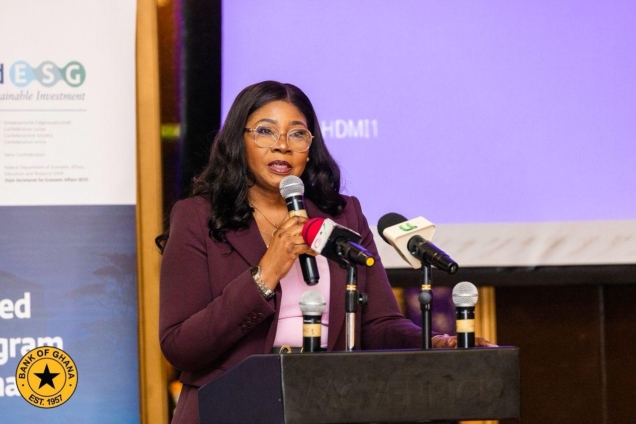
The Second Deputy Governor of the Bank of Ghana (BoG), Matilda Asante-Asiedu, has urged financial institutions to balance profit-making with sustainable investment practices, particularly in the country’s extractive sector.
Speaking at a forum on sustainable banking practices, she underscored the importance of looking beyond short-term financial gains and considering the long-term socio-economic and environmental impacts of financing decisions.
“I was just doing the math. Between mining and oil and gas, in the first half of this year, their contribution to GDP amounts to 20 percent,” she noted. “That’s significant. It’s the backbone of the economy.”
While acknowledging the crucial role these sectors play in driving Ghana’s economic growth, Mrs. Asante-Asiedu also highlighted the inherent risks they pose. She urged financial institutions to shift their mindset away from solely maximizing shareholder value.
“But it also comes with its own issues and risks. As people in the financial services sector, our objective is profit-making. Especially in a commercial environment like I used to be in, where it’s often about making shareholders happy,” she said.
She challenged players in the financial space to adopt a forward-thinking approach, stressing the need to integrate environmental, social, and governance (ESG) considerations into their lending practices.
Her remarks come at a time when Ghana is intensifying its push for green finance and sustainable banking. The Bank of Ghana recently reported a 73.6 percent compliance rate with sustainable banking standards as of the first quarter of 2025, signaling growing commitment to environmentally responsible financing.
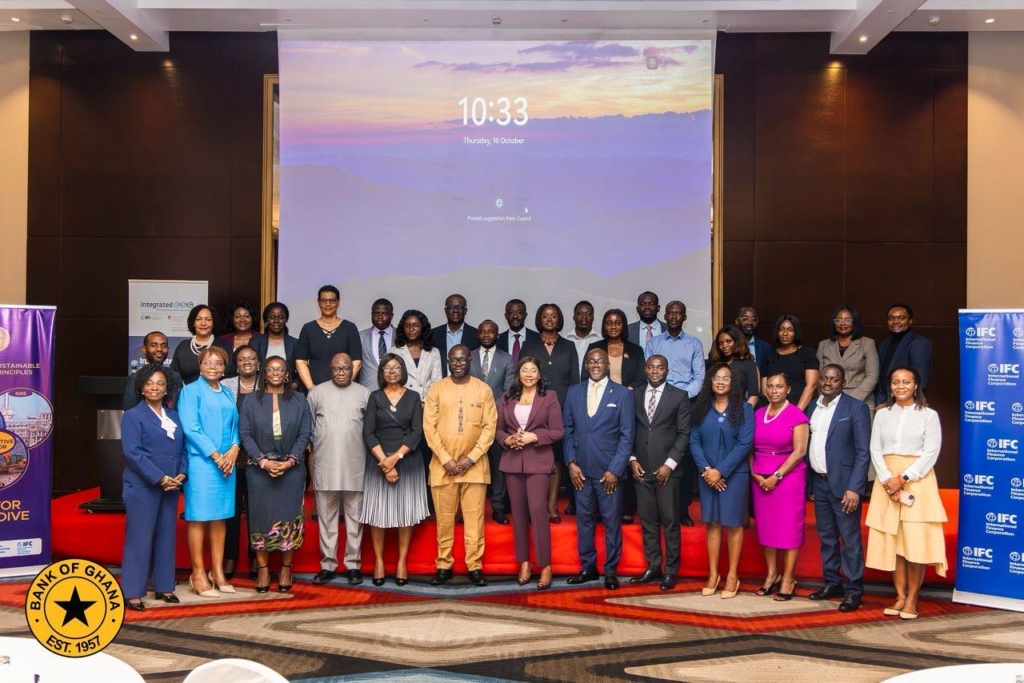
The forum brought together key stakeholders from the banking, extractive, and development sectors to deliberate on strengthening sustainability frameworks within the financial industry.
John Awuah, CEO of the Ghana Association of Banks, called for reforms to de-risk sustainable projects in the extractive and energy sectors, which are often deemed high-risk and capital-intensive. He proposed the introduction of political risk insurance products and other incentives to reduce exposure.
“Access to sustainable finance is often constrained by high perceived risks and limited long-term funding. This is where de-risking mechanisms become indispensable. We must actively explore and scale up tools such as partial credit guarantee schemes,” he noted.
Meanwhile, Yiwande Giwa, Senior Country Manager for the International Finance Corporation (IFC), expressed optimism that continued engagement would be crucial in building an environmentally sustainable financial ecosystem.
The forum was jointly organized by the Bank of Ghana and the International Finance Corporation (IFC).
Latest Stories
-
Nearly 400 sentenced in Nigeria for links to militant Islamists
2 minutes -
Ghana’s recovery supported by gold strength despite global oil price pressures – Standard Bank Research
8 minutes -
Kwaku Azar writes: A-G vs OSP
41 minutes -
Mfantsipim–Adisadel rivalry built excellence, not division – Sam Jonah
1 hour -
Vice President launches Mfantsipim’s 150 years of shaping Ghana’s greatest mind
1 hour -
I assure Otumfuo, Mahama will join him to commission KNUST Teaching Hospital by end of this year – Haruna Iddrisu
2 hours -
Barcelona dominate derby to extend La Liga lead
2 hours -
Gov’t to roll out free special education for persons with disabilities from July 1 – Education Minister
2 hours -
Importers and Exporters Association declares full support for Publican AI port system
3 hours -
“We used it to test our officiating officials’ readiness” – Bawah Fuseini after CAA Athletics event
3 hours -
Volleyball emerges as Ghana’s fastest rising sport
3 hours -
National Sports Fund needs strong leadership from the top – Administrator David Wuaku
3 hours -
JoySports Exclusive: Steve McLaren in talks with GFA after expressing interest in Black Stars job
3 hours -
Fire guts auto parts warehouse at Bubuashie, one fire officer injured
4 hours -
I owe my victory to coach Ofori Asare – Allotey after winning WBA Africa Gold Super Flyweight belt
4 hours