

Audio By Carbonatix
In Canada’s oil-rich province of Alberta, there is a deep sense of unease over President-elect Donald Trump's threat to impose a 25% tariff on Canadian goods.
Canadian politicians and energy experts are warning the hefty tariff would have dire consequences for the economy of America's northern neighbour - and hike prices on US consumers.
"Canada has no choice in this," Dennis McConaghy, an Alberta-based former energy executive, told the BBC.
"It has to find an accommodation with Trump."
Trump announced on Monday that, upon taking office in January, he would slap an across-the-board tariff on Mexico and Canada - with no suggestion that would exclude oil and gas.
Lisa Baiton, president and CEO of the Calgary-based Canadian Association of Petroleum Producers, said the levy would likely mean Canada producing less oil.
Mr McConaghy said that would lead to job losses in Alberta, with potential repercussions for Canada as a whole, as poorer provinces rely on cash transfers from revenues generated by wealthier provinces - like Alberta - to help offset costs and provide social services.
It could also lead to a devaluation of the Canadian dollar at a time when the currency is already struggling due to domestic economic factors, he said.
“Keep in mind, roughly 80% of Canada’s trade is with the United States, and a majority of that trade is in hydrocarbons. Canadians can’t escape how integrated they are with the US.”
US fuel makers have also urged Trump to rule out oil and gas from any proposed levies given that Americans rely heavily on imported Canadian crude.
“Crude oil is to refineries what flour is to bakeries,” said the American Fuel and Petrochemical Manufacturers (AFPM) industry group in a statement this week.
“It’s our number one feedstock and input cost. If those feedstocks were to become significantly more expensive, so too would the overall cost of making fuel here in the United States.”
The US is the world’s largest producer of crude oil and natural gas, but some regions - California, the northeast and parts of the Midwest - do not have the infrastructure or pipeline capacity to rely solely on US oil and need imports to supply fuel to consumers.
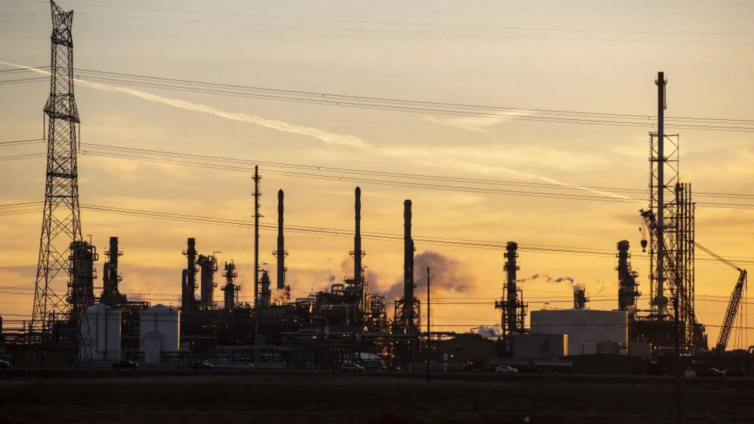
Around 40% of the crude that runs through US oil refineries is imported, and the vast majority of it comes from Canada.
Canadian oil is especially relied on in the landlocked Midwest, where refineries have been outfitted to process the heavier Canadian blends.
The AFPM said there is no easy replacement for that crude without relying on overseas sources that could erode US energy security.
The industry group warned that a tariff on Canadian oil would drive up operating costs in the Midwest - costs some experts say will be downloaded onto consumers.
Patrick De Haan, a Chicago-based gas prices analyst, estimated that states like Minnesota, Wisconsin and Michigan could see gas prices rising by up to 75 cents a gallon.
Mr De Haan noted in a post on X, formerly Twitter, that these higher prices would not only be felt at the pump, but could potentially increase costs for airlines and freight haulers as well.
An increase in oil prices for US consumers would run counter to Trump's promise to slash energy costs.
On the campaign trail, Trump frequently said he planned to cut the price of gasoline to under $2 (£1.57) a gallon. As of late November, the price of regular gasoline in the US sat around $3 a gallon.
But Trump has also vowed to increase American energy independence by boosting domestic drilling and being less reliant on foreign oil and gas, particularly from countries not allied with the US.
It remains unclear whether the tariffs will ultimately materialise, analysts have noted, as Trump has been known to use such threats in the past as a negotiation tactic to achieve certain goals.
In this case, Trump could be using the tariffs to get Canada and Mexico to cooperate on border security.
Trump has signalled that the levies would remain in place until both Canada and Mexico work on securing their shared borders with the US, limiting the number of unlawful migrants and drugs flowing into the country.

Prime Minister Justin Trudeau is promising to present a united “Team Canada” front and to work together with the incoming Trump administration to avoid the blanket tariffs.
The leaders of major Canadian provinces like Ontario, Quebec and Alberta have urged Trudeau to act quickly on these demands, and on Wednesday, Trudeau held an emergency meeting with provincial and territorial leaders to discuss how to move forward.
Danielle Smith, premier of Alberta, said her province will be “working aggressively” in the coming months to connect with US counterparts and to drill home the message that a strong partnership with Canada would be of benefit to the US and its energy security.
She said that in her view, Trump “and the tens of millions of Americans who voted for him have valid concerns” related border security.
She and other premiers, Smith said, have asked Trudeau to come up with a comprehensive border security plan.
Smith also said the province is exploring the option of creating specialised sheriff units to patrol its own shared border with the US state of Montana.
No matter the approach, Mr McConaghy said he hopes there is an urgency among Canadian officials to get the risk of tariffs “off the table as soon as possible”.
Latest Stories
-
Mental Health Alliance urges government to operationalise Mental Health Fund
13 minutes -
Ghana–Holy See agreement heads to Parliament after Cabinet approval
18 minutes -
Luv FM Corporate Games 2026: Kumasi Central Prisons, Amanfiman Bank win big amid fun
29 minutes -
WAFU B U17: Ghana top Group A after win over Togo
58 minutes -
Ho Central Mosque reopens amid unresolved leadership dispute that led to closure
2 hours -
Minority caucus questions GH¢16.4m in Ablakwa’s SA evacuation spending, demands independent audit
2 hours -
Gender Ministry meets Nana Akua Addo’s husband over domestic violence after hospital discharge
3 hours -
UG Vice-Chancellor urges swift operationalisation of National Research Fund
4 hours -
Pope Leo to have surgery after lump found in lung
4 hours -
Joseph Cudjoe writes: Ghana must break free from the dangerous mindset that natural resources are the foundation for wealth
4 hours -
Children among 109 dead after boat capsizes off Djibouti, UN says
4 hours -
OmniBSIC Bank’s 11th health walk promotes fitness and business growth
4 hours -
2026 World Maritime Day: Danish Embassy organises “The Gulf of Guinea Speaks”
5 hours -
New Economy will tackle unemployment and restore hope – Ato Forson
5 hours -
IMMILAC president recounts personal losses as security women lead breast cancer awareness campaign in Wa
5 hours