

Audio By Carbonatix
A Catholic Priest in Damongo in the Savannah Region is producing liquid fertilizer from eggs.
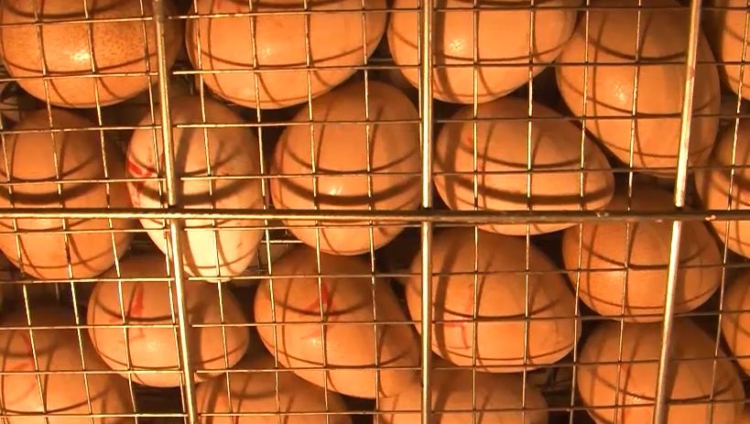
Dr Father Clément Aapengnuo got the idea when they had a problem with locally made incubator belonging to brother and over four hundred eggs spoilt.
The locally made incubator has its own challenges, “Power goes off and some the eggs fail to hatch and get spoilt”.
“So I was sitting with about 200 spoilt eggs and didn’t know what to do.”
The Catholic Priest with Damongo Archdiocese went to meet one Martin Yelibora who said he could turn the eggs into liquid fertilizer.
“I was like what?” he exclaims. Dr Fr. Aapengnuo did not believe what Yelibora told him but only had to give time a chance.
Mr Yelibora who is Climate-smart farming innovator and based in Damongo converted the eggs into liquid fertilizer in about three weeks.
That innovation got the Catholic priest enthusiastic and enthused him to start producing the fertiliser for his farm.
Crushed eggs are kept for 21 days to allow for fermentation before being applied on his farm.
He mixes the eggs with household waste, including vegetables as well as neem and moringa leaves.
Dr Fr. Aapengnuo says, “The neem leaves are good for nematodes control”.
In his first application on the farm, Dr Fr. Aapengnuo says his plants became greener and that became a test case for him.
Dr Fr. Aapengnuo says the process is cost-effective and the product gives good results on the farm.
Eggs contain high levels of calcium, which is an important nutrient for plants, especially, vegetables and fruits.
The liquid fertilizer leaches the calcium into the soil for root uptake during composting.
Since discovering this method of fertilizer formulation, Dr Fr Aapengnuo no longer buys fertilizer on the market.
Dr Fr. Aapengnuo is encouraging poultry farmers to take cue from him and convert their spoilt or unsold eggs into fertilizer for use and sale.
So with this method, there is no need to be worried about low demand and price for eggs.
This is because there is another chance of turning it into liquid fertilizer for sale or for domestic use.
So eat your eggs, save the spoiled ones and fix your soil for bigger, better crops.
Latest Stories
-
Gov’t to develop policy for Ghanaian Sign Language in education
7 minutes -
Accra Academy defend ODADEƐ ’90 5-a-side title
16 minutes -
Ghana risks EU gas market access over methane emissions – Expert warns
38 minutes -
Salt Pond’s $200m warning: Why Ghana cannot afford to exclude Fisheries Commission from future decommissioning
40 minutes -
Venezuela frees 39 political prisoners after post-Maduro talks
1 hour -
EU unlocks humanitarian aid for crises worldwide
1 hour -
Tenth woman’s body found as South Africa police probe killings
1 hour -
Black woman found hanging from tree was dead before body was ‘staged’, police say
2 hours -
Final day: 3rd Republic Bank-JoyNews Habitat Fair clinic underway at Junction Mall, Nungua
2 hours -
Nor’easter brings flooding as New York and New Jersey declare emergency
2 hours -
Africa’s richest man helps fund $660m fuel pipeline between Ethiopia and Djibouti
2 hours -
Security lapses at Utah campus where Charlie Kirk was killed, review says
2 hours -
White House bars CNN from travelling with Trump on Air Force One
2 hours -
Pope praises young people’s ‘energy and commitment’ at huge open-air Mass in Paris
3 hours -
Nyankamam residents benefit from free medical screening, healthcare outreach
3 hours