

Audio By Carbonatix
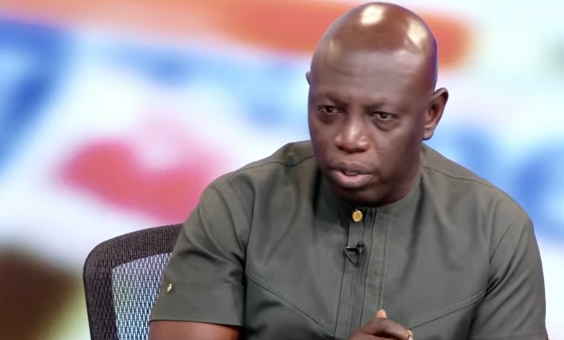
The Dean of the Faculty of Accounting and Finance at the University of Professional Studies, Accra (UPSA), Professor Isaac Boadi, has questioned the appropriateness of Chief Justice Paul Baffoe-Bonnie’s recent praise of the performance of public institutions under the current administration.
Prof Boadi said the Chief Justice occupies a critical position in Ghana’s constitutional democracy and, as a result, must be seen as an ultimate symbol of neutrality and impartiality.
His comments follow remarks by the Chief Justice during a visit to the Minerals Income Investment Fund (MIIF) on Wednesday, September 2, where he commended the performance of MIIF and other public institutions.
The Chief Justice reportedly said some of the developments he had witnessed during his engagements with public institutions had left him wondering what Ghana had been doing over the previous eight years.
However, speaking on the JoyNews AM Show on Friday, September 4, Prof Boadi said he was concerned about the nature of the comments, particularly given the constitutional position occupied by the Chief Justice.
He stressed that the Chief Justice plays a particularly important role in a constitutional democracy because of the need for the judiciary to maintain public confidence in its neutrality.
“I think that in a constitutional democracy, the role of the CJ is very important. Because he is the ultimate embodiment of neutrality, that's what I think,” he said.
Prof Boadi argued that the Chief Justice’s praise of the institutions he visited could create the perception that he was endorsing government performance rather than maintaining the detached position expected of the head of the judiciary.
“But when it happens this way, per what I saw or read, it is becoming more of a cheerleader of government statistics,” he said.
He described the Chief Justice’s remarks as those of a “cheerleader”, particularly because of the positive appraisal given to the performance of the institutions visited.
Calls for a More Balanced Assessment
Prof Boadi said his concern was not necessarily that the Chief Justice had acknowledged improvements at some public institutions, but that his assessment appeared to focus heavily on institutions that had recorded positive outcomes.
He noted that recent reports from various state institutions showed that the performance of public entities was mixed, with some performing well while others continued to struggle.
“Majority of these institutions, if you even allow the aggregate figure to lie and go to other state institutions, some of them have not performed well.”
According to Prof Boadi, a more balanced approach would have involved the Chief Justice engaging institutions that were also recording losses or facing operational difficulties.
He argued that such engagements would have provided a broader picture of the performance of state institutions and avoided the perception that the judiciary was endorsing the government’s economic narrative.
“My point is that he could have probably gone to those institutions,” Prof Boadi said.
He further acknowledged that the Chief Justice may have been speaking facts based on what he observed during his visit. However, he suggested that the timing and setting of the remarks could have been better considered.
“He spoke the fact at the wrong place,” Prof Boadi said. “For me, he could have probably balanced the two. He could have gone to those institutions that also make losses and give a fair comment on that.”
While public officials and institutions are often expected to acknowledge positive developments in the country, the head of the judiciary occupies a particularly sensitive position because the judiciary is constitutionally expected to operate independently of the executive and other arms of government.
For Prof Boadi, maintaining that perception of neutrality is essential to public confidence in the judicial system.
Latest Stories
-
Call to Glory
3 minutes -
AFCON 2027: Sports Minister ‘convinced’ Black Stars will qualify despite losing opening two games
4 minutes -
CUTS welcomes VAT collection on cross-border digital services, urges fair treatment of Distance Learning students on overseas programmes
8 minutes -
Leave the Chiefs and fix the Galamsey Problem: Dr Solomon Owusu Advises President Mahama
11 minutes -
Pay attention to teachers and give them what is due – Ho District GNAT tells government
15 minutes -
Authorities knew of abuse allegations against Obuasi headmaster months before suspension – JoyNews investigation
20 minutes -
US teenager appears in court over alleged Hindu temple shooting plot
22 minutes -
Academic City donates paediatric rehabilitation staircase to Ga East Hospital
26 minutes -
Services drive 7.4% expansion in Ghana’s economic activity
37 minutes -
‘I don’t make music for awards, I make it to connect people’ – Rocky Dawuni
49 minutes -
Farmer jailed for three months over assault on wife in viral video
55 minutes -
Police arrest eight in Okaishie operation targeting illicit drugs and medicines
58 minutes -
David Agyemang Yeboah: Marriage is not the problem; your approach is
1 hour -
Lawyer sues Standards Authority over used-vehicle import restrictions
1 hour -
Ukraine to restart strikes on Russian oil refineries, Zelensky says
1 hour