

Audio By Carbonatix
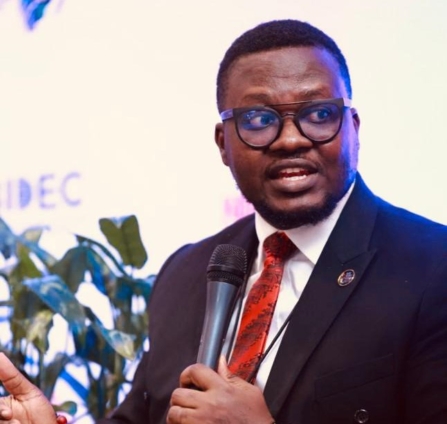
As Ghana gears up for its next presidential election, Chartered Financial Economist and lecturer at AAMUSTED, Dr. Evans Duah has issued a compelling call to action for Ghanaians to deeply reflect on the future of the country and core values as a people in selecting the next leader.
Dr. Duah said that the time has come for citizens to engage in in-depth discussions about the qualities and capabilities required in the next President, emphasising the need for a true "Change Agent."
In a candid statement, Dr. Duah urged Ghanaians to move beyond the role of spectators and become active participants in shaping the destiny of the nation.
He articulated the necessity of identifying the specific positive changes the nation needs and then choosing a leader who embodies the capacity to initiate and sustain these changes.
"The days of sitting on the fence, complaining, or losing hope are over. Ghana is our homeland, and it's our collective responsibility to actively participate in its progress by making informed choices," Dr. Duah declared.
Reflecting on the country's political history, Dr. Duah acknowledged that successive governments have achieved varying degrees of success and faced their share of failures.
He argued that the benchmark for evaluating their performance should not merely be their peers but also their own potential and their ability to harness the nation's abundant resources for the betterment of its citizens.
Dr. Duah questioned how effectively past governments had used Ghana's abundant resources to improve the lives of its people.
Describing Ghana as a nation of immense potential and promise, Dr. Duah expressed concern that the pace of development has not matched the country's capabilities.
He challenged the prevailing attitude of resignation, where people believe there is nothing they can do to effect positive change.
Analysing the concept of change, Dr. Duah delineated driving forces and restraining forces as factors that either push for or against change.
He urged the nation to focus on increasing the driving forces while diminishing the restraining forces to foster progress and development.
He explained that achieving change involves three stages: unfreezing, change, and refreezing. Unfreezing requires redirecting behaviour away from the existing status quo by increasing driving forces and decreasing restraining forces.
The change stage involves altering thoughts, feelings, and behaviours to create a more liberating and productive environment. Finally, refreezing establishes the new changes as the norm, preventing a return to old habits.
Dr. Duah emphasised that the choice of the next president is as critical as the change itself. The wrong choice can increase restraining forces, leading to a deteriorating state.
He underscored that the required change is comprehensive - encompassing the executive, legislature, judiciary, and ordinary citizens. Within this context, the Executive, headed by the President, wields substantial power in driving positive change, in accordance with the constitution.
As Ghana enters a pivotal moment in its history, Dr. Duah's call for a more thoughtful selection of the next president resonates deeply.
In his words, “It is high time we started discussing intensively who our next President and change agent for our beloved country should be.”
The forthcoming election represents an opportunity for Ghanaians to steer the country towards a brighter future, founded on meaningful change, and a commitment to harnessing its remarkable potential.
The choice made by the electorate will undoubtedly shape the nation for years to come.
Latest Stories
-
Journalists look back on a decade of breast cancer reporting in Ghana
18 minutes -
President Mahama ends Resetting Ghana tour of Ahafo Region
2 hours -
African negotiators seek delivery of climate commitments at COP31
2 hours -
BoG develops AI rules for financial sector
2 hours -
‘Big Push’: Government assures contractors of prompt payments
2 hours -
Court fines miner for breaking into gold buying shop
2 hours -
Tarkwa court jails labourer for three years over GH¢123,000 theft
3 hours -
GAEC must retain nuclear scientists for Ghana’s nuclear ambitions – Minister
4 hours -
Man reportedly mistaken for game and shot by hunter dead in forest
4 hours -
19-year-old mason jailed 15 years for defiling seven-year-old pupil
4 hours -
Ghana’s banking sector assets rise 20.47% to GH¢500.2bn – BoG Governor
4 hours -
22 injured as Sprinter bus overturns at Sege after tyre burst
4 hours -
UN housing expert urges Ghana to strengthen Rent Control Department amid housing affordability concerns
4 hours -
Delta-BCI partnership reaches 166,000 people with breast cancer education
4 hours -
Power restoration fault suspected in Kumasi Central Market fire
10 hours