

Audio By Carbonatix
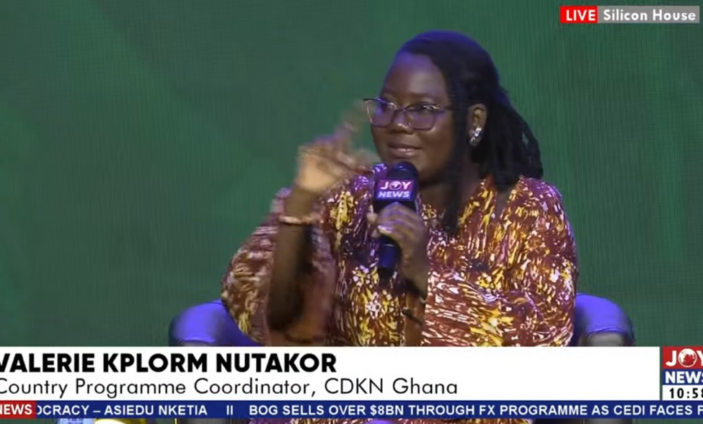
Country Programme Coordinator of the Climate and Development Knowledge Network (CDKN), Valerie Kplorm Nutakor, has urged stakeholders to move beyond climate change education and policy discussions and focus on practical actions that people can incorporate into their everyday lives.
She said climate action would remain limited if citizens were repeatedly told about the dangers of climate change without being given practical reasons and opportunities to change their behaviour.
Speaking at the WaterAid and JoyNews National Dialogue, Ms Nutakor said people were more likely to adopt sustainable practices when those practices were connected to their immediate realities.
“People say we've done a lot of climate education. We're talking too much, and when will it stop. But we're actually not talking too much; when people do not know, they can't do anything,” she said on Wednesday, August 12.
She said her own experience of growing up around people who practised simple forms of waste management demonstrated how everyday behaviour could contribute to sustainability even without people having a detailed understanding of climate science.
“The only reason I believe that I'm even in this space is because my parents are very interested in keeping things sustainable,” she said.
Ms Nutakor recalled that people in her community would keep plastic sachet materials because they could later be collected and sold.
“I grew up seeing it. I didn't know all about ozone layer cover and all of that, but that's where the greenhouse conversation comes in. I didn't care about it,” she said.
“All I knew is that, if I fold my rubber well, I can put this in the receptacle. The woman who comes around to come and pick it doesn't even want to stick their long pole into it anymore.”
“They just buy it, and then the school gets to get some money. We use it for our school garden. And then we are happy. I didn't know that it was sustainable, but I just knew that it was right.”
She said the experience illustrated the importance of creating systems in which environmentally responsible behaviour also delivers a direct benefit to individuals and communities.
Ms Nutakor argued that climate action should therefore be approached as a development issue rather than as an isolated environmental campaign.
“We have over the years made climate change a one-off conversation instead of looking at it in policy,” she said.
“Climate change is a sustainable development conversation. It should not be done out of this sustainable development conversation. Once you take it out of there, you have problems.”
She explained that the effects of climate change could increase the cost of development by reducing the lifespan of infrastructure and other investments.
“Climate change comes in because of what we call incremental costs,” she said.
She explained that a facility designed to operate for 30 years under normal conditions could face a shorter lifespan because of adverse climate impacts, creating additional costs that would have to be addressed.
“Now because the facility will now last only 15 years, the extra 15 years that will now have to be accounted for are what we call incremental cost. And that is what climate change needs,” she said.
Ms Nutakor said the challenge was therefore not simply to convince people that climate change was a problem, but to make climate action relevant to their daily decisions.
She pointed to farming as one example, saying farmers were primarily concerned with whether their crops would grow and provide an income.
“For instance, I'm going to the farm to say that I want to plant climate-smart seeds, the orange and the sweet potato, for instance,” she said.
“The reason I'm going to go and plant it is because I need money. I'm a farmer. At the end of the day, I need the crops to grow, and that's my business. I don't care about whether it is sustainable or whatever.”
“All I care about is that the market is ready for orange, the sweet potato, and so I'm going to plant it.”
She said climate-smart practices could gain traction when they were presented in ways that showed citizens how sustainability could support their livelihoods.
Ms Nutakor similarly cited the use of alternative transport technologies, saying economic benefits were often a stronger motivation for users than environmental arguments.
“The number one answer I've always received is that it's cheaper,” she said.
“If I get up, I can plug in the charging system, and then it lasts me more than necessary throughout the day. And I make my money, I make my returns, I pay everybody a fee, and I'm gone.”
“It's not because they are interested in these additional alternatives. It's because it makes sense to the pocket.”
She said policymakers therefore needed to pay closer attention to the economic incentives and practical conditions that determine whether people adopt climate-friendly practices.
“When I understand that I can still make my money and still be sustainable in doing it, then I'll be interested in actually defending it,” she said.
Latest Stories
-
Trump says he is considering firing US ambassador to Greece
4 hours -
Man City bananas ‘brought fun back’, says Varadi
4 hours -
Meta releases Muse Wonder AI models to challenge Anthropic and OpenAI
4 hours -
Daily Insight for CEOs: The CEO as Chief Decision Maker
4 hours -
Burnham had formal meeting with Man City chair while mayor
5 hours -
Is Ghana producing too many lawyers? What is the best lawyer-to-citizen ratio?
5 hours -
NDC sinking Ghana’s democracy with Emelia Agbenyo’s appointment – Miracles Aboagye
5 hours -
Seedorf back in football as Corinthians head coach
5 hours -
Hincapié and Zubimendi injured in post-match training session
5 hours -
Fridges in French supermarkets hit by cyberattack
5 hours -
Qantas flight grounded after bedbug outbreak
5 hours -
Reality Zone with Vicky Wireko: International Day of the Girl, shaping today’s girl for tomorrow’s future – ZONTA Clubs lead the way
6 hours -
Global health must be led by countries, not designed for them – Mintah Akandoh
7 hours -
Mahama honoured at 2026 World Health Summit in Berlin for global health leadership
7 hours -
Breast cancer is not a death sentence – Besease Kontire Obaapanin, Magmina Foundation lead awareness campaign
7 hours