


Audio By Carbonatix
Colombia's constitutional court has decriminalised abortions within the first 24 weeks of pregnancy.
Under the new rules, no one will be prosecuted for having an abortion within that time frame.
Since 2006, abortions have been allowed in Colombia in cases of rape, when the woman's life is at risk, or if the pregnancy is not viable.
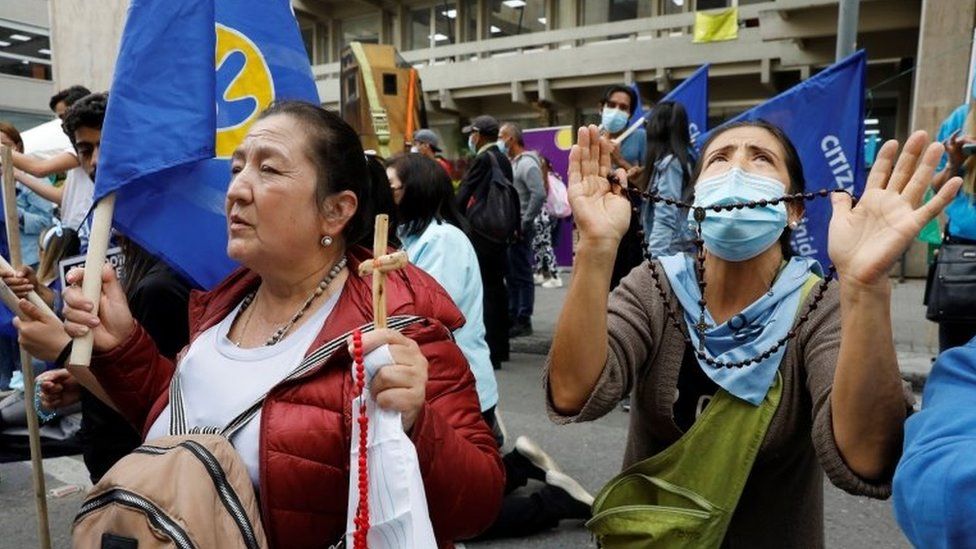
The ruling was welcomed by pro-choice groups, who called it "a historic achievement".
But Archbishop José Luis Rueda said the Catholic Church would "continue to proclaim, defend and promote human life from gestation until natural death".
Pro-choice activists say it is the latest in a series of victories in recent years, including a similar ruling by Mexico's Supreme Court in September and the legalisation of abortion up to the 14th week in Argentina.


This is a massive step for Latin America, a Catholic region and one with deeply conservative values.
But the fact that Mexico, Argentina and now Colombia have decriminalised abortion feels like there is momentum growing.
The activist movement in the region has been huge these past few years and that has definitely influenced change.
But the fight is not over yet. Many Latin American countries still severely limit abortion rights, namely Brazil, the region's biggest nation by far.
And in several Central American states abortion is banned outright, even in the case of rape and incest.
There are women in prison serving long sentences, many of whom say that they suffered miscarriages. But with so few reproductive rights in some countries, women who need medical help are instead abandoned by the state.
The ruling came about as a result of a lawsuit filed by the umbrella group Causa Justa (Just Cause) whose aim is to have abortion removed from the penal code.
Causa Justa argued that because abortions were defined as a crime outside of the three cases allowed under the 2006 ruling, doctors who performed abortions and their patients were often stigmatised.
The group estimates that 90% of abortions in Colombia are carried out clandestinely, putting the health and life of women at risk.
While Monday's decision has not removed abortion from Colombia's penal code entirely, it is seen as a victory in the battle to widen access to the procedure.
Following its 5-4 ruling, the court urged the Congress and the government to come up with legislation which will protect the rights of pregnant women, including providing family planning services, eliminating obstacles to abortion care and helping with adoptions.
Latest Stories
-
Central Regional Minister urges use of religious platforms to change environmental, sanitation practices
3 minutes -
Henry Kweku Banning
3 minutes -
Execution of US murderer Christa Pike halted an hour before it was due to happen
5 minutes -
GoldBod generates US$1.87bn in FX in September, exceeds monthly target
9 minutes -
SOE comments controversy: ‘We must never abandon our humanity because of judicial office’ – CJ
18 minutes -
Samuel Kojo Brace declares intention to contest NPP parliamentary primary in Ahanta West
20 minutes -
Dr Apaak calls for evidence-based education response to emergencies
23 minutes -
Pilot may have sought to crash Israel-bound flight after stabbing other pilot, Netanyahu says
28 minutes -
Report flags potential money laundering, terrorist financing risks among Ghana’s NGOs
28 minutes -
Breast Cancer Awareness Month launched: 2,695 women die from breast cancer annually — Dr Ann-Dadzie
36 minutes -
Mahama’s proposed airline looks to South America, Caribbean as Ghana confronts mounting drug trafficking cases
51 minutes -
5% progress on Suame Interchange Phase One inadequate – Roads Minister tasks contractor to speed up work
54 minutes -
Photos: Vice President joins GAAS Awards to celebrate outstanding women leaders
55 minutes -
OSP vs Ken Ofori-Atta, SML and others: Court gives OSP four more weeks to serve Ofori-Atta with summons
56 minutes -
High Commission sends caution to Ghanaians in South Africa ahead of planned protests
59 minutes