

Audio By Carbonatix
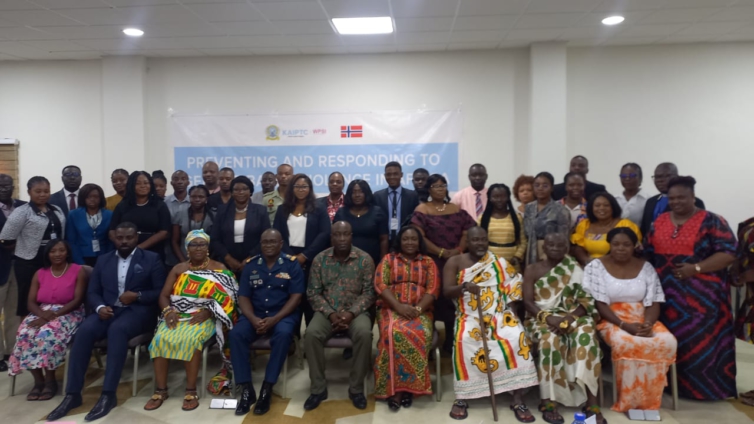
The Women, Peace, and Security Institute (WPSI) of the Kofi Annan International Peacekeeping Training Centre (KAIPTC) with financial support from the Norwegian government have trained local actors preventing and responding to Gender Based Violence in Africa.
The training which was under the theme "Promoting Peace and Security in Africa to achieving the sustainable development goals "brought together the CSOs, FBOs,t traditional and community leaders ,judiciary, police and the military, gender department and the media .
The Deputy Commandant of KAIPTC , Air Commodore George Kweku Arko -Dadzie noted that Gender Based Violence has been a problem which was addresed by the international instruments like CEDAW,UNSC Resolution 1325, and Resolution 1820
He noted that a research by the WPSI in 2020 revealed that the high rate of GBV is due to certain factors such as lack of local actors, capacity, low persecution rates, lack of evidence and inefficient and effective investigation
Air Commodore George Kweku Arko -Dadzie noted an impactful approach to eliminate the menace is therefore to re-examine the approaches adopted in engaging with local actors in the delivery of sensitization and advocacy tools in the various communities.

“’One of such innovative approaches emanated from recommendations made during the celebration of the 20th Anniversary of the UNSCR 1325 in 2020 at the KAIPTC, which consequently led to the birth of this new training programme’’ he said
He noted that it identified that an impactful approach to eliminate this menace will be to collaborate with local actors in our communities adding that online survey was among stakeholders leading to the development of a manual for training on GBV in Africa based on the findings
“Till date, this training has been delivered in Nigeria, Niger, Cameroon, Central Africa Republic, South Sudan and Liberia” he said
Air Commodore George Kweku Arko -Dadzie noted that the training is tailor-made with the objectives among others, to provide a cross section of local actors with requisite knowledge and skills set to effectively prevent and respond to Gender-Based Violence in the Ghana in particular and on the Africa continent as a whole.
Air Commodore George Kweku Arko -Dadzie noted that Gender Based Violence has been a problem which was initiative forms part of the KAIPTC-WPSI’s broader strategic objective to build African capacity to fully implement the Protocol to the African Charter on Human and Peoples’ Rights on the Rights of Women in Africa (Maputo Protocol) and the UN Security Council Resolution 1325 and follow-up Resolutions on Women, Peace and Security in the context of Africa, with specific focus to assist member states to eliminate gender-based violence. “It is our expectations that, the training would contribute to strengthen your capacity and add value to your professional life as you continue to support and promote the fight against GBV in Ghana”
Air Commodore George Kweku Arko -Dadzie noted that Gender Based Violence has been a problem which was program will foster an environment of collaboration and networking, enabling actors engaged in the prevention and response to GBV to forge valuable partnerships and share experiences in addressing GBV in Ghana.
“ as you are aware, the world, commemorated the 30th Anniversary of ending gender-based violence against women in year 2001. However, GBV continue to be a significant challenge especially at the community level. Through this training, we urge you to reaffirm your enduring commitment to preventing and responding to GBV in Ghana “ Air Commodore George Kweku Arko -Dadzie said u
He noted that the significance of our collective efforts in combatting gender-based violence cannot be underestimated adding that the undermining of the fundamental principles of equality, justice, and human rights must be eradicated under our watch and by building local capacity.
He said the KAIPTC hopes to empower individuals and communities to actively participate in the prevention and response to GBV, fostering a culture of peace, equality, and respect for all.
“I would like to with this opportunity extend our sincere appreciation to the Norwegian government for its generous and continued support to the KAIPTC. Your commitment to promoting peace and security in Africa is commendable” he said
Volta Regional Director of Health services, Dr Senanu Kwesi Dzokoto in his speech noted that many authorities have stated that Gender-based violence (GBV) against women, men, girls, and boys is a human rights violation with profoundly negative short-term and long-term health and social consequences.
He noted that people who experience violence are at increased risk of serious physical, mental, and reproductive health problems and that the root cause analysis of this societal scourge situates this violence in gender-based inequalities and discrimination
Dr Senanu Kwesi Dzokoto Gender Based Violence is the symptomatic expression of these unequal gender power relations in society which leads to a vicious cycle of human rights violations and our collective under-achievement of gender equality.
“Although men and boys can be subjected to gender-based violence, women and girls are mostly affected. Globally at least one-third of all women have been exposed to violence in an intimate relationship” Dr Senanu Kwesi Dzokoto said
He noted that children and adolescents are especially more vulnerable because they are less likely to find their voice or be heard, and they do not have the resources to facilitate their recovery and break the cycle of violence.
“As a health service, we mostly encounter GBV because of medical situations that arise from intimate partner violence, sexual violence by non-partners, and early marriages. Female Genital Mutilations are however rare in this part of the country’’ he said
He said, prevention efforts should start early in life and be directed at girls and boys (catch them young approach) consistent stakeholder engagement and education in both non-formal education and formal education are important to quicken the pace of social behavioural change.
Volta Regional Director of the department of gender, Mrs Thywill Eyra Kpe noted that issues of GBV must be addressed at homes as well as it is the first level of its stating point before it gets escalated.
Mrs Kpe noted it is imperative to demystify SGBV and how gender stereotypes are driving data gathered as a continent to help fully tackle it
She said SGBV has serious economic effects for the country and Africa as a whole with Ghana spending about GHc 18 million for SGBV response
She also noted that a lot of men are these days reporting cases against women as well .
Latest Stories
-
Knights and Ladies of Marshall group backs Catholic Bishops’ stance on anti-LGBTQ+
7 minutes -
Bright Simons writes: All the Filla in the Ibrahim Mahama/E&P – Gold Fields Saga
32 minutes -
Monetise Idiocy In Ghana
38 minutes -
The Ghanaian prophet and the mysterious death of his scottish wife Charmain Speirs
1 hour -
Nearly 400 sentenced in Nigeria for links to militant Islamists
2 hours -
Ghana’s recovery supported by gold strength despite global oil price pressures – Standard Bank Research
2 hours -
‘Excellence is our inheritance’ – Nana Sam Brew-Butler hails Mfantsipim’s 150-year reign in leadership
2 hours -
Kwaku Azar writes: A-G vs OSP
2 hours -
Mfantsipim–Adisadel rivalry built excellence, not division – Sam Jonah
3 hours -
Vice President launches Mfantsipim’s 150 years of shaping Ghana’s greatest mind
3 hours -
I assure Otumfuo, Mahama will join him to commission KNUST Teaching Hospital by end of this year – Haruna Iddrisu
4 hours -
Barcelona dominate derby to extend La Liga lead
4 hours -
Gov’t to roll out free special education for persons with disabilities from July 1 – Education Minister
4 hours -
Importers and Exporters Association declares full support for Publican AI port system
4 hours -
“We used it to test our officiating officials’ readiness” – Bawah Fuseini after CAA Athletics event
5 hours