

Audio By Carbonatix
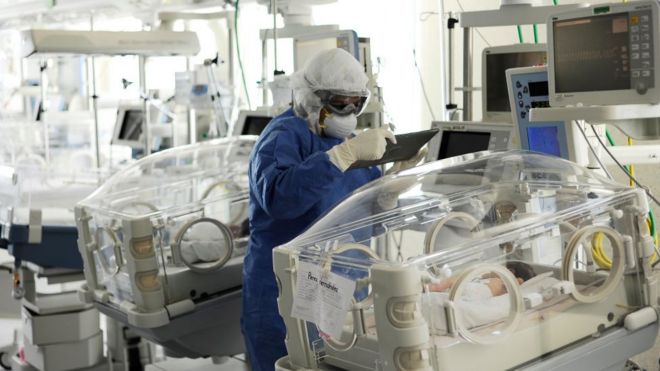
Newborn triplets in Mexico have tested positive for coronavirus in an "unprecedented" case, according to local health authorities.
Medical experts are investigating whether the disease could have been passed on through the mother's placenta during pregnancy.
Two of the babies, one boy and one girl, are in a stable condition in a hospital in San Luis Potosí state.
But the second boy is receiving treatment for a respiratory condition.
A spokesperson for the state's Health Safety Committee said contagion in multiple births had not been detected anywhere globally and so the case would be investigated.
A very small number of newborn babies have been known to pick up the virus after birth, but health officials say they do not believe this is what happened in this case.
State Health Secretary Mónica Liliana Rangel Martínez said: "It would be impossible for them to have been infected at the moment of birth."
However, the parents are currently being tested, with authorities saying they may have been asymptomatic.
Mexico has recorded more than 185,000 coronavirus cases and 22,584 deaths since the country's first case on 28 February.
Coronavirus in newborns
The triplets - born prematurely on 17 June in Mexico - all tested positive for coronavirus on the day of their birth.
Coronavirus in newborns is unusual, but not unheard of. Babies can catch the virus after birth if they have close contact with anyone who is already infected. Coronavirus might also be passed on in the womb from mother to baby via the placenta.
US researchers from Yale School of Medicine recently reported the first known case of placental infection with coronavirus. When infection does occur, the risk to mother and baby is often low - although some reports suggest it might increase the likelihood of babies being born early.
There is no evidence that the virus causes miscarriage or affects how your baby develops in pregnancy, but, as a precaution, pregnant women are advised to be strict about avoiding close social contact to reduce their chance of getting coronavirus. If they do become infected, most mums-to-be will have mild or moderate symptoms and recover. Babies may show no signs of the illness at all. If you are caring for a baby, you can reduce their risk of getting the virus by keeping your hands clean with regular hand washing.
Latest Stories
-
‘Whatever the personal cost, I will not abandon my duty’ – Baffour Awuah assures Salomey Bafoh
2 minutes -
Government to increase funding for Houses of Chiefs to speed up dispute resolution
3 minutes -
Govt’ to introduce digital property rate system to boost MMDAs’ revenue – Mahama Ayariga
5 minutes -
Traditional Medicine Practice Council closes three unlicensed spa and massage centres in Ashanti Region
8 minutes -
Let’s accept the reality and move along – Mike Oquaye on NPP’s decision to make flagbearer party leader
10 minutes -
Early presidential primary helped cool tensions in NPP – Prof. Mike Oquaye
27 minutes -
NDC congratulates new NPP executives, urges national interest above party interests
30 minutes -
NPP implementing 2024 election review recommendations in stages – Prof Mike Oquaye
31 minutes -
Ghana Rugby Union announces managerial changes
32 minutes -
US removes all bombers from RAF Fairford base
33 minutes -
France closes up to 500 schools Monday over student protests
33 minutes -
Girl, 12, fatally shot in US during ‘dispute over parking space’
34 minutes -
NPP is a party for all classes – Prof. Mike Oquaye
34 minutes -
Chief Justice urges Judiciary to strengthen foundations of justice
34 minutes -
Rescuers suspend search for survivors after plane went missing off US coast
35 minutes