

Audio By Carbonatix
The Australian state of Victoria has declared a state of disaster and imposed new lockdown measures after a surge in coronavirus infections.
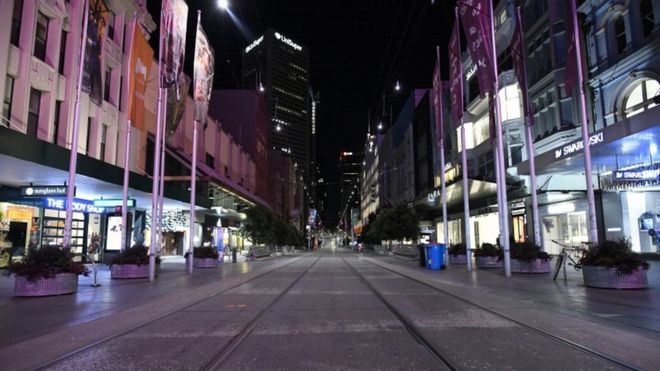
Under the new rules, which came into effect at 18:00 (08:00 GMT), residents of the state capital Melbourne are subject to a night-time curfew.
There will be further restrictions on residents' ability to leave home.
Australia has been more successful than many other countries in tackling Covid-19, but cases are rising in Victoria.
The state - Australia's second most populous state - now accounts for many of the country's new infections in recent weeks, prompting the return of lockdown restrictions in early July.
But on Sunday Premier Daniel Andrews said the measures were working but too slowly. "We must go harder. It's the only way we'll get to the other side of this," he told reporters.
The new rules will remain in place until at least 13 September, Mr Andrews added.
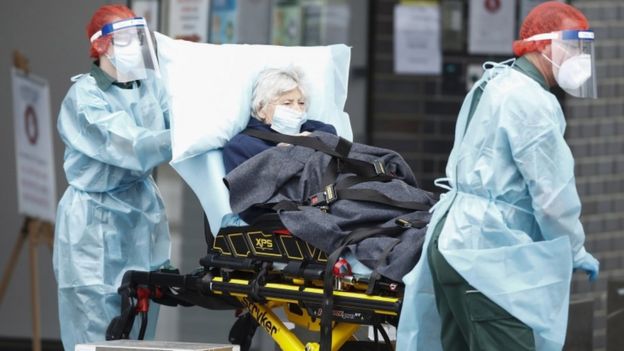
On Sunday, Victoria reported 671 new coronavirus cases and seven deaths. Those increases brought the totals to 11,557 infections and 123 deaths.
What are the new restrictions?
The night-time curfew is being implemented across Melbourne from 20:00 to 05:00.
The only valid reasons for leaving home during these hours will be work, medical care or care-giving.
Melbourne residents will only be allowed to shop and exercise within 5km (three miles) of their home. Exercise outside of the home will only be allowed for one hour at a time.
Only one person per household is allowed to shop for essentials at a time.
All students across the state are returning to home-based learning and childcare centres are closed.
Restrictions will also be tightened across regional Victoria from Thursday, with restaurants, cafes, bars and gyms closing from 23:59 on Wednesday.
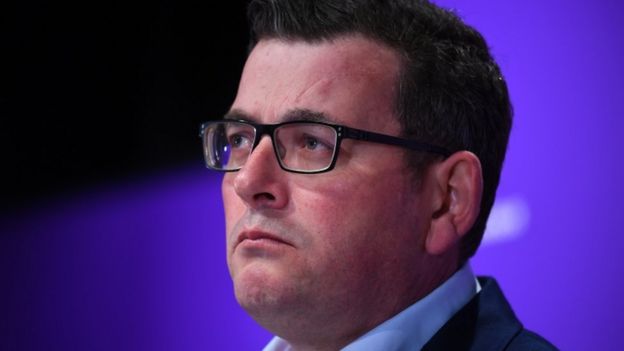
To ensure these rules are observed, police will be given additional powers, Mr Andrews said.
"We have got to limit the amount of movement, therefore limiting the amount of transmission of this virus. We have to clamp down on this," Mr Andrews said.
Why did Victoria become the epicentre of Australia's outbreak?
The country has recorded about 17,000 infections and 200 deaths so far - with the majority of these in Victoria.
Initially officials felt optimistic about containing Covid-19, with lockdowns and mandatory quarantines for people entering the country.
For months, most cases were coming from travellers returning from overseas, but the spike in Melbourne has proved to be a major setback.
Local transmissions have become a key source of infections, putting authorities on the back foot.
In early July about 300,000 people were ordered back into lockdown amid a military-assisted operation to "ring-fence" 10 areas at the centre of the outbreak.
Then, about five million residents of Melbourne were told to stay at home for six weeks.
Initially, Mr Andrews pinpointed the origin of many infections to security guards who reportedly broke lockdown rules while overseeing hotel quarantines.
Health experts say the relaxation of rules, complacency on social distancing and sheer bad luck have all contributed to Victoria's rise in cases.
Now Mr Andrews says the current rate of community transmission - including "mystery cases" that cannot be traced back to work or home - is far too high.
"And they tell us, based on the current number, cases might begin to drop off, not in days or weeks, but months," Mr Andrews said. "That's not something I'm willing to accept."
Latest Stories
-
Let’s give OSP time to mature, not to scrap it – Hassan Tampuli
2 minutes -
Nigeria convicts 386 Islamist militants in mass trials
8 minutes -
Djibouti president wins election with 97.8% of vote, state media says
12 minutes -
We don’t have mandate to deduct tax from rent allowance of security services personnel – Interior Ministry clarifies
26 minutes -
Ablakwa receives Presidential Special Envoy on Reparations to advance global agenda
44 minutes -
Christina Koch becomes first woman to travel around the moon on Artemis II
55 minutes -
Epstein survivors’ calls to meet King Charles and Queen harder to ignore as US visit approaches
1 hour -
UN Secretary-General names Ghana’s Anita Kiki Gbeho as South Sudan envoy
1 hour -
Mali withdraws recognition of Sahrawi Republic, backs Morocco’s autonomy plan
1 hour -
Gov’t distributes over 8,500 laptops to One Million Coders project
1 hour -
Julius Debrah, ‘man to beat’ as NDC’s James Agbey dismisses Musah Dankwah’s polls
1 hour -
GPRTU in Savannah Region to protest alleged eviction in Damongo
2 hours -
Re: Reinsurance does not replace process — A response to the SIGA–SIC defence
2 hours -
Gender Ministry supports Harriet Amuzu in ongoing abuse case
2 hours -
AG joins plaintiff to scrap OSP ?: We should be mindful of the mischief in this – Bobby Banson
2 hours