

Audio By Carbonatix
Shops, restaurants, and schools will be closed across most of Italy on Monday, with PM Mario Draghi warning of a "new wave" of the coronavirus outbreak.
For three days over Easter, 3-5 April, there will be a total shutdown.
Italy, which one year ago imposed one of the first national lockdowns, is once again struggling to contain the rapid spread of infections.
The country has reported more than 100,000 Covid-related deaths, Europe's second highest tally after the UK.
Italy's vaccination campaign has been hit by delays, as has been seen elsewhere in the European Union.
Last week the government in Rome blocked the export of 250,000 doses of the Oxford-AstraZeneca vaccine to Australia in a bid to address shortfalls of vaccines.
Elsewhere, Bulgaria, Denmark and Norway have all paused the use of the Oxford-AstraZeneca vaccine over fears it causes blood clots.
The World Health Organization said on Friday there was no indication this was true, stressing that countries should not stop using the vaccine.
In other developments across Europe:
- Poland registered nearly 19,000 new daily cases on Friday - the highest number since November
- Germany reported a rapid rise in infections among schoolchildren, with new Covid variants blamed
- In France, the number of patients in intensive care units exceeded 4,000 - the record figure for more than three months. The government has not ruled out more regional lockdowns
- Slovakia and the Czech Republic were hit by government crises over buying non-EU approved vaccines
What are the new rules in Italy?
From Monday, schools, shops and restaurants will shut in more than half of Italy, including the two most populous regions containing Rome and Milan.
Residents will be required to stay home except for work, health or other essential reasons.
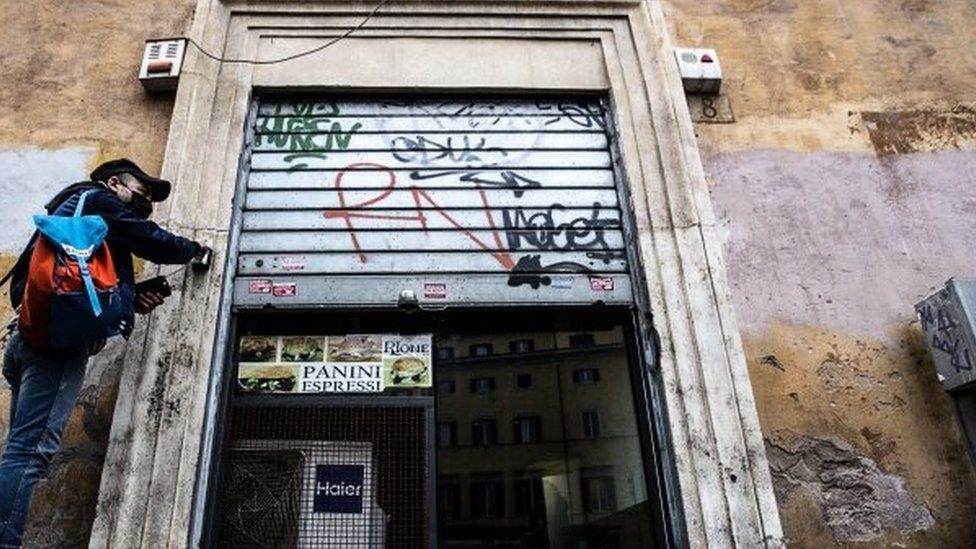
The extra restrictions would last until Easter, Mr Draghi's office said, and over the Easter weekend the whole country would be turned into the high-risk "red zone".
"I'm aware that today's restrictions will have consequences on the education of your children, on the economy and on everyone's mental health," Mr Draghi said.
"But they're necessary to avoid a worsening of the situation that would require even stricter measures."
Cases have been rising across Italy for the past six weeks, exceeding 25,000 a day.
In a majority of the country's regions "hospitals and above all intensive care units are already overloaded", the GIMBE health think-tank warned this week, the AFP news agency reported.
The island of Sardinia is the only region where infections rates are low.
Italy has had nearly 3.2 million confirmed infections since the outbreak began last year.
Latest Stories
-
Nearly 400 sentenced in Nigeria for links to militant Islamists
20 minutes -
Ghana’s recovery supported by gold strength despite global oil price pressures – Standard Bank Research
27 minutes -
Kwaku Azar writes: A-G vs OSP
60 minutes -
Mfantsipim–Adisadel rivalry built excellence, not division – Sam Jonah
1 hour -
Vice President launches Mfantsipim’s 150 years of shaping Ghana’s greatest mind
2 hours -
I assure Otumfuo, Mahama will join him to commission KNUST Teaching Hospital by end of this year – Haruna Iddrisu
2 hours -
Barcelona dominate derby to extend La Liga lead
3 hours -
Gov’t to roll out free special education for persons with disabilities from July 1 – Education Minister
3 hours -
Importers and Exporters Association declares full support for Publican AI port system
3 hours -
“We used it to test our officiating officials’ readiness” – Bawah Fuseini after CAA Athletics event
3 hours -
Volleyball emerges as Ghana’s fastest rising sport
3 hours -
National Sports Fund needs strong leadership from the top – Administrator David Wuaku
4 hours -
JoySports Exclusive: Steve McLaren in talks with GFA after expressing interest in Black Stars job
4 hours -
Fire guts auto parts warehouse at Bubuashie, one fire officer injured
4 hours -
I owe my victory to coach Ofori Asare – Allotey after winning WBA Africa Gold Super Flyweight belt
4 hours