

Audio By Carbonatix
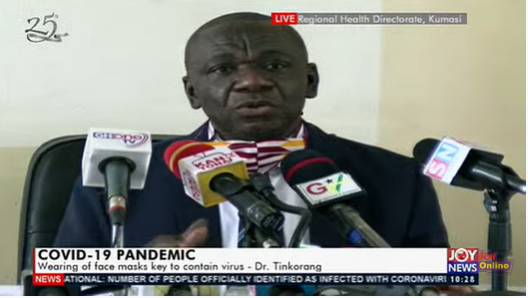
The Ashanti Regional Director of the Ghana Health Service says the country can still win the fight against the novel coronavirus by strictly observing all laid down protocols and not necessarily through a lockdown.
Dr Emmanuel Tinkorang said adhering to social distancing, washing of hands with soap under running water and regularly using hand sanitisers are sure ways of preventing the spread of the virus.
“The wearing of face masks is so important, it protects you better. A lot of countries have used that and they have come out with a lot of success stories.
"I believe that we also have to adhere to this social distancing, wearing of face masks and obeying all the rules and regulations.
"This is the key. I know without the lockdown, if we do all this, the principle will be the same and we will all help to fight Covid-19.”
Speaking at a Press Conference held in Kumasi Tuesday, Dr Tinkorang urged residents in Kumasi and beyond to be careful as they are currently a large number of asymptomatic carriers moving around and possibly spreading the virus.
“The most important thing is that the rules and regulation still applies. The lockdown we all admitted was difficult, especially for the poor and the vulnerable so it is out of very good wisdom that the President decided that he is going to call it off.
"But as he said, that is not a reason to assume that the fight is over. The fight is not over at all, this is the time that we need to strengthen the fight and then we make sure that we all adhere by the rules and regulations and when we do that it is likely we may contain the infection.
“The proportion of asymptomatic carriers are many and it's unlikely that you will identify them because they themselves don’t know that they carry the virus.
He added that the service will not only be organizing mandatory quarantine for a specific group of people but will soon begin a voluntary testing exercise among frontline workers and others who are seen as high-risk groups.
“What we are going to do now is to strengthen surveillance and as part of that we have come up with certain strategies that we are going to embark on. We are going to be doing active contact tracing to test, isolate and follow up on all the positive cases.
"We will also have mass screening at certain hot spots in the region. They are areas where we have confirmed cases and all the households where we have isolated cases will go through voluntary testing.
"We are also considering testing high-risk groups and that will include frontline workers, drivers of both uber and commercial vehicles, market women and people who sell because they come into contact with a lot of people. They will also be enrolled into the voluntary testing and then the routine surveillance will continue,” he told the media.
Latest Stories
-
Ibrahim Mahama urges Ghanaians to overcome fear and venture into business
11 minutes -
2026 U-17 WWC: Black Maidens lose to China in pre-tournament friendly
15 minutes -
Who gave Gbande the EOCO remote control?
36 minutes -
Ghana begins review of 1999 National Land Policy, targets new framework by 2027
1 hour -
Tiptoe Lane’s tech takeover: The story behind Ghana’s booming informal phone market
3 hours -
Abanga vows to use social media to counter NDC messaging ahead of 2028 elections
3 hours -
Okai Mintah seeks Sabah Zita Benson’s support for NDC National Youth Organiser bid
3 hours -
Okai Mintah vows to strengthen NDC campaign machinery ahead of 2028
3 hours -
Mother of four and Jasikan teacher among new Telecel M’ahitti Promo winners
3 hours -
International Youth Shakers Conclave 2026 set to bring global young leaders to London
3 hours -
Gov’t is committed to addressing teachers’ conditions of service, deprived-area allowance – Education Minister
3 hours -
GoldBod’s structure encouraging galamsey – Afenyo-Markin
3 hours -
Tullow starts selling Jubilee, TEN crude to Ghanaian refineries
3 hours -
Local Government Service authorises rationalisation, redistribution of staff
3 hours -
PURC assures consumers of working to ensure quality services in Northern Region
3 hours