

Audio By Carbonatix
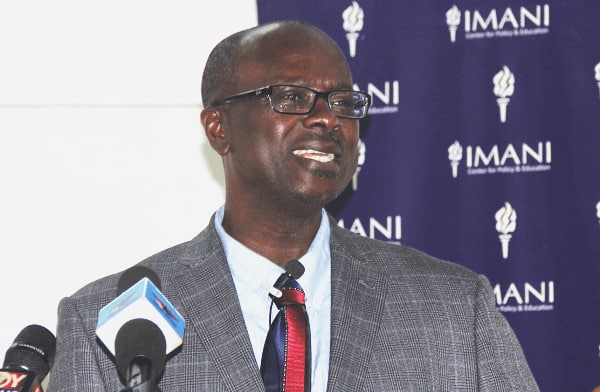
Legal practitioner and governance advocate Professor Stephen Kwaku Asare has criticised the one-year prison sentence handed to TikToker Camilla Alhassan.
The professor, popularly known as Kwaku Azar, argued that while her comments were offensive and false, they should not have attracted criminal prosecution in a constitutional democracy.
In a Facebook post following Alhassan's conviction, Kwaku Azar said the case raises broader constitutional concerns about freedom of expression and the role of the criminal justice system in policing speech.
"The conviction and one-year sentence imposed on a TikToker for insulting the President should concern everyone committed to constitutional democracy," he wrote.
Madam Alhassan was sentenced by an Accra Circuit Court after pleading guilty to charges of offensive conduct and publication of false news over videos in which she made unsubstantiated allegations against President John Dramani Mahama.
Although condemning the content of the TikToker's remarks as "vulgar, irresponsible, and false," Kwaku Azar argued that criminal prosecution was not the appropriate response.
"The real question, however, is whether speech of this nature should attract criminal prosecution in a constitutional democracy. GOGO believes it should not," he stated.
According to him, democracies should not rely on criminal sanctions to enforce civility or regulate political discourse.
"A democracy cannot prosecute its way to civility. Criminal courts should not become arbiters of taste, manners, or political discourse," he said.
He maintained that public officials, particularly the President, must be prepared to endure criticism, ridicule, exaggeration and even offensive speech as part of democratic governance.
"Public office demands broad shoulders, not broad criminal statutes," he wrote, adding that the criminal law should not be used to vindicate "bruised feelings or wounded egos."
Instead, Kwaku Azar argued that offensive speech should be countered through public condemnation, civic accountability and social sanctions rather than imprisonment.
"The appropriate response to bad speech is more speech, public condemnation, and social accountability, not imprisonment," he said.
The legal scholar attributed the increasing use of abusive language in public discourse to a broader decline in civic values, accusing political parties, sections of the media, social media platforms and even some religious leaders of contributing to the deterioration of public conversation.
He argued that society has increasingly rewarded outrage and sensationalism over truth and reason.
"The criminal law cannot repair what civic culture has allowed to decay. It can punish crimes. It cannot manufacture virtue," he wrote.
As part of his recommendations, Kwaku Azar called on Parliament to review and repeal what he described as colonial-era laws that criminalise expression rather than genuine harm.
He also urged law enforcement agencies to focus their efforts on fighting corruption, violent crime, organised crime, fraud and cybercrime instead of prosecuting offensive speech.
"The measure of a professional police service is not how quickly it responds to offensive speech, but how effectively it protects citizens from real crime," he stated.
Kwaku Azar further called on political parties to refrain from promoting individuals whose public profile is built on abuse and vulgarity, while urging schools, families, religious institutions and civil society organisations to strengthen civic education and encourage respectful public discourse.
He concluded by stressing that while society should reject incivility, the Constitution must continue to protect freedom of expression.
"The State should punish crime. Society should punish incivility. Political parties should refuse to reward it.
"The Constitution should protect the freedom to speak, even when society condemns what is said. That is how constitutional democracies cultivate both liberty and civility."
Latest Stories
-
GRA blames system failure for delay in issuing receipt over passenger’s customs duty
7 minutes -
Livestream: Newsfile discusses World Cup visa scandal, beach demolitions, education strikes, BRICS bid
11 minutes -
NC-PTAs welcomes end of teachers’ strike, urges parents to prepare children for Monday
21 minutes -
Government procures over 2,000 transformers as Ghana’s electricity access hits 89.13% – Energy Minister
47 minutes -
UTAG-UG threatens strike on October 19 over unpaid allowance
56 minutes -
Let The Constitution direct Chieftaincy to deliver “All Development Is Local”
2 hours -
John Jinapor outlines renewable energy, nuclear power priorities for 2027
3 hours -
Ghana explores centre of excellence for hearing, communication and cochlear implant care
4 hours -
Schizophrenia-related disorders lead mental health cases recorded in Ghana
4 hours -
Dutch authorities enlist Ghana in hunt for fugitive drug lord Bolle Jos
4 hours -
Ghana housing finance conference adopts communiqué to improve affordable housing access
9 hours -
Special Initiatives Minister urges Wa Technical Institute to enrol more girls as EU-backed solar training lab opens
9 hours -
In the matter of my first year at the Bar
9 hours -
ActionAid Ghana calls for an end to child marriage, greater investment in girls’ rights
9 hours -
Newsfile to tackle World Cup visa scandal, beach demolitions, education strikes, BRICS bid
10 hours