


Audio By Carbonatix
Why do numerous organisational initiatives and projects often fail despite having a seemingly well-designed internal communication plan?
I believe the key factor is culture, which is often undervalued in both research and practice.
Across Africa, organisations are adopting digital transformation, restructuring, policy reform, and innovative work methods. Employee resistance is often a major obstacle to successful change. However, the issue is not always poor internal communication; rather, organisations often struggle to communicate in ways that align with their employees' cultural contexts.
This observation is the foundation of the ACCRA Framework for Internal Communication and Change Management, which I present in my forthcoming book, Communicating Change in Africa (Palgrave Macmillan).
The framework begins with a simple proposition: effective internal communication must start with culture.
Employees do not interpret organisational messages in isolation. They interpret them through their beliefs, lived experiences, family responsibilities, respect for authority, religious values, and communal relationships. These factors determine whether they trust leaders, accept change, or resist it.
That is why internal communication cannot simply transmit information. It must help employees make sense of change within their own cultural context.
The ACCRA Framework invites leaders to ask different questions before launching any change initiative:
- What cultural values will shape how employees interpret this change?
- Who are the trusted voices within the organisation?
- Which organisational traditions should be acknowledged rather than ignored?
- How can internal communication build trust before it asks employees to change?
These questions move internal communication from information sharing to meaning-making. And that shift changes everything.
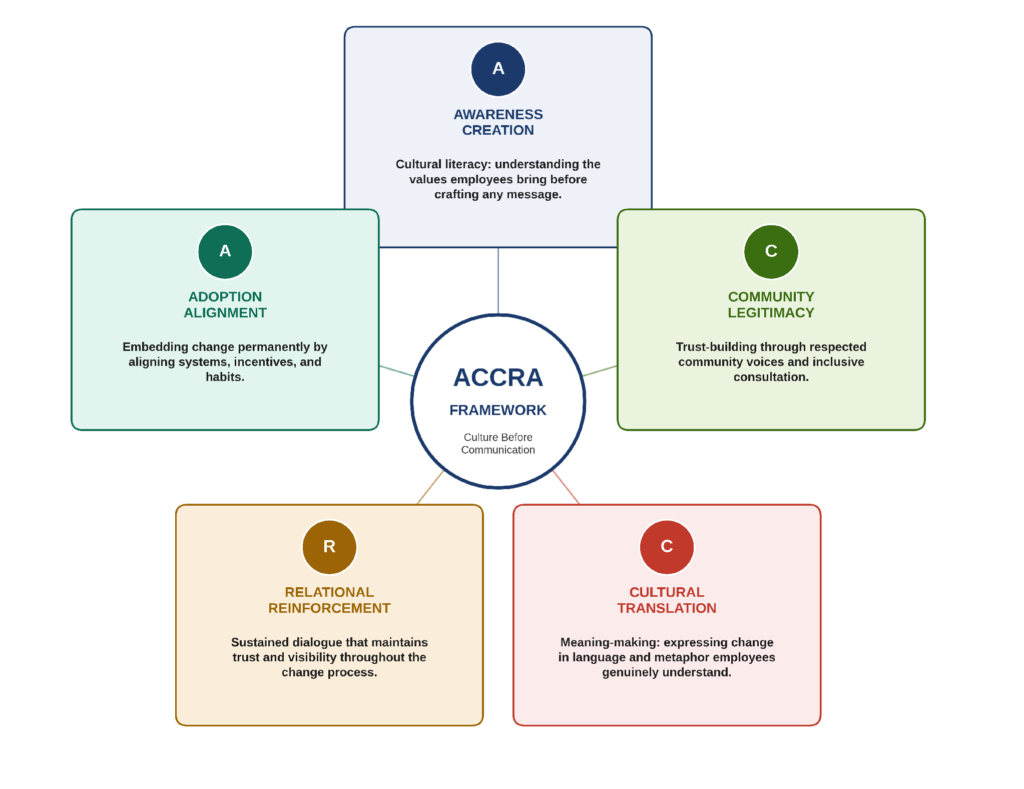
Figure 1. The ACCRA Framework: Awareness Creation, Community Legitimacy, Cultural Translation, Relational Reinforcement, Adoption Alignment (Tandoh, Communicating Change in Africa)
THE ACCRA FRAMEWORK: Five Dimensions
| A | Awareness Creation | Cultural literacy: understanding the values employees bring before crafting any message. |
| C | Community Legitimacy | Trust-building through respected community voices and inclusive consultation. |
| C | Cultural Translation | Meaning-making: expressing change in language and metaphor employees genuinely understand. |
| R | Relational Reinforcement | Sustained dialogue that maintains trust and visibility throughout the change process. |
| A | Adoption Alignment | Embedding change permanently by aligning systems, incentives, and habits. |
Three types of resistance, three different responses
The framework also recognises that employee resistance is not uniform. During organisational change, employees generally fall into three broad groups.
| Type | Root Cause | Internal Communication Response Required |
|---|---|---|
| Unknowing | Lack of information | Provide clear, consistent, timely information in accessible language. |
| Unwilling | Trust deficit or perceived unfairness | Rebuild trust through credible leadership, honest dialogue, and demonstrated fairness. |
| Unable | Skill, confidence, or support gap | Provide targeted training, mentoring, resources, and genuine organisational support. |
Diagnosing the source of resistance must come before designing the communication strategy. A response designed for the unknowing will not reach the unwilling. A response designed for the unwilling will not help the unable.
Africa's opportunity in global scholarship
As internal communication continues to evolve as a strategic management function, I believe Africa's contribution cannot stop at applying theories built elsewhere. We have the scholarship, the case studies, and the lived organisational experience to originate our own frameworks built for Africa, by Africa.
Our organisational cultures, leadership traditions, communal values, and workplace experiences provide the foundation for The ACCRA Framework, which is intended to contribute valuable insights that can truly enhance global scholarship. and this is my contribution to Africanising our frameworks and models.
It is an invitation to frameworknal communication from an African perspective, one where culture is recognised not as background noise, but as the foundation on which meaningful communication and sustainable organisational change must be built.
I look forward to engaging with colleagues, researchers, and practitioners to discuss how African perspectives can strengthen the future of internal communication.
Dr Ike Tandoh is a Senior Lecturer and Dean of Students at UniMAC-IJ, Accra, Ghana, and the Founder/CEO of 1PR Communications Group. His forthcoming book, Communicating Change in Africa, is under consideration for publication in the Palgrave Studies of Sustainable Business in Africa series.
Article hashtags: #SharingIsSpiritual #InternalCommunication #OrganisationalChange #AfricanLeadership #ACCRA #CommunicatingChangeInAfrica #Palgrave
Latest Stories
-
Man City rule breaches not my concern – Mancini
3 seconds -
NSA releases PIN Codes for 2026/2027 national service private candidates and foreign-trained graduates
3 minutes -
GMet forecasts thunderstorms, rain across parts of Ghana this evening
5 minutes -
APRA wins Africa PR Legacy Award
7 minutes -
UN Special Rapporteur on adequate housing to visit Ghana
10 minutes -
Telecel Ghana concludes SME Month 2026 with Business Runway in Takoradi
18 minutes -
Ghana must embrace AI to transform tourism — GHATOF
19 minutes -
National Investment Quiz: Corpus Christi, Wesley Girls, advance to semi-finals
49 minutes -
Is Ghana losing the fight to protect children online?
59 minutes -
Ghana Institution of Surveyors pushes for Governing Council Bill, conference reforms
59 minutes -
Professional collaboration key to Ghana’s land, property development – Western Regional Minister
1 hour -
UPSA holds first session of 18th Congregation.
1 hour -
Why demand another country’s medical records? – Mahama on Ghana’s rejection of ‘humiliating’ US health compact
1 hour -
Mentorship critical to survival and growth of MSMEs – Sinapi Aba Trust
1 hour -
Nsawam Adoagyiri MP joins residents to oppose Agbogbloshie waste relocation to his constituency
2 hours