

Audio By Carbonatix
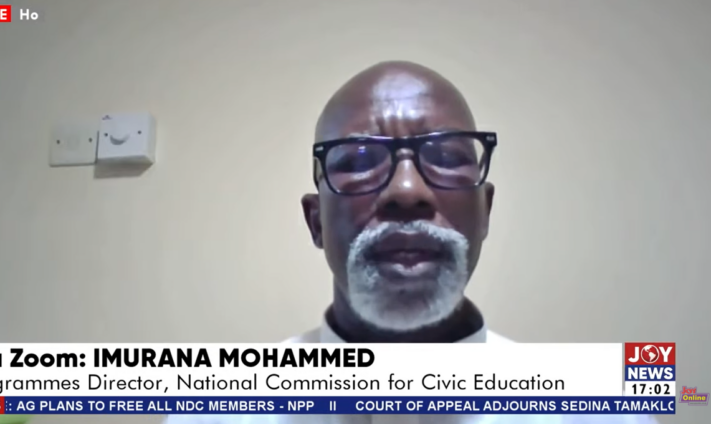
The Programmes Director of the National Commission for Civic Education (NCCE), Imurana Mohammed, has attributed the growing acceptance of vote-buying and electoral inducements in Ghana to the failure of democracy to deliver basic socio-economic needs.
Speaking at the 'Democracy Is Not For Sale' dialogue organised by the JoyNews Impact Makers Foundation, Mr Mohammed said while some Ghanaians have become disillusioned with democratic governance, the solution is not to abandon democracy but to ensure it delivers meaningful improvements in people's lives.
According to him, Ghana's Constitution recognises that a strong democracy is one that guarantees citizens access to the basic necessities of life.
"There is a very profound provision in our Constitution that says that the most secure democracy is the one that assures the basic necessities of life for its citizens," he explained via Zoom in Ho on Thursday, July 31.
He noted that growing public frustration with democracy stems from unmet expectations, as many citizens continue to struggle with inadequate access to essential services despite participating in successive elections.
"People have talked about the disenchantment of our citizens with democracy and to some extent some are calling for us to go back to the bad old days."
Rejecting any suggestion of returning to military rule, Mr Mohammed described previous periods of unconstitutional governance as "very bad old days."
"I say they are very bad old days."
He argued that democracy should be viewed as a vehicle for achieving socio-economic development rather than an end in itself.
"I think that the disenchantment stems from the fact that democracy is not an end in itself. It's a means to socio-economic development."
Mr Mohammed said when citizens continue to lack access to basic amenities such as roads, potable water and healthcare, they become more susceptible to accepting inducements during elections.
"When people feel that after several years of going to vote, access to roads is a problem, access to potable water is a problem, access to healthcare is a problem, very little things will stop them from taking handouts in order to go and vote."
He stressed that addressing vote-buying requires tackling the structural socio-economic conditions that make voters vulnerable, rather than focusing solely on enforcement.
"So primarily these are the structural issues that push people into accepting rights and then giving rights."
Latest Stories
-
Israel-bound flight diverted after fight between pilots
2 minutes -
EchoWave earns praise for sound quality at 10th Women in Worship
11 minutes -
Crackdown on South Africa’s unsafe streets ordered by president to keep women safe
23 minutes -
Banks are responding to improved monetary policy conditions – John Awuah
42 minutes -
Judges’ conference forces further adjournment of Salomey Baffoe case to Oct. 5
54 minutes -
Chorkor community joins AC4NCA clean-up to tackle marine and coastal pollution
1 hour -
GRA assures Tullow of collaboration to settle $393m tax liability without disrupting its petroleum operations
1 hour -
South Korea demands apology from Pyongyang for landmine blasts that injured three
1 hour -
Carlos Queiroz not the sort of coach Black Stars need – Nii Lante Vanderpuye
2 hours -
AFCON 2027Q: ‘Our Black Stars team is gone’ – Former Sports Minister
2 hours -
Prof. Prempeh calls for public review of draft constitutional reform bills
2 hours -
AFCON 2027Q: ‘I have never seen a poor performance from Black Stars like against Gambia’ – Nii Lante Vanderpuye
3 hours -
Bawumia backs insurance sector reforms after engagement with IBAG
3 hours -
Nigeria set to launch National Digital Address System 9 years after Ghana showed the way
3 hours -
Policy rate decision takes time to reflect in lower lending rates – BoG
3 hours