

Audio By Carbonatix
Former Vice President, Dr Mahamudu Bawumia, has strongly advocated increased investment to accelerate Ghana’s AI readiness.
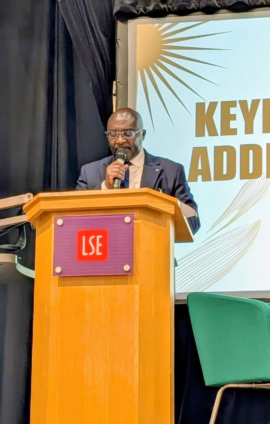
Delivering a keynote address at the 2026 Africa Summit at the London School of Economics and Political Science in London on Saturday, 28 March 2026, Dr Bawumia said Africa must be purposeful in its investment in digital transformation, including AI, if the continent is to catch up with the developed world.
While lamenting limited tech funding in Africa, Dr Bawumia noted that despite a recent report indicating a rebound in funding, such gains remain concentrated in a few countries, with Ghana outside this top tier.
“Partech, a venture capital firm, reports African tech funding rebounded to US$4.1 billion in 2025, but it remains highly concentrated: Kenya, South Africa, Egypt and Nigeria captured 72 per cent of total funding,” Dr Bawumia said.
“Outside the top tier, Ghana is cited at US$90 million in 2025, while most other countries recorded below US$50 million, underscoring the challenge of scaling innovation across the continent’s long-tail markets.”
As Ghana begins UNESCO AI Readiness Assessment Methodology consultations to evaluate its AI governance framework, identify gaps and inform a national AI strategy focused on ethics and inclusivity, among others, Dr Bawumia also called for a stronger focus on capacity building, which he described as the “binding constraint”.
“The AI Talent Readiness Index for Africa ranks digital skills with South Africa at 25.85, Kenya at 21.65, Rwanda at 19.7 and Ghana at 16.0. This confirms that skills gaps remain substantial even where connectivity is improving.”
“The implication is straightforward: Africa’s AI policy must be designed as a skills-and-standards agenda—modernising curricula and teacher training, expanding TVET and apprenticeships for applied data skills, and training public servants for responsible procurement, impact assessment and oversight.”
“And because both exposure and benefit can be uneven, especially along gender lines, the education strategy must deliberately include women and underserved communities. AI that excludes talent cannot deliver inclusive growth,” he said.
Latest Stories
-
LA 2028: Black Queens face Zambia in final Olympic qualifier
6 minutes -
WAFU Zone B: Black Starlets seal semifinal place with 3-1 win over Benin
13 minutes -
Black Queens thrash Mauritius 7-0 to advance 10-0 on aggregate in Olympic Qualifiers
22 minutes -
Kaizen as a strategic pathway for micro business scale-up in Ghana
26 minutes -
Minister orders suspension of Obuasi SHS headmaster over alleged sexual misconduct following JoyNews investigation
30 minutes -
Over 38,000 commercial, 150,000 residential customers unbilled – Ghana Water MD
59 minutes -
Several injured as Sprinter bus collides with ‘trotro’ at Odorkor
59 minutes -
Ghana records progress on reparatory justice agenda – Ablakwa
1 hour -
Mahama commissions Christian Tetteh Yohuno Ward Complex at Police Hospital
2 hours -
Vice President calls for wider access to Ghana’s political party histories
2 hours -
Republic Bank JoyNews Habitat Fair to connect prospective homeowners with exhibitors in Ho from October 16 to 18
2 hours -
Obaasima Summit: ‘AI is not a spiritual attack’ — Rev. Dr. Ofori-Boateng urges young women to embrace technology
2 hours -
GHS to distribute 80,000 pairs of locally-made protective footwear to health workers
2 hours -
GoldBod boosts local jobs as 90% of gold undergoes refining in Ghana – Sammy Gyamfi
2 hours -
The search for the politically unblemished: Are we asking the impossible of public appointees?
2 hours